Archives for category: Uncategorized

13No Press is proud to announce the publication of

Top Secret Calligraphy by Ken Hunt

Published in a hand-bound edition of 50 copies (only 25 of which are for sale), Documentary Poetry is available for $5 including domestic postage (+ $2 non-Canadian postage). To order please email derek beaulieu.

These asemic, visual poems invent a form of calligraphy out of the strike-throughs used to cross out the word “CONFIDENTIAL” from the pages of NASA’s voice transcription document of the Apollo 11 moon mission. This calligraphy exemplifies the creation of a new text through the re-censorship of a declassified transcript.

The author becomes the new censor of the text, obliterating all trace of the word that the strike-throughs attempt to obscure and negate. This erasure frees the strike-throughs from their original context, and accentuates their abstract forms. The lines become a lost language, ushering explorers of textual space through the vacuum of meaning.

Ken Hunt’s work appears in Sphere Literary Magazine: International Journal of Student Writing; in The Gauntlet, the University of Calgary’s student newspaper; and in various chapbooks. For three years, Ken served as editor of NōD Magazine, the University of Calgary English department’s publication of undergraduate prose, poetry, and visual art. In 2010, Ken co-founded The Scribe and Muse, a University of Calgary club that promotes writing and literacy, offering a free peer-editing service to students across all faculties. Ken lives in Calgary.

logoIn support of WORDSWORTH 2014 SUMMER LITERARY CAMP I am taking part in their SCRAWL-A-THON fundraiser.

Wordsworth is a writing residency for youth between the ages of 12-19. It’s a residency sleepover for a week and a place for them to come and get a writing experience they can’t get anywhere else. It’s a place to come and explore the written word through the arts. We do everything from spoken word, visual poetry, photography, comics, nonfiction, journalism [to] fiction. Every year it changes, and the students come and study it. They eat it, they live it, and they breathe it for a week. We try to bring in instructors that can bring in something unique and different that children wouldn’t get in classrooms or community course.

I have taught for WORDSWORTH in 2011 and 2012 (and plan to return this year) and my daughter is also eager to enroll as a camper this year.

On Saturday March 15 from 4pm-10pm I will endeavour, for 6 hours straight, to create a large-scale visual poem directly on the windows of LOFT112, a new literary space here in Calgary (www.loft122.org). Alongside me will be up to 20 authors, each writing for 6 hours straight, and each trying to raise pledges in support of Wordsworth.

This writing marathon is designed to raise funds and raise awareness for WORDSWORTH — all funds raised will go directly to helping the camp run again this year

I write to ask you for DONATIONS / PLEDGES in support of my 6 hour marathon (and in support of WORDSWORTH) – all donations over $10 will receive a tax receipt through the Writers Guild of Alberta (WGA).

If you are interested in donating – and thus helping an amazing summer camp dedicated to Alberta Youth who are interested in writing — please email me with a brief note, and you can donate online (via credit card) here.

kern-beaulieu-forthcoming-featuredForthcoming from Les Figues press:

Kern

derek beaulieu

Visual Poetry | $17.00 | ISBN 13: 978-1-934254-55-4 | Binding: Softcover, Perfect

Pre-order here

Advance Praise for Kern:

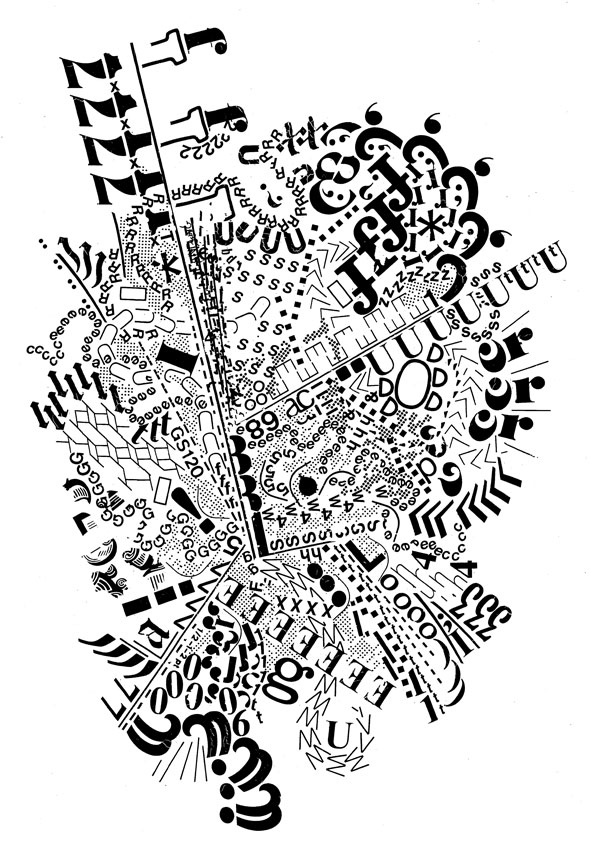
The detritus of signage is all around us. Wherever we look we see signs telling us where to go, what to do, how much it will cost. The 78 poems in Derek Beaulieu’s riveting new collection begin by resembling the signs, logos, and slogans of everyday life—and then become more and more unreadable. No two of these constellations—made individually by hand using dry-transfer lettering (letraset)—are alike; each promises something it cannot quite fulfill, as readability, having failed, gives way to lookability. So suggestive are these images that we cannot stop looking, trying to decipher, to arrest the flow. For the Kern poems present moments of poetic nostalgia for the signposts of a past that never fully existed. Rejecting our advances, they say to the reader/viewer: catch me if you can! And in the meantime, enjoy the promise of each moment: it won’t let you down.

—Marjorie Perloff, Professor emerita Standford University

 Kern tweaks the white space of the page, arranging language while unsettling letters. Machines made not of words, but characters, these poems crank and churn, antiquated material rattling to life beneath Beaulieu’s beau frottage. The eye scans the boggled mass, seeing patterns within the patter as words stutter and boil while D.B. minds our b’s and q’s, p’s and d’s.

—Amaranth Borsuk

 for_Kristen_511Do letters have lives? We have to wonder, seduced as we are by the antics of these characters. The tradition of taking alphabetic forms and making them into suggestive glyphs, their phonetic and graphic attributes seeming to cross lines of reading/seeing protocols, has a complex history in the signs of masons, brands, trademarks, monograms and graphical poetics. In Beaulieu’s latest volume, Kern, the principle of enjambment is put to poetic purpose, invoking precedents in work of Hendrik Werkman, Christian Morgenstern, Mary Ellen Solt, and bpNichol, among others. The Canadians have long had a penchant for graphico-visuo-poetics, and Beaulieu’s innovative contribution is a living demonstration that poetry is about unleashing the potential of combinatoric protocols to drive the performative art of letters on a page.

—Johanna Drucker

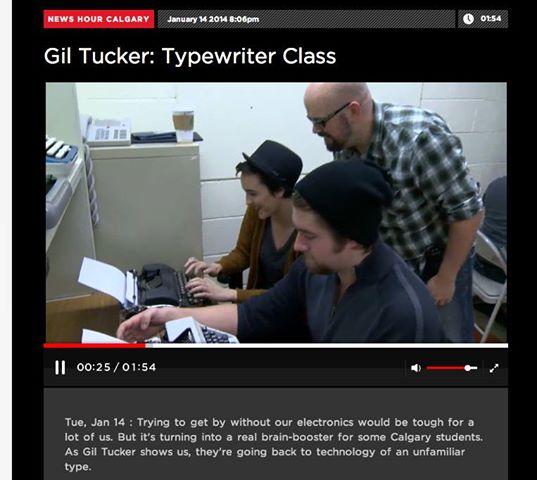
imageTue, Jan 14 : Trying to get by without our electronics would be tough for a lot of us. But it’s turning into a real brain-booster for some Calgary students. As Gil Tucker shows us, they’re going back to technology of an unfamiliar type.

EnamelSandMy Fall 2013 Alberta College of Art + Design ENGLISH 315 students spent a semester studying 21st-Century Canadian Poetry. As their final assignment, they responded to Jordan Scott and Stephen Collis’s book, Decomp, via sound art. Students were responsible for creating pieces of sound art that responded to Decomp‘s text, photography or concepts. Completed assignments were produced in limited edition CDs, cassettes, performances and musical objects, Many of those objects and performances are now compiled here, at the Coach House website.

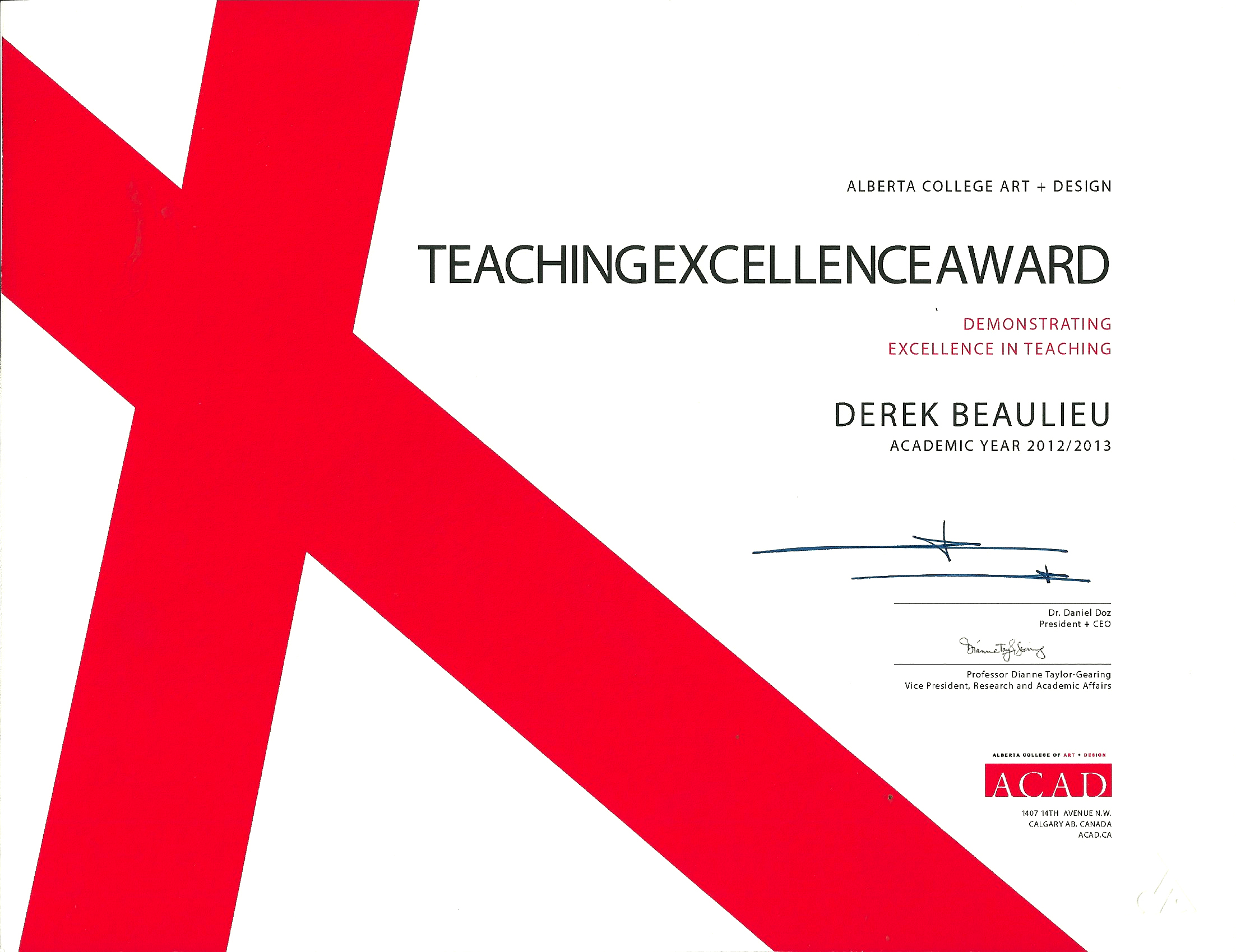
Thank you so very much to the students and faculty at the Alberta College of Art + Design for this incredible recognition …teaching excellence award

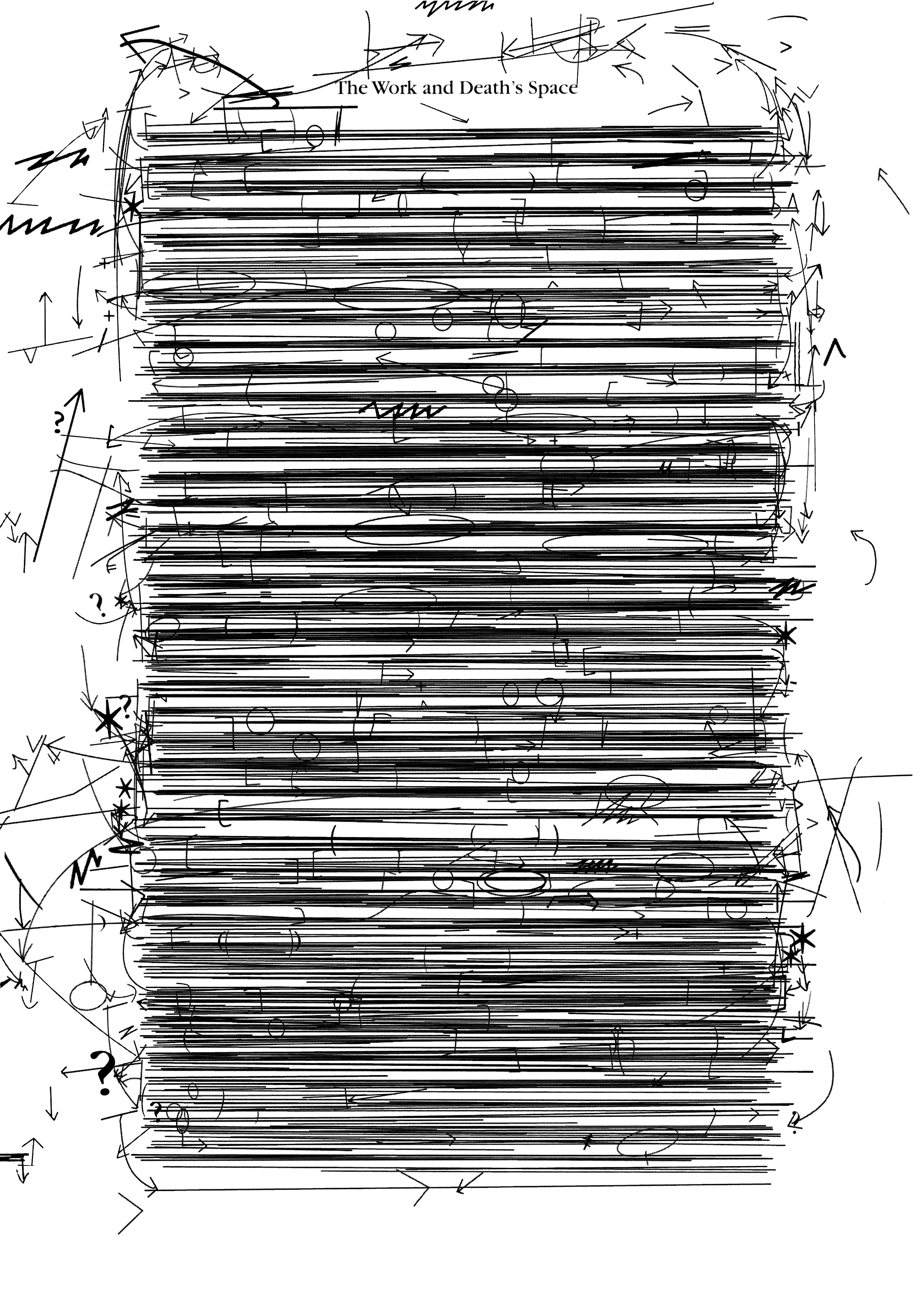
ch4 16 FLAT Reading Remove copyNo Press is proud to announce the publication of Kristen Mueller’s “Partially Removing the Remove of Literature”


Produced in a limited edition of 50 hand-bound copies.


Partially Removing the Remove of Literature is a reading of Nick Thurston’s book Reading the Remove of Literature, which is itself a reading of Maurice Blanchot’s book L’Espace littéraire (The Space of Literature). In Thurston’s appropriation, he has assiduously erased every page of Blanchot’s seminal work, while preserving his own marginalia, through a processual transposition of hand-writing into formal typography. In Mueller’s reading of Thurston, she has partially erased every page of his book, leaving only Thurston’s (extra-textual(?)) markings—the underlinings and arrows, parentheses and exclamation marks—intact. By layering these remains, chapter for chapter, she presents portraits of Thurston’s reading of Blanchot, collapsed and condensed, proffering the gift of theft.


Kristen Mueller is the author of Language to Cover a Page (Motto Books, 2014). A longer version of Partially Removing the Remove of Literature will be published by her small press, & So, in 2014. 


“Partially Removing the Remove of Literature” is now available for $5ea.


To order please email derek beaulieu


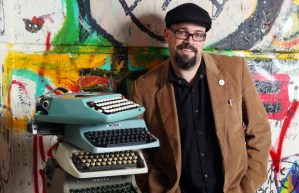
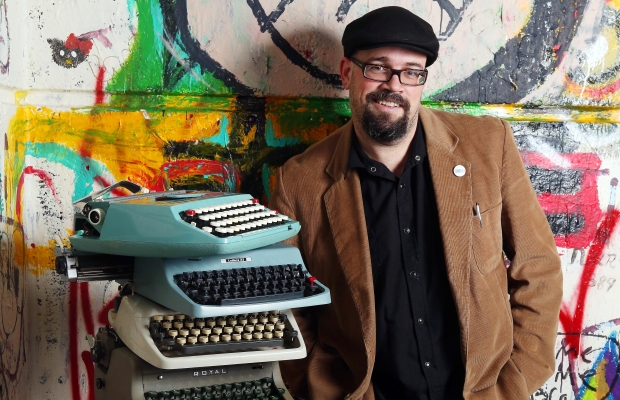
9251749If all goes as planned for local poet and Alberta College of Art and Design writing instructor Derek Beaulieu, fledgling scribes across Calgary will soon be seen loudly tapping away at portable typewriters in public places.

By Eric Volmers, Calgary Herald.

They will be on the CTrain. In coffee shops. In the class room. Just about anywhere you would see fledgling writers tapping silently away on laptops.

“We are going to have that sound back in the culture again,” says Beaulieu, in an interview at a typewriter-free coffee shop last week. “We are going to have that sound in the classroom. I’m going to tell them no laptops and no iPads in the classroom, only manual typewriters. All their notes are going to have be done that way, and yes they are going to have to hand them in. They are going to be doing poetry, they are going to be doing prose.”

While all this might sound avant-garde and far afield from what many would consider traditional instruction for creative writing, it fits with Beaulieu’s own impressive canon of work as a writer and the theories that guide it. He has earned acclaim locally and internationally for cheerfully breaking rules when it comes to poetry. Even in Calgary, a hot spot for the avant-garde, Beaulieu’s work is aggressively experimental. Earlier this year, Wilfrid Laurier University Press released Please, No More Poetry, which found Mount Royal English instructor Kit Dobson putting together an anthology of Beaulieu’s work, which stretches back to the 1990s and includes nine books and countless pieces in magazines and chapbooks.

The title poem was written as a “manifesto” for a Vancouver magazine a few years back. It was meant to be a less-than-subtle nudge to his fellow bards, encouraging them to think more about expanding poetry than adhering to its old rules.

Among the withering observations contained within are “In poetry we celebrate mediocrity and ignore radicality” and “all bad poetry springs from genuine feelings” and “having been unpopular in high school is not just cause for book publications.”

“I want our community of writers and of poets to push this art form forward,” says Beaulieu. “I don’t see poetry as where we go to be told comforting stories or to have the same old words told back to us. I would like poetry to be challenging itself, to be pushing itself and to be finding new ways of expressing and using language in a way that is akin to experimental astrophysics, where scientists don’t just create work for consumption, they also try to theorize what comes next.”

Which should give some context to Beaulieu’s own body of work. In “That’s Not Writing”, another piece in the collection, Beaulieu puts together 50 proclamations that he found through a Google search that start with the titular term. “That’s not writing, that’s plumbing” is one, which was apparently what Samuel Beckett said about William Burroughs. But most of the work isn’t so on the nose in presenting Beaulieu’s ideas. Please, No More Poetry contains a number of concrete or shape poems, where the visual aspects are just as, if not more, important than the words. In his 2011 book How to Write, Beaulieu “plagiarized” 10 short stories from various sources; basically treating words the way a DJ samples music. A few years ago, he created a representation of an issue of the Calgary Herald without using any text. He used different colours to represent the type of news that was being reported, recreating 124 pages of multi-coloured blocks for a piece that has been exhibited worldwide.

It all fits loosely into the category of conceptual art, something writer Russell Smith once cheekily described as “art that takes longer to read about than to witness.”

But it represents the sort of radical thinking that Beaulieu wants to pass on to his students with the typewriter. Of course, the problem with using an antiquated remnant from the past is that they tend to be antiquated. So far, Beaulieu has only secured seven manual typewriters. He reckons he needs 35. But he hopes more will be donated, with the idea that the collection can be used for future classes as well.

So what if, to play devil’s advocate, a young student has scant interest in expanding the boundaries of poetry and simply wants to learn how to write like Shakespeare or Robert Frost or E.E. Cummings or Kanye West?

Well, the nuts and bolts of writing are still part of the course, he says. But Beaulieu does not see a contradiction in encouraging young poets to be forward-looking in how they approach their art, while simultaneously forcing them to use an outdated machine to create it. In fact, it all makes strange sense, at least in a poetic, avant-garde kind of way.

“By using dead technology, but using these machines that are outside, we are in fact learning how we interface with the tools we have now,” Beaulieu says. “Students don’t look to their iPad and their cellphone as productive artistic spaces because they are too close. These are not paint brushes, these are the extensions of their hand. So if you get them a few steps back from their machine and give them another one that does the same stuff, it gives them enough artistic distance to be able to use them as a tool. Then, once they learn how to use them as a tool and how to be productive around these type of machines, hopefully what they end up doing is bring that forward. (They will) use that same kind of awareness of the poetic possibilities of these tools and apply them to cellphones, iPads, your PlayStation 3. Whatever.”
Thursday DEC 5 5:30-9:00: (RE)VERB, A multimedia event in response to Decomp by Stephen Collis and Jordan Scott. Featuring a reading and talk by Jordan Scott and performances and sound art pieces by students in ENGL315 (Room 595).

Friday DEC 6 7:30pm at PAGES BOOKS: Jordan Scott will be reading from his new book Decomp (co-written with Stephen Collis and published by Coach House Books) and Aaron Giovannone will be reading selections from his forthcoming book The Loneliness Machine (Insomniac Press)

and A REMINDER: I’m still hoping to gather 35 working portable manual typewriters for my January 2014 Creative Writing class at ACAD. Can you help

reverb

decompMy students, colleagues and I have organized some phenomenal (and free) events at Alberta College of Art + Design and around Calgary over the next few weeks, don’t miss out!

Wednesday NOV 27th 12:30-1:30: Chris Frey and Julia Petrov will be speaking in Room 520 in the last Liberal Studies Speakers Series of 2013 — come on out, bring a friend!

Thursday NOV 28th 5:15: probably Canada’s most important contemporary sound artist / composer, John Oswald, will be talking in Room 595.

Friday NOV 29 12:30-1:50: my ENGL216 students will launch PRY— a zine / compilation of interviews done by ACAD students of local (Calgary and Alberta) artists, writers and poets — in Room 520. Food and drinks will be served. Many of the interviewees will be in attendance at the release party.

Thursday DEC 5 5:30-9:00: (RE)VERB, A multimedia event in response to Decomp by Stephen Collis and Jordan Scott. Featuring a reading and talk by Jordan Scott and performances and sound art pieces by students in ENGL315 (Room 595)

Friday DEC 6 7:30pm at PAGES BOOKS: Jordan Scott will be reading from his new book Decomp (co-written with Stephen Collis and published by Coach House Books) and Aaron Giovannone will be reading selections from his forthcoming book The Loneliness Machine (Insomniac Press)

Thursday DEC 12 7:30pm at PAGES BOOKS: Christian Bök (author of Eunoia), Paul Zits (author of Massacre Street) and I will be reading as part of filling Station magazine’s Flywheel reading series.

and A REMINDER: I’m still hoping to gather 35 working portable manual typewriters for my January 2014 Creative Writing class at ACAD. Can you help?

Microsoft Word - Document1 reverbOswald-Talk