
 Zswound (a blog dedicated to heteroglossia, mixed speech, hybridization, distortion, glossolalia, linguistic mestizaje, slang, frontier-words, pop translation, dysfunctional or diverted translation, stolen languages, […]) has recently reviewed Local Colour here.
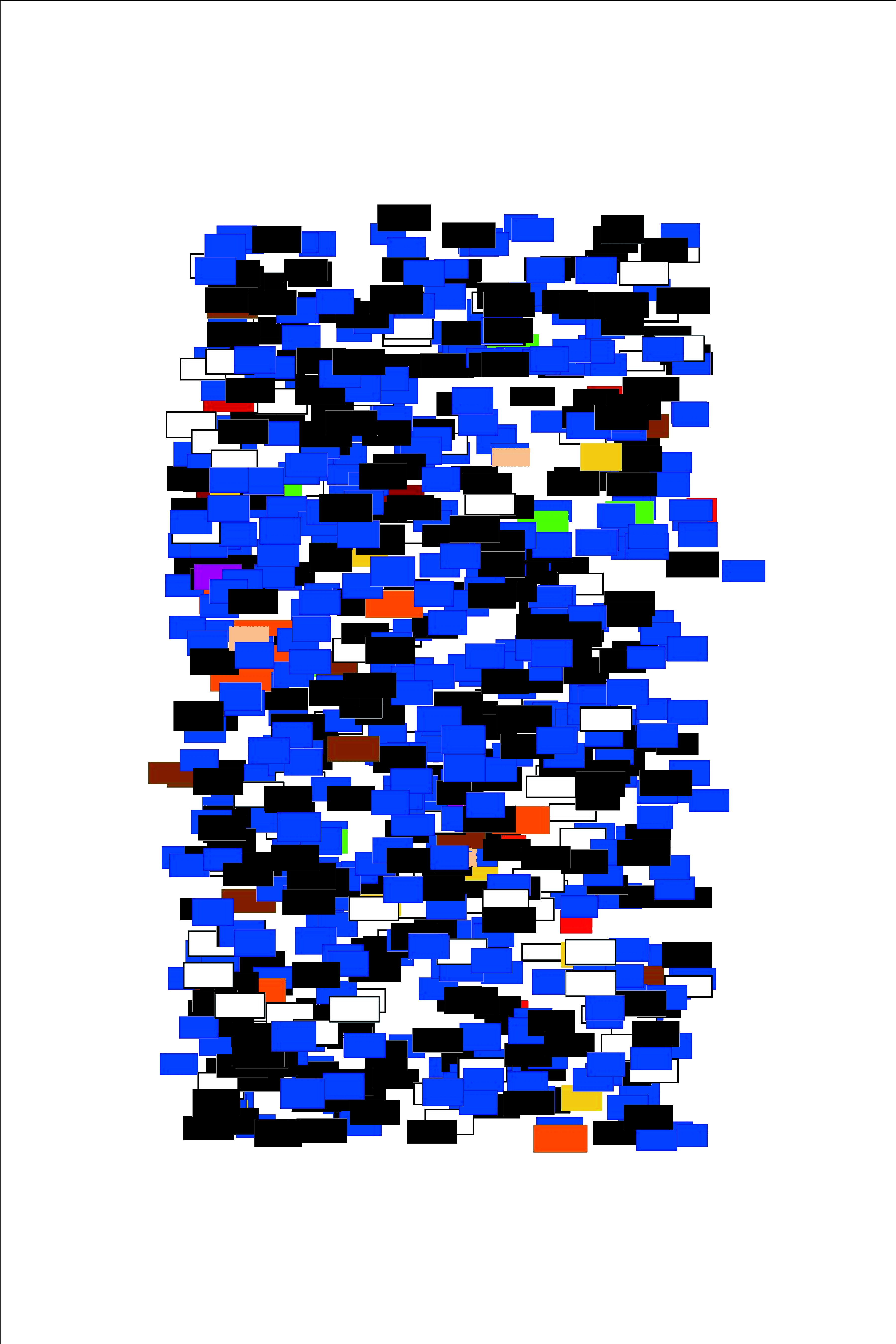
 As part of the opening celebrations for “Bird is the Word” exhibition in St.Catharines this Spring, Gary Barwin will be performing a musical interpretation of my novel Local Colour. He has created a musical score (a page of which is excerpted on the left) ,where the Y axis is time; X axis is pitch. An excerpt from Gary’s “Local Colour” work-in-progress is available here.
Gary’s work can be found extensively online, including his Doctoral dissertation “Martin’s Idea“
 On display from 9 March – 4 June 2011
Niagara Artists Centre
354 St.Paul Street,
St. Catharines, ON, Canada
The Bird is the Word
derek beaulieu • bill bissett • Judith Copithorne • kevin mcpherson eckhoff • Marinko Jareb • Travis Kirton • Kelly Mark • Steve McCaffery • a.rawlings • Laurel Woodcock • Hallie Siegel & Matthew Donovan & Gregory Betts
Opening Reception Friday 11 March 7pm
Readings beginning at 8pm by derek beaulieu, bill bissett & Honey Novick, a.rawlings, kevin mcpherson eckoff and Steve McCaffery & Jeremy Lessard. Musical Performance by Gary Barwin
This exhibit explores the territory where language and visual art intersect through the work of writers and artists. This common (play)ground has been covered by Concrete Poets, Cubists, Dadaists, Futurists, and Surrealists among others. Expanding semantic expression beyond the conventional structures of language includes the exploration of typography as imagery and engages philosophy, semiotics, and political and social commentary. The Bird is the Word will feature six poets and six visual artists from across Canada delving into the conceptual, spatial, and material presence of the written word. It showcases a multiplicity of media and disciplines including video projection, onsite installation, collage, sculpture, and micrography.
 I am honoured to be named one of Broken Pencil‘s “50 Favourite Indie Arts People and Places” (I assume i’m one of the people and not a place… see article at left).
 Boog City and d.a. levy lives: celebrating the renegade press
presents an evening with No Press
Tues., March 29, 6:00 p.m. sharp, free
ACA Galleries
529 W. 20th St., 5th Flr.
NYC
Featuring readings from
Kevin McPherson Eckhoff
Rob Fitterman
Charles Gute
Jake Kennedy
Rachel Zolf
and music from Rorie Kelly
There will be wine, cheese, and crackers, too.
——
Directions:
C/E to 23rd St., 1/9 to 18th St.
Venue is bet. 10th and 11th avenues
 In a column for Sina Queyras’ Lemon Hound blog I discussed poets and novelists who used previously published texts as palimpsests for new writing. These books—as exemplified by Mary Ruefle’s A Little White Shadow, Jen Bervin’s Nets, Elizabeth Tonnard’s Let us go then, you and I and Janet Holmes’ The ms of m y kin—treat other writers’ texts as the raw material for their own work. Each of those books—and the key texts in this genre, Tom Phillip’s A Humument and Ronald Johnson’s Radi Os—look to “compose the holes” and create a new text from the already present. They suggest that embedded within any text is a myriad of latent texts.
Jonathan Safran Foer’s Tree of Codes (London: Visual Editions, 2010) is the latest entry in this sub-genre and has become an Internet sensation. Foer has executed the logical extension of these projects by literally excising unwanted from his source text leaving each page a lattice-work. The book is visually stunning—when I’ve shown my copy to friends it has elicited gasps of surprise (first by its incongruous lack of weight considering its page count, then by the pages themselves)—and the production values are exceptional.
The publisher, London’s Visual Editions, has released only one other title, a beautiful new edition of Laurence Sterne’s The Life and opinions of Tristram Shandy, Gentleman and has seemingly spared no expense in the preparation of Tree of Codes.
As radical as Tree of Codes may look on the surface, it belies a traditional sensibility which undermines the project as a whole. Foer has chosen as his source text Bruno Schultz’s short story collection Street of Crocodiles, his “favorite book.” This selection reflects not upon a latent text within Street of Crocodiles, nor upon a potential commentary upon Schultz’s biography or bibliography, but rather simply upon Foer’s own personal aesthetic. Tree of Codes is, then, Foer’s love letter to Schultz’s oeuvre. An excision text like Tree of Codes is based entirely on the quality of the writer’s choices: her ability to choose an initial text and style of writing / creation which is both uncanny and self-contained. In the best examples in this genre the resultant text is dictated by, and comments upon, the source text. There should be some awareness, some commentary, some self-reflection, on the process of moving the source text into the recombinant resultant text. Tree of Codes, sadly, is not an example of (as Craig Dworkin defines Conceptual writing) “a writing in which the idea cannot be separated from the writing itself: in which the instance of writing is inextricably intertwined with the idea of Writing: the material practice of écriture.” Foer has merely mined one straight-forward narrative for yet another straight-forward narrative.
The litmus test for writing is, as Craig Dworkin argues, “no longer whether it could have been done better (the question of the workshop), but whether it could conceivably have been done otherwise.” Tree of Codes has claimed this form of excision writing as squarely its own and prevents other writers from undertaking a project with similar execution; sadly it does so without engaging with the content as solidly as it has the form of the novel. The entirety of the first page of text in Tree of Codes reads “The passerby / had their eyes half-closed / . Everyone / wore his / mask . / children greeted each other with masks painted / on their faces; they smiled at each other’s / smiles” [8] and while the excisions and textual absences does create a sense of foreboding and melancholy, they do not meaningfully add to the story itself. Tree of Codes is not explicitly tied to its means of creation; there is no reason that the book was composed in this manner instead of a more traditional means of composition.
 At each of my scheduled speaking engagements this spring (St.Catharines March 10/11, New York City March 29, Philadelphia March 31, Lethbridge April 8, Manchester April 30 and more to come) I will be handing out a series of poetic leaflets. The series is still expanding, but so far includes:
“I Want to Have a Chuck and Di Party Like My Parents Did in the 80s” – Elizabeth Bachinsky
“Special Containment Procedure 001” – Jonathan Ball
“Kern 12” – derek beaulieu
“Measurement” – Jason Christie
“from How to be Everywhere” – Warren Craghead III
“Proud Fiends / I Lace Words” – Jon Paul Fiorentino
“Viau’s Corsets” – Helen Hajnoczky
“Errors to Correct before Reading” – Bronwyn Haslam & Samuel Garrigó Meza
“The National Research Council Official Time Signal” – Emma Healey
“On Sadness” – Jake Kennedy
“finally” – Billy Mavreas
“Pain Extracts” – kevin mcpherson eckhoff
“Home” – a.rawlings
“Business Casual” – Kyle Schlesinger
“Alphabetica 11” – Eric Zboya
“from The Tolerance Project” – Rachel Zolf & co.
each leaflet is produced in edition of 50 copies (25 of which will be available for distribution) — keep an eye out!
 No press is proud to announce the publication of FOUR PANELS by Gary Barwin.
A beautiful visual poem presented as a 4-panel suite…
Published in an edition of 50 copies (25 of which are for sale), this teeny-tiny leaflet sells for $1.00
To order, please contact derek beaulieu.
The entirety of “A Future for the Novel (2011)” can be downloaded as a PDF here: A Future for the Novel.
V.
All this might seem very theoretical, very illusory, if something were not actually changing – changing totally, definitively—in our relations with text. Which is why we glimpse an answer to the old ironic question, “Why now?” There is today, in fact, a new element that separates us radically this time from Dickens as from Austen or from Brontë: it is the destitution of the old myths of “depth.”
We know that the whole literature of the novel was based on these myths, and on them alone. The writer’s traditional role consisted in excavating Nature, in burrowing deeper and deeper to reach some ever more intimate strata, in finally unearthing some fragment of a disconcerting secret. Having descended into the abyss of human passions, she would send to the seemingly tranquil world (the world on the surface) triumphant messages describing the mysteries she had actually touched with her own hands. And the sacred vertigo the reader suffered then, far from causing her anguish or nausea, reassured her as to her power of domination over the world. There were chasms, certainly, but thanks to such valiant speleologists, their depths could be sounded.
It is not surprising, given these conditions, that the literary phenomenon par excellence should have resided in the total and unique adjective, which attempted to unite all the inner qualities, the entire hidden soul of things. Thus the word functioned as a trap in which the writer captured the universe in order to hand it over to society.
The revolution which has occurred is in kind; not only do we no longer consider texts as our own, our private property, designed according to our needs and readily domesticated, but we no longer even believe in their “depth.” While essentialist conceptions of man met their destruction, the notion of “condition” henceforth replacing that of “nature,” the surface of things has ceased to be for us the mask of their heart, a sentiment that led to every kind of metaphysical transcendence.
Thus it is the entire literary language that must change, that is changing already. From day to day, we witness the growing repugnance felt by some writers for texts of a visceral, analogical, or incantatory character. On the other hand, the visual or descriptive adjective, the text that contents itself with measuring, locating, limiting, defining, indicates a difficult but most likely direction for a new art of the novel.
 derek beaulieu's blog