The entirety of “A Future for the Novel (2011)” can be downloaded as a PDF here: A Future for the Novel.
V.
All this might seem very theoretical, very illusory, if something were not actually changing – changing totally, definitively—in our relations with text. Which is why we glimpse an answer to the old ironic question, “Why now?” There is today, in fact, a new element that separates us radically this time from Dickens as from Austen or from Brontë: it is the destitution of the old myths of “depth.”
We know that the whole literature of the novel was based on these myths, and on them alone. The writer’s traditional role consisted in excavating Nature, in burrowing deeper and deeper to reach some ever more intimate strata, in finally unearthing some fragment of a disconcerting secret. Having descended into the abyss of human passions, she would send to the seemingly tranquil world (the world on the surface) triumphant messages describing the mysteries she had actually touched with her own hands. And the sacred vertigo the reader suffered then, far from causing her anguish or nausea, reassured her as to her power of domination over the world. There were chasms, certainly, but thanks to such valiant speleologists, their depths could be sounded.
It is not surprising, given these conditions, that the literary phenomenon par excellence should have resided in the total and unique adjective, which attempted to unite all the inner qualities, the entire hidden soul of things. Thus the word functioned as a trap in which the writer captured the universe in order to hand it over to society.
The revolution which has occurred is in kind; not only do we no longer consider texts as our own, our private property, designed according to our needs and readily domesticated, but we no longer even believe in their “depth.” While essentialist conceptions of man met their destruction, the notion of “condition” henceforth replacing that of “nature,” the surface of things has ceased to be for us the mask of their heart, a sentiment that led to every kind of metaphysical transcendence.
Thus it is the entire literary language that must change, that is changing already. From day to day, we witness the growing repugnance felt by some writers for texts of a visceral, analogical, or incantatory character. On the other hand, the visual or descriptive adjective, the text that contents itself with measuring, locating, limiting, defining, indicates a difficult but most likely direction for a new art of the novel.
Edmonton’s Douglas Barbour has reviewed both How to Write and Fractal Economies on his Eclectic Ruckus blog.
The Poetry Foundation‘s Harriet blog has a quick mention of Local Colour (“the prettiest PDF you’ll look at all day”), but sadly demonstrates a lack of understanding about Canadian spelling…
My conceptual novel Local Colour (ntamo, 2008) is now available online at Craig Dworkin’s “eclipse” archive as a downloadable PDF.
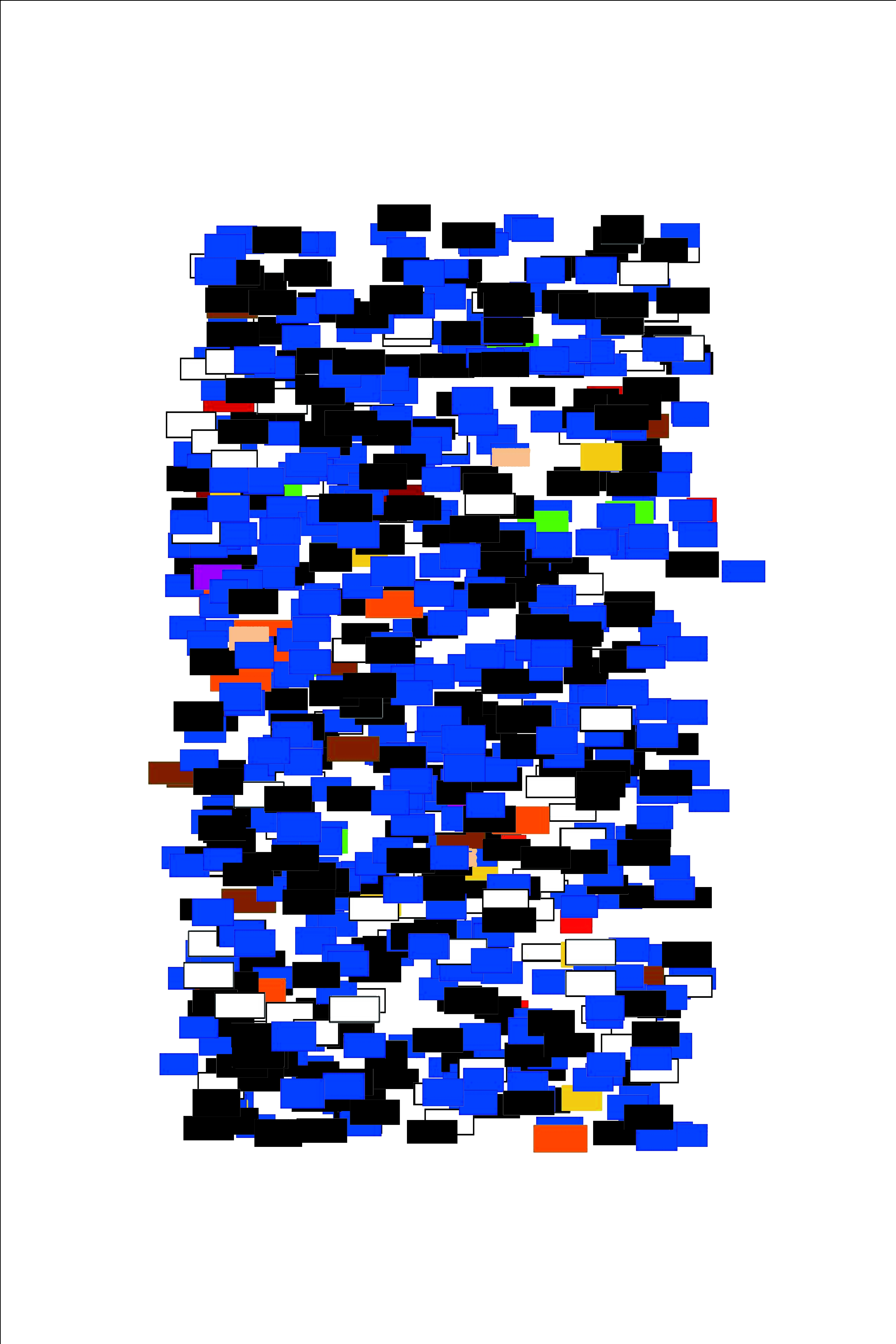
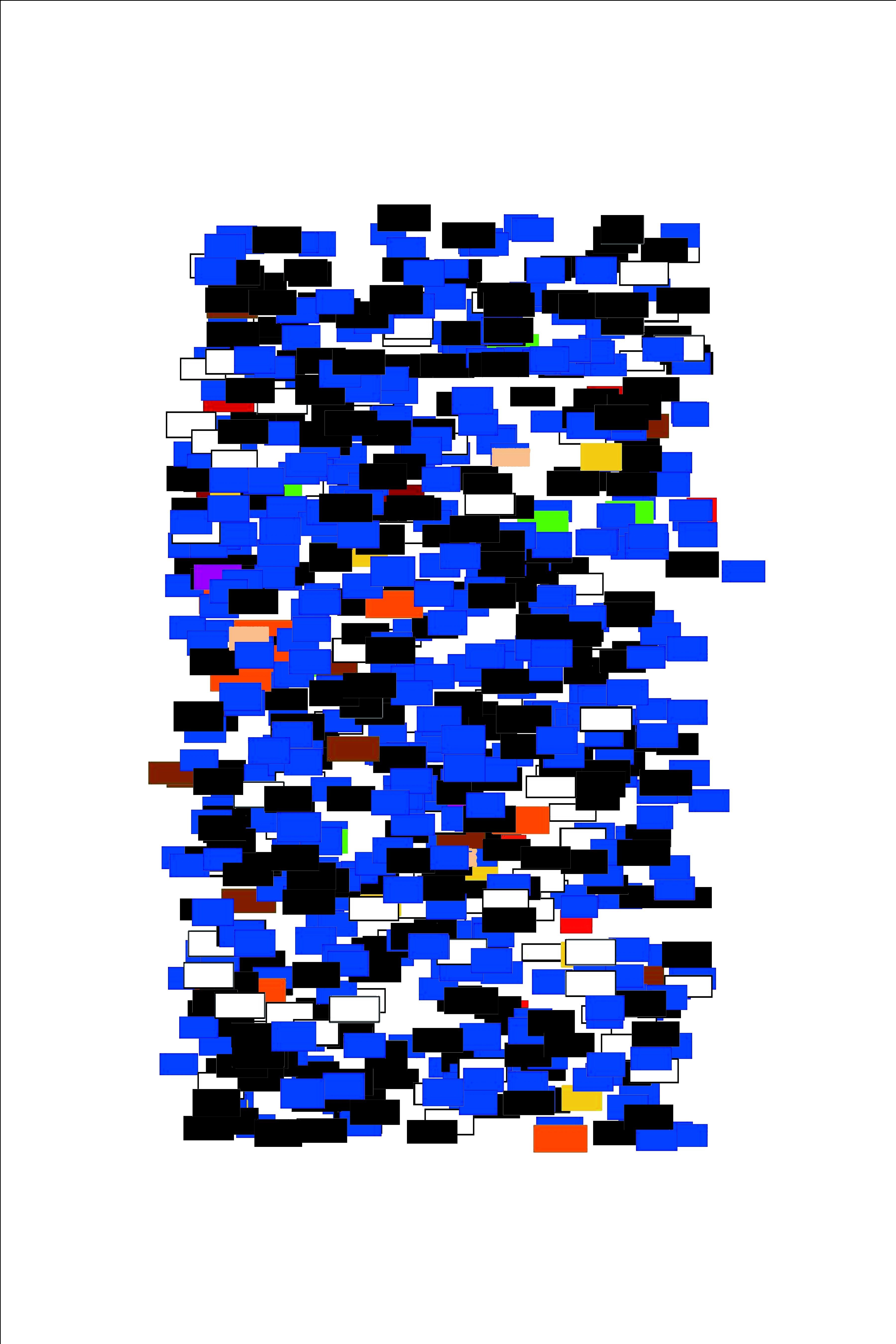
Local Colour is a page-by-page interpretation of Paul Auster’s 72–page novella Ghosts. Ghosts concerns itself with Blue, a private detective hired by a mysterious character named White to transcribe the actions of Black, a denizen of Brooklyn Heights. As Blue reports his findings, the reader becomes more aware of the intricate relationship between Black and White, and a tactile awareness of the role of colour spreads through the narrative.
Local Colour removes the entirety of Auster’s text, leaving only chromatic words—proper nouns or not—spread across the page as dollops of paint on a palette. What remains is the written equivalent of ambient music—words which are meant to seen but not read. The colours, through repetition, build a suspense and crescendo which is loosened from traditional narrative into a more pixellated construction.
In addition to my reading at Gallery Vertigo (Vernon, BC), I will also be discussing conceptual writing in Jake Kennedy’s class at Okanagan College on January 28th…
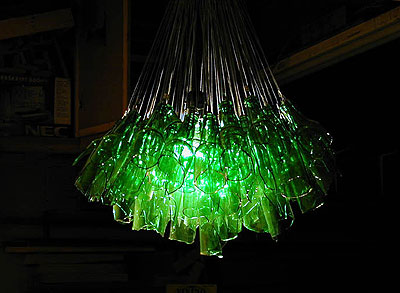
I was at Calgary’s Grand Theatre Saturday night (to see Quebec City’s excellent L’Orchestre L’Homme-Orchestra perform the music of Tom Waits) where Eric Sauvé has two chandeliers installed in permanent exhibition. These pieces were commissioned in response to The New Gallery‘s exhibition of Sauvé’s Yield while i was Administrative Director of the gallery. I had forgotten about his work, but this seems a good opportunity to post my explanatory note written for his 2006 Yield exhibition:
**
From its origins in the medieval Catholic church, the chandelier has been a pointed marker of class & privilege. Through the 18th & 19th Centuries, with newer techniques of glass-making, the chandelier became increasingly aligned with the ruling & merchant classes, & continued to remain a classist signifier of wealth & power. The bourgeois decorated their houses—& found their way in the darkened rooms of their own homes—by the light of purchased, crafted, ornate, cut glass.
The chandelier, with the advent of electrical light, is increasingly an antiquated form of lighting, now even more associated with excess—even the very structure of classic chandeliers require reinforced (& higher) ceilings—necessitating specifically designed rooms to house these devices.
With Eric Sauvé’s Yield, we are no longer presented with a vision of privilege & safety; he has détourned the chandelier through a series of material & contextual interventions. Instead of finely cut glass shimmering safely above us, our heads are threatened by clusters of broken beer bottles emitting the vomitous-green glow of the evidence of an ideological bar-fight.
Hanging slightly too low for functionality & just above the height of injury, Yield disturbs the scale of the gallery space, making the viewer hideously aware of her own body; we move with a slight cringe through a space defined by the jagged edge of the proverbial glass-ceiling. Our own bodies betray our place as class interlopers—we do not belong around these structures. Their nauseous colouring belies the threatening fragility of emptied & shattered remains restructured as a momento mori—a reminder of the temporariness of celebration, uprising & insurrection.
These chandeliers reconfigure cultural & economic bottlenecks; for while the bottle’s necks themselves are intact, their bases are missing, no longer containing or restricting flow. The jagged edges of potential Molotov cocktails are hoisted to the ceiling in clusters hanging just beyond reach—suggesting both an ease of distribution, & a commemoration of the glassy-eyed stare of excess.
Sauvé gathers our refuse, our garbage—these broken beer bottles—& presents them as a threatening reminder of their previous function. Sauvé’s Yield is as much as a silent, illuminating symbol of the power of class as the traditional chandelier is. The reference here, however, is not to the hand that cut the fine crystal glass, but rather to the hand that gripped the bottle by the neck.
What once held ales, liquors — the very spirit of classist debauchery & celebration—are now raised to the ceiling (mimicking the bottles being raised in a toast) & hanged in a glorious, eerie revolt.
I’ll be reading at Vernon, BC’s GALLERY VERTIGO Friday January 28th at 7pm. Admission is free, and the event will be lovingly hosted by Jake Kennedy and kevin mcpherson eckhoff.
On display from 9 March – 4 June 2011
Niagara Artists Centre
354 St.Paul Street,
St. Catharines, ON, Canada
The Bird is the Word
derek beaulieu • bill bissett • Judith Copithorne • kevin mcpherson eckhoff • Travis Kirton • Steve McCaffery • a. rawlings • Laurel Woodcock •
Opening Reception Friday 11 March 7pm
Readings beginning at 8pm by derek beaulieu, bill bissett, a. rawlings & Steve McCaffrey & musical performance by Gary Barwin
This exhibit explores the territory where language and visual art intersect through the work of writers and artists. This common (play)ground has been covered by Concrete Poets, Cubists, Dadaists, Futurists, and Surrealists among others. Expanding semantic expression beyond the conventional structures of language includes the exploration of typography as imagery and engages philosophy, semiotics, and political and social commentary. The Bird is the Word will feature six poets and six visual artists from across Canada delving into the conceptual, spatial, and material presence of the written word. It showcases a multiplicity of media and disciplines including video projection, onsite installation, collage, sculpture, and micrography.
IV.
As for the novel’s words, they may themselves suggest many possible interpretations; they may, according to the preoccupations of each reader, accommodate all kinds of comment—psychological, psychiatric, religious or political—yet their indifference to these “potentialities” is apparent. Whereas the traditional text is constantly solicited, caught up, destroyed by these interpretations of the author’s, ceaselessly projected into an immaterial and unstable elsewhere, always more remote and blurred, the conceptual text remains, on the contrary, there. It is the commentaries that will be left elsewhere; in the face of this irrefutable presence, they will seem useless, superfluous, even improper.
Exhibit X in any detective story gives us, paradoxically, a clear image of this situation. The evidence gathered by the inspectors—an object left at the scene of the crime, a movement captured in a photograph, a sentence overheard by a witness—seem chiefly, at first, to require an explanation, to exist only in relation to their role in a context which overpowers them. And already the theories begin to take shape: the presiding magistrate attempts to establish a logical and presiding link between things; it appears that everything will be resolved in a banal bundle of causes and consequences, intentions and coincidences….
But the story begins to proliferate in a disturbing way: the witnesses contradict one another, the defendant offers several alibis, new evidence appears that had not been taken into account … And we keep going back to the recorded evidence: the exact position of a piece of furniture, the shape and frequency of a fingerprint, the word scribbled in a message. We have the mounting sense that nothing else is true. Though they may conceal a mystery, or betray it, these elements which make a mockery of systems have only one serious, obvious quality, which is to be there.
The same is true of the language around us. We had thought to control it by assigning it a meaning, and the entire art of the novel, in particular, seemed dedicated to this enterprise. But this was merely an illusory simplification; and far from becoming clearer and closer because of it, language has only, little by little, lost all its life. Since it is chiefly in its presence that the text’s reality resides, our task is now to create a literature which takes that presence into account.