Between January 7, 2011 and February 3, 2011 Calgary’s TRUCK Gallery is exhibiting PERMUTATIONS by Hyang Cho (Guelph, ON) and Roula Partheniou (Toronto (ON).

I was honoured that The TRUCK Gallery asked me to contribute to their explanatory leaflet for the exhibition:

**

Jorge Luis Borges’s “The Library of Babel” describes a infinite honey-comb-like library filled an infinite number of books. Each book in Borges’s bibliophillic nightmare is minimally different from its neighbour—the library effectively contains all possible permutations of all possible books, obsessively arranged in a hive-like structure. Citizens in this phantasm are doomed to wander the library’s unending corridors in a vain search for meaning and enlightenment.

Artists—like Borges’s librarians—are now responsible for not only being arbiters of public taste (whereby their ouevre is built upon issues of selection) but also theorists of information consumption (whereby their ouevre is built upon matters of parsing).

Roula Partheniou uses Rubik’s Cubes to extend a discussion around logic, scale and language. Her 100 variations presents an exhaustive cataloguing of the arrangement of geometric objects in a way which points back to the oeuvre of Sol LeWitt. Using 6 × 6 × 4 stacks of the ubiquitous children’s toy reknowned for its combinatory nature, Partheniou playfully presents the permutation of these toys in a disorienting architectural display. Distanced from the viewer through photography, each piece becomes the 3-dimensional plan for an imposing Brutalist structure. The harsh lighting and shadows in Partheniou’s photography are illusionary. The shadows suggest an architecture built to reduce human involvement to mere ciphers within a beaucratic grid—but those shadows (much like the scale of the sculptures themselves) are structures built from our own terror. Partheniou has chosen to reject the Rubik’s Cube’s original chromatic array in favour of a minimalist scheme of white, black and a gun-metal gray. We are subjected to a playful uncertainty of scale, architecture and arrangement.
Much as Partheniou’s architectural structures impose a presence without entrance, Hyang Cho’s bookworks suggest a reading without reading. We expect our architecture to be transparent; that we can move from one space to another with the minimum amount of interferrence or trouble. We do not want to be overly aware of how our body occupies our living space. We expect the same from reading.

Cho’s bookworks trouble our literacy and our expectations around reading itself. The content of the book asserts itself in a way which makes reading (and writing) palpable. In each piece the narrative of the book-narrative asserts itself beyond the mechanics of the book-container into a new form. These new sculptural books allows the information to assert how it wants to be read, how it believes it is best received. No longer are the tales happy to be safely ensconced between covers, they want a new form, a form which places the text before the reader. Narratives are no longer clearly transmitted, they are locked, they struggle, they assert; they free themselves from the bounds of readerly expectation into some new.

Partheniou creates and photographs the barbicans and fortresses which loom over our dreams; each tower is constructed from the logic puzzles of our subconscious. Cho suggests that within each of these fortifications writhe our dream-narratives, struggling to assert their own shape.

No press is proud to announce the publication of ECHO by Vanessa Place

ECHO is an examination of the role of speech, response and gender is conceptual writing and how they are enacted in radical mimesis, the “very real representation of the Real.”

Published in a limited edition of 70 copies (35 of which are for sale) each of which is printed on fine paper, hand bound and includes a CD recording of Place performing “Echo.”

Copies are available for $15.00 each (including postage).

To order, please contact derek beaulieu.

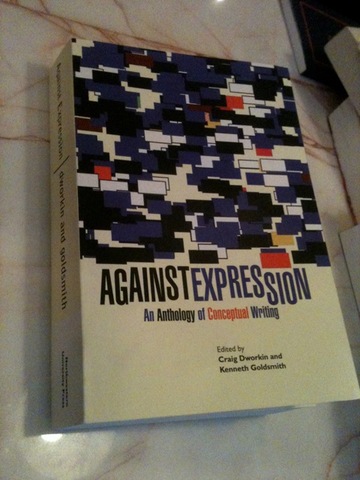
Craig Dworkin and Kenneth Goldsmith’s monumental anthology

Against Expression: An Anthology of Conceptual Writing

has just been published by Northwestern University Press.

In much the same way that photography forced painting to move in new directions, the advent of the World Wide Web, with its proliferation of easily transferable and manipulated text, forces us to think about writing, creativity, and the materiality of language in new ways.

In Against Expression, editors Craig Dworkin and Kenneth Goldsmith present the most innovative works responding to the challenges posed by these developments. Charles Bernstein has described conceptual poetry as “poetry pregnant with thought.” Against Expression, the premier anthology of conceptual writing, presents work that is by turns thoughtful, funny, provocative, and disturbing.

Dworkin and Goldsmith, two of the leading spokespersons and practitioners of conceptual writing, chart the trajectory of the conceptual aesthetic from early precursors including Samuel Beckett and Marcel Duchamp to the most prominent of today’s writers. Nearly all of the major avant-garde groups of the past century are represented here, including Dada, OuLiPo, L=A=N=G=U=A=G=E, and Flarf to name just a few, but all the writers are united in their imaginative appropriation of found and generated texts and their exploration of nonexpressive language. Against Expression is a timely collection and an invaluable resource for readers and writers alike.

I am honoured to have contributed the cover image (from Local Colour) and an excerpt from Flatland to this collection.

Despite being a celebrated contributor to Canadian art from the 1960s through 1990’s, Greg Curnoe’s reputation among the literary community is limited to the generation of writers who knew him personally or who were active within his community (see, for instance, George Bowering’s The Moustache: Memories of Greg Curnoe (Toronto: Coach House Press, 1993) and the ‘We are not Greg Curnoe’ issue of Open Letter (11.5, Summer 2002)).

The majority of Curnoe’s visual work, highly celebrated in the 1960s and 1970s, has become a cultural artifact, a time capsule of the Centennial / Expo ’67 period in Canadian art. His work in little magazines Region and 20 Cents Magazine has faded from view (although, the be fair, the Forest City Gallery and the Nihilist Spasm Band, both of which he co-founded, continue).

Greg Curnoe (1936–1992) was a constant advocate for celebrating the regional arts and literary communities in southwestern Ontario (especially around London). A pair of posthumously published books which link to his passion for the local deserve more attention and should be of interest to conceptual writers. Conceptual writing centres on the ideas of transcription, selection and choice as informed by the archival, the echoed and the highly personal. I’ve written elsewhere on Emma Kay’s personal history of the world, Worldview, and Craig Dworkin’s rumination on the construction of libraries and archives, The Perverse Library.

Curnoe’s Deeds / Abstracts: The History of a London Lot (London: Brick Books, 1995) and Deeds / Nations (London: Ontario Archeological Society, 1996) are both examples of conceptual anticipatory plagiarism.

Initially begun as a means of settling a property-line dispute (a non-poetic issue retrofit to a poetic exploration), Curnoe’s Deeds / Abstracts: The History of a London Lot is a meticulous mining of the historical record for commentary on every person to have interacted with his property at 38 Weston Street, London, ON, or the surrounding community. Presented without editorial commentary or contextual remarks (beyond an introduction, as edited by Frank Davey), a typical entry reads:
April 9, 1894:

William Weatherhead [gardener 1829-1916] and Eliza Jane Weatherhead [1830-1905] to Ellen Knowles [married to Joseph Knowles {lithographer 1867-?}], sub-lot 6, Registered Plan #32 [30 Weston Street]. Bargain and sale #733. (Middlesex County Registry Office) [112]

Positioned between Benjamin’s The Arcades Project and an amateur genealogist’s recounting of a family history, Deeds / Abstracts is a curious anomaly in Canadian poetry. Many of the long poems that preceded Deeds / Abstracts similarly used archival documents and histories as found and manipulated objects, forming the backbone from which the poetic text grew. Kroetsch’s The Ledger (1975) and McKinnon’s I Wanted To Say Something (1975, 1990) both typify this long-poem trope. Curnoe has not poeticized his language or the material, in any way—he has simply gathered and transcribed the entries and reported them in chronological order.

Deeds / Abstracts attempts to trouble the Eurocentric sense of Canadian history by extending its scope to include a recording of every aboriginal and first-nations person who had interaction with the area around what would be come 38 Weston Street. Because of the nature of the documents that Curnoe draws upon for his cataloguing, Deeds / Abstracts lists only the aboriginal and first-nations people who had interaction with Europeans. Documenting a decidedly European perspective on presence, “personhood” is defined here, as having interacted with Europeans:

Nigigoonce [fl. 1843], Ojibwa Nation, possibly a relative of Ne~gig (1)?; lived on the Upper St.Clair reserve [Sarnia], January 20, 1843 (Canada 1847: no.20). [83]

Too often, to my eye, Deeds / Nations becomes a 238-page catalogue of names, and reading a European-Canadian listing of every Aboriginal person who interacted with a piece of land becomes an uncomfortable inventory. Curnoe was well-aware of this issue, and did attempt to mitigate this cultural lens by interviewing descendants of Surrender No.2 (1790) and Surrender No.6 (1796), and incorporated issues of voice into his “I am OUY” series of rubberstamp visual art.

Curnoe’s artistic practice was greatly influenced by collage, and the aestheticization of non-artistic and mundane items, and this aesthetic flows into his work on Deeds / Abstracts and Deeds/ Nations. Collage, as an art-form, includes both a non-discriminatory reach (anything can become art) and aesthetic of choice (but only those items chosen by an aesthetically-aware eye). With Deeds / Nations and Deeds / Abstracts Curnoe gathers as much information as he can about every person who had interaction with “his” property at 38 Weston Street—but the results carry with it the inherent problems of voice and historical appropriation.

The “Reading Children’s Books” blog has two new posts concerning Shift & Switch: new Canadian Poetry (2005) here and here.

But words are neither significant nor experimental. They are, quite simply. That, in any case, is the most remarkable thing about them. And suddenly the obviousness of this strikes us with irresistible force. All at once the whole splendid construction collapses; opening our eyes unexpectedly, we have experienced, once too often, the shock of this stubborn reality we were pretending to have mastered. Around us, words are there. Their surfaces are distinct and smooth, intact, neither suspiciously brilliant nor transparent. All our literature has not yet succeeded in eroding their smallest corner, in flattening their slightest curve.

Instead of this universe of “signification” (psychological, social functional), we must try, then, to construct texts both more solid and more immediate. Let it be first of all by their presence that words establish themselves, and let this presence continue to prevail over whatever explanatory theory that may try to enclose them in a system of references, whether Structuralist, Freudian or metatextual.

In this future universe of the novel, words will be there before meaning something; and they will still be there afterwards, hard, unalterable, eternally present, mocking their own “meaning,” that meaning which vainly tries to reduce them to the role of precarious tools, or a temporary and shameful fabric woven exclusively—and deliberately—by the superior human truth expressed in it.

Henceforth, on the contrary, words will gradually lose their instability and their secrets, will renounce their pseudo-mystery, that suspect interiority which Roland Barthes has called “the romantic heart of things.” No longer will texts be merely the vague reflection of a hero’s vague soul, the image of her torments, the shadow of her desires. Or rather, if words still afford a momentary prop to human passions they will do so only provisionally, and will accept the tyranny of significations only in appearance—derisively, one might say—the better to show how alien they remain to people.

No press is proud to announce the publication of CHAPTER VIII: THE FUN HOUSE MIRROR STAGE by Jake Kennedy.

This Kennedy’s first published excerpt from his bio-fiction on the life of Madeline Gins, completely authorized by Gins herself.

Published in an edition of 50 copies (25 of which are for sale), this leaflet sells for $2.00

To order, please contact derek beaulieu.

Bob Cobbing's "tyger 1" (1971)

Bob Cobbing (1920–2002) was a (if not the) master of concrete and visual poetry. He began working in typewriter and duplicator monotypes (single-run prints) in 1942, sound poems in 1954 and also initiated his press Writers Forum press in 1954 (more on Writers Forum in a forthcoming column). He worked continuously in those forms (and more) until his death in 2002. Cobbing’s influence and notoriety in Canadian poetry peaked under bpNichol’s efforts in the late 1970’s (Nichol published Cobbing’s Sensations of the Retina in 1978 and shepherded his 1976 book bill jubobe: selected texts of bob cobbing, 1942–1975, as edited by Cobbing and Sean O’Huigin, through Coach House Books). His work deserves further, and on-going, exploration.

I plan on returning to Cobbing’s work with some frequency as part of this ‘an irresponsible act of imaginative license’ series, but for the time being, I want to turn my attention to a GLOUP and WOUP, a 1974 collection that Cobbing edited (Kent, UK: Arc Publications, 1974). A extremely difficult collection to find in the 21st-century, GLOUP and WOUP documents the efforts by two geographically distinct groups of visual poets in the UK in the late 1960s/early 1970s: the GLOUcestershire grouP—as represented by Dom Sylvester Houédard (1924–1992), John Furnival (1933–) and Kenelm Cox (1927–1968) and the Westminster grOUP—as represented by Tom Edmonds (1944–1971) and Cobbing himself.

Much visual poetry from the 1960s and 1970s retains a whiff of hippie-like optimism and faith in universal, liberatory, language. Most collections of concrete poetry from this period have not dated well (a problem common to much poetry: it doesn’t date well), and there is often a great deal of repetition between the major anthologies of the time (the best of which can now most easily be found, of course, on ubuweb). GLOUP and WOUP is not immune to these charges, but none-the-less does include some vital, rarely seen, work.

Published in a printed pink gate-fold wrapper, GLOUP and WOUP is a gathering of single-fold poetic statements and introductions along-side a series of roughly 7 ½” square broadsides printed black and white on lovely matte-finish cardstock.

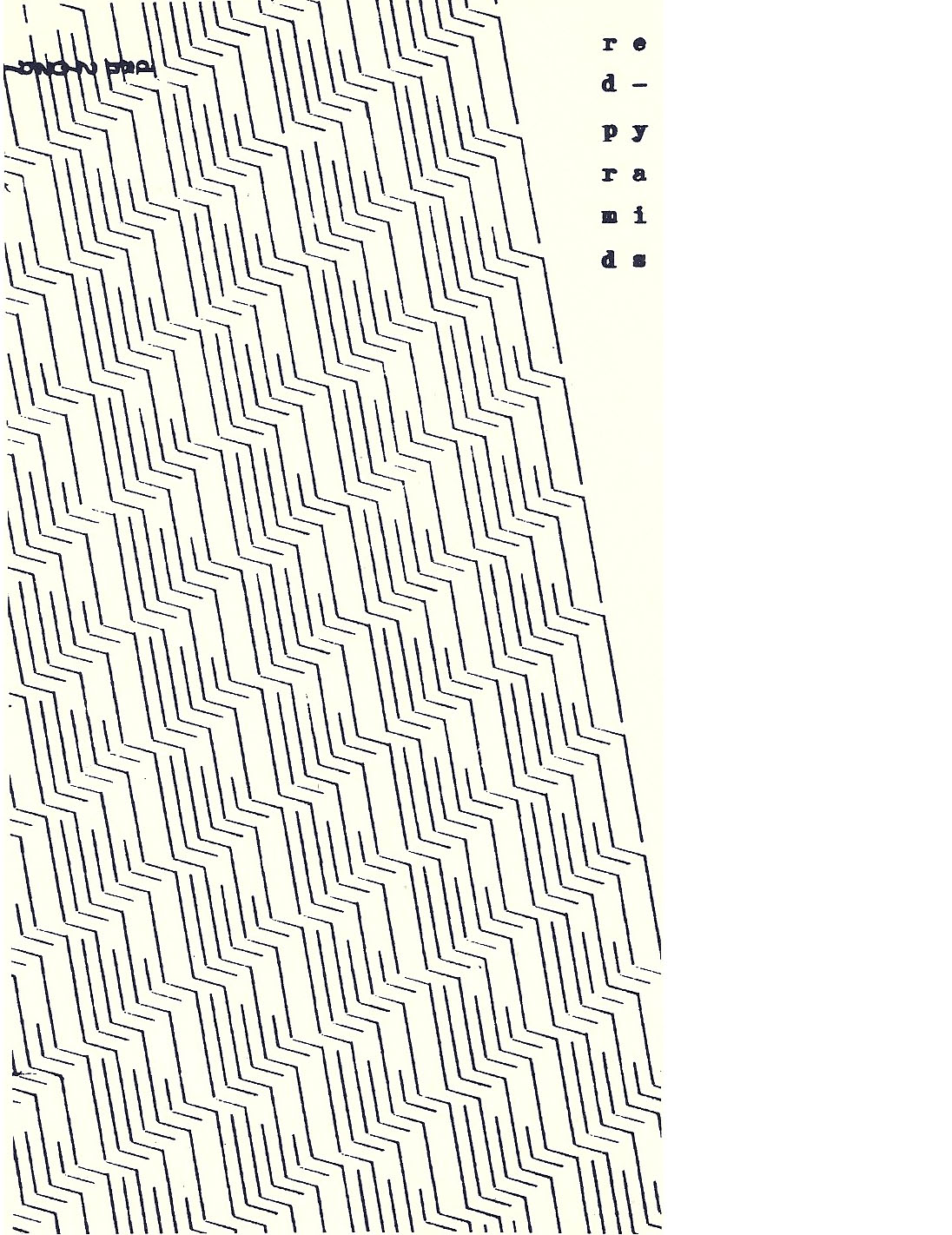
The collection opens with Cobbing’s own 5-poem selection, each of which represents a disparate facet of his varied concrete oeuvre. Typical of his work are dense black overprinted pieces that combine repeated texts, crumpled and distorted page fields and collaged advertising lettering. Its certainly unreasonable to sum up Cobbing’s work in 5 pieces and I know of at least one visual poet who has found that as he’s explored his own practice he was confronted with the fact that Cobbing had covered most bases, exhaustively, more than 50-year prior. Cobbing’s “tyger 1” (1971) is pictured at top-left.

Kenelm Cox is new to me, and his work is machine-centred and focused on the “process of becoming, existing, disintegrating and thereby becoming something else” but wanted to “exorcize some of the machine’s terrifying aspects—and give it some charm.” My work (especially in fractal economies) has been more focused on those ‘terrifying aspects’ of mechanistic poetry—especially in light of increased automation and mechanization in correspondence and communication. Cox argues that he is open to his work being “funny, that is part of being friendly, but […] would like it to have some elegance too” and thus his contributions to GLOUP and WOUP are primarily photographs of letter-based mobiles and simple clock-like machines. Approachable, audience-friendly, Italian Futurism (which is an oxymoron if there ever was one).

Tom Edmonds was also a new addition to my reading, and his contribution to GLOUP and WOUP are, like Cox, are sculptural in tone though Edmunds display a greater debt to Ian Hamilton Finlay’s glass and text-based work. Edmunds constructs cool shadow-boxes with ordered sheets of glass, each inscribed with textual fragments. The resultant pieces have an intriguing engagement with depth, moving for the page as 2-dimensional space to a 3D conceptualization of poetry. (See Edmunds’s “compromise poem box” (1969) on the right…)

Tom Edmunds's "compromise poem box" (1969)

John Furnival is the most problematic inclusion in the collection. His work—which exuberantly overwhelms the reader with panels of hand-lettering arranged in architectural structures—sadly typifies many concrete poetry clichés. The panels, which the author admits are “still very confused, which [he] take[s] to be an artist’s privilege” centre on two overly enticing images for visual poets—the Tower of Babel and John 1:1 (“In the beginning was the word, and the word was with God…”). Placing both of these images as ejaculate from a huge textual phallus, however, quickly negates any astonishment the viewer may have towards the process of erecting these structures in the first place.

Dom Sylvester Houédard (who I also plan to write on in future columns) is, like Cobbing, also a sadly under-discussed and under-appreciated master of concrete poetry. His inclusion in GLOUP and WOUP is the high point. His typewriter abstracts—typescracts—are the most technically complex examplars of clean concrete. Sadly, his work is rarely reproduced in colour (and this is no exception), as often worked with multi-coloured typewriter ribbons. As concise as Houedard’s work is, the realization that each piece was created on a manual typewriter (see Houedard’s “typestract the five buddhas” (1967) on right…).
Dom Sylvester Houedard's "typestract the five buddhas" (1967)

GLOUP and WOUP closes with a “Bibliography and Sources of Comments” leaflet which provides yet more openings for future research. I’ve searching out more than a few titles. Compared to the major anthologies of the 1960s/70’s (Mary Ellen Solt’s, Stephen Bann’s, Emmett Williams’s, etc.) GLOUP and WOUP has a very focused editorial mandate, but the 5 poets included make this collection an admirable model, exemplifying both the triumphs and pratfalls of historical concrete poetry.


In any case, we must make no mistake as to the difficulties such a revolution will encounter. They are considerable. The entire caste system of our literary life (from publisher to the humblest reader, including bookseller and critic) has no choice but to oppose the unknown form that is attempting to establish itself. The minds best disposed to the idea of a necessary transformation, those most willing to countenance and even welcome the values of the experiment, remain, nonetheless, the heirs of a tradition. A new form will always seem more or less an absence of any form at all, since it is unconsciously judged by reference to the consecrated forms. A Canadian critic dismisses contemporary craft as “certified by use of fragmentation, layered texts, collage, and the embrace of—why not say it?—nonsense. [A t]heoretically self-pleasuring […] zoo of rampant esotericisms.” This brief judgment is to be found in an anthology of poetry, evidently written by a specialist.

The newborn work will always be regarded as a monster, even by those who find experiment fascinating. There will be some curiosity, of course, some gestures of interest, always some provision for the future. And some praise; though what is sincere will always be addressed to the vestiges of the familiar, to all those bonds from which the new work has not yet broken free and which desperately seek to imprison it in the past.

For if the norms of the past serve to measure the present, they also serve to construct it. The writer herself, despite her desire for independence, is situated within an intellectual culture and a literature that can only be those of the past. It is impossible for her to escape altogether from this tradition of which she is the product. Sometimes the very elements she has tried hardest to oppose seem, on the contrary, to flourish more vigorously than ever in the very work by which she hoped to destroy them; and she will be congratulated, of course, with relief for having cultivated them so zealously.

Hence it will be the literary specialists (novelists, poets or critics, or over-assiduous readers) who have the hardest time dragging themselves out of its rut.

Even the least conditioned observer is unable to see the world around her through entirely unprejudiced eyes. Not, of course, that I have in mind the naïve concern for objectivity which the analysts of the (subjective) soul find it so easy to smile at. Objectivity in the ordinary sense of the word—total impersonality of observation—is all too obviously an illusion. But freedom from observation should be possible, and yet it is not. At every moment, a continuous fringe of culture (psychology, ethics, metaphysics, etc.) is added to words, giving them a less alien aspect, one that is more comprehensible, more reassuring. Sometimes the camouflage is complete: a word vanishes from our mind, supplanted by the emotions which supposedly produced it, and we remember a landscape as austere or calm without being able to evoke a single outlines, a single determining element. Even if we immediately think, “That’s literary,” we don’t try to react against the thought we accept the fact that what is literary (the word has become pejorative) functions like a grid or screen set with bits of different coloured glass that fracture our field of vision into tiny assimilable facets.

And if something resists this systematic appropriation of the visual, if an element of the world breaks the glass, without finding any place in the interpretative screen, we can always make use of our convenient category of “the experimental” in order to absorb this awkward residue.

No press is proud to announce the publication of SIX PANELS by Gary Barwin.

A beautiful visual poem, this visual poem is presented as 6-panel suite combining typography and anatomy…

Published in an edition of 50 copies (25 of which are for sale), this leaflet sells for $1.50

To order, please contact derek beaulieu.