Archives for category: smallpress

No press is proud to announce the publication of Last Words from ‘Sentences My Father Used’ by Charles Bernstein.

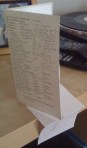
Produced in a limited edition of 80 handbound copies, Last Words from ‘Sentences My Father Used’ is produced on 4 gate-folded long, narrow pages.

“Last Words from ‘Sentences My Father Used’ takes the final word in each of the 179 lines of “Sentences My Father Used” from Controlling Interests (New York: Roof Books, 1980, reprinted 2004). It is published here for the first time and will be collected in Recalculating (Chicago: University of Chicago Press, 2013).” — Charles Bernstein.

Last Words from ‘Sentences My Father Used’ is available for $5. Please email derek@housepress.ca to order.

Local Colour : Ghosts, variations

(Malmö: In Edit Mode Press, 2012)
ISBN: 978-91-977853-4-1
First edition: 200 copies
Release date: December 17, 2012
Retail price: €65

Pre-order your copy now at a discount : €50.

LOCAL COLOUR : Ghosts, variations is a collaboration between In Edit Mode Press and Canadian poet Derek Beaulieu. The publication takes as its point of departure, Paul Auster’s novella Ghosts, and, in particular, Derek Beaulieu’s reworking of Auster’s text, Local Colour, which he describes as follows:

‘Local Colour’ is a page-by-page interpretation of Paul Auster’s 72-page novella ‘Ghosts’. ‘Ghosts’ concerns itself with Blue, a private detective hired by a mysterious character named White to transcribe the actions of Black, a denizen of Brooklyn Heights living on Orange Street. As Blue reports his findings, the reader becomes more aware of the intricate relationship between Black and White, and a tactile awareness of the role of colour spreads through the narrative. With ‘Local Colour’, I have removed the entirety of Auster’s text, leaving only chromatic words—proper nouns or not—spread across the page as dollops of paint on a palette. Taking inspiration from Kenneth Goldsmith’s Gertrude Stein on Punctuation (Abaton Books, 2000) what remains is the written equivalent of ambient music—words which are meant to be seen but not read. The colours, through repetition, build a suspense and crescendo which is loosened from traditional narrative into a more pointillist construction.

Focusing on the tension created in Beaulieu’s manuscript – and alluded to in the description of his process – between the textual narrative and the relatively abstract graphical mark, and the opening it seems to provide towards a sonic realm, we are now hoping to solicit a series of textual, aural, oral, musical, and other interpretations, as well as more machinic ‘utilisations’, of Beaulieu’s manuscript. What interests us, in particular, is the way in which Local Colour seems to split Auster’s narrative text open, deterritorialising it, serially, by rendering it purely graphical, freeing it up, in the same gesture, to an excess and a bifurcation of meaning. Seeking to extend and amplify this ambition, we are now opening the project up for others – writers, poets, musicians, artists – to split Beualieu’s manuscript open, to deterritorialise the coloured rectangles of his manuscript by textual, aural, narrative, graphical and other means.

Local Colour: Ghosts, variations collects and counterposes a wide array of strategies and approaches. It features both textual and aural contributions and contributions that combine text and sound. We hope it will prove an ambitious, vigorous collection that oscillates and moves between textual narrative, graphical mark, and aural impression, exploring these different realms whilst rendering uncertain any easy distinction between them.

CONTENTS (IN PRINT) :

Derek Beaulieu, Local Colour (printed book)
Steve Giasson, Couleur Locale (printed book)
Cia Rinne, Securiousity  (printed booklet)
Peder Alexis Olsson, Title TBA (print)
Jörgen Gassilewski, After Image (print)
Craig Dworkin, Unseen Colour (print)
Elisabeth Tonnard, Monochromatic Bits (print)
Martin Glaz Serup, Title TBA (printed book)
Eric Zboya, Untitled # 1 & 2 (Local Colour) (prints)
Ola Ståhl, Colour’s Gravity (printed book and prints)
Magda Tyzlik-Carver & Andy Prior, Ghost Machine (printed booklet)

CONTENTS (ON CD) :

Pär Thörn, Sound Interpretation of Derek Beaulieu’s ‘Local Colour’(sound piece)
Cecilie Bjørgås Jordheim, First of all there is Blue, Brown and I got ham, White and Blue (this section includes education) (sound pieces)
Ola Lindefelt, Title TBA (sound piece)
Andreas Kurtsson, Voice Range, Dialect Genre (sound piece)
Helen White, Local Ghosts (sound piece)
Ola Ståhl, Colour’s Gravity (recorded speech)
Gary Barwin, Local Colour (sound piece)
Ola Ståhl & Carl Lindh, Music Box (sound piece)
Magda Tyzlik-Carver & Andy Prior, Ghost Machine (software and videos)

Rabble: derek beaulieu

All Work and No Play Makes Jack a Dull Boy

“In Stanley Kubrick’s 1980 film adaptation of Stephen King’s The Shining, author Jack Torrance slowly loses his grip on sanity while ensconced in a winter-long residency as caretaker for the seasonally-closed Overlook Hotel. Over the season Jack, a struggling novelist, uses the solitude (interrupted only by his wife Wendy and son Danny) to attempt to construct his new novel. Only a few pages of Torrance’s efforts are revealed in The Shining, but every page consists wholly and entirely of the phrase “All work and no play makes Jack a dull boy” repeated ad infinitum over a presumably several-hundred-page manuscript. In the filmic reveal of Torrance’s creative masterpiece, Wendy emotionally collapses as she finally realizes the extent of her husband’s crumbling rationality. Under the mental anguish of this Sisyphean task of nonlinearity, Jack Torrance’s grip on reality is weakened, much as readers feel the strain of such a non-traditional manuscript.”

Rabble, an imprint of Insert Blanc Press, is co-edited by Holly Myers and Mathew Timmons. Rabble prints single author issues of critical essays of about 1500 words on a subject of the author’s choosing. The subject will be an artwork (or series of artworks), but broadly defined: could be visual art, literature, music, architecture, film, design; could be contemporary or historical. The essay will be printed in pamphlet form, with room for a couple full color images, and distributed at a reasonable price.

Rabble seeks to be a venue through which to interrogate the nature of criticism, a laboratory for prodding at the boundaries of criticism as a form. The idea is to begin with a framework that reduces criticism down to its two fundamental components—the thing that’s been made and the person who responds to the thing that’s been made (i.e., the art work and the critic)—and then to invite a lot of smart people to take up that framework as they see fit. We’re not looking for the average book or exhibition review, but something that tests out a new direction, whatever that means to the individual author.

We have great confidence in the potential of Rabble to make a lasting contribution to the cultural discourse on the West Coast and beyond. It is our hope that, in charting a path between the two prevailing poles of the genre—the ever-narrowing shutters of print journalism on the one hand and the ponderous obscurity of the academy on the other—Rabble will go some way in restoring the sheer excitement of criticism.


new from NO PRESS:

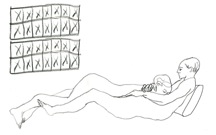
“A Marriage Tract by Marie Stopes” by Sheila Heti.

Published in an edition of 80 handbound numbered copies, only $4ea.

from the author’s afterword:

“At one point in my novel, Ticknor, the character of George Ticknor reads a “marriage pamphlet” which is handed to him by a woman in the street. I wrote up the marriage pamphlet but I never put it in the book. One Christmas, I turned it into a little hand-sewn pamphlet and sent it to dozens of friends. This is the pamphlet’s second iteration. The text was borrowed and adapted from the writings of Marie Stopes (1880—1958), a controversial birth control reformer and sex education advocate. […] This pamphlet is dedicated to the young men and women who once gathered at 1223 Bathurst Street in Toronto, where we were joyously developing a “morality… in a time of innocence … insufficient to bring [us] happiness through the course of [our] life.” —Sheila Heti

to order, email derek beaulieu at derek@housepress.ca

In addition to getting married, taking a few day honeymoon in San Francisco and working on several essays and pieces of writing, the latest news around here includes:

Conceptualist ostranenie: A dialogue between Derek Beaulieu (Canada) and Natalia Fedorova (Russia), now posted at Jacket2

a new chapbook of mine entitled Untitled (for billy mavreas) is now available from Puddles of Sky Press. A link to the press’s Facebook site is here.

I recently had an article on concrete poetry in the latest issue of Uppercase magazine

26 Alphabets (for Sol LeWitt) is still available in both print ($20) and digital ($0) editions.

No press is proud to announce the publication of “4am” by Eryk Wenziak, “Helvetica Neue” by Emma King, “2 poems” a leaflet by Kye Kocher, “The Winnipeg Cold Storage Company ” by Jon Paul Fiorentino and “Scrapple” by Jacob Spector (and a few more!) … rob mclennan reviews a few recent No press editions here.

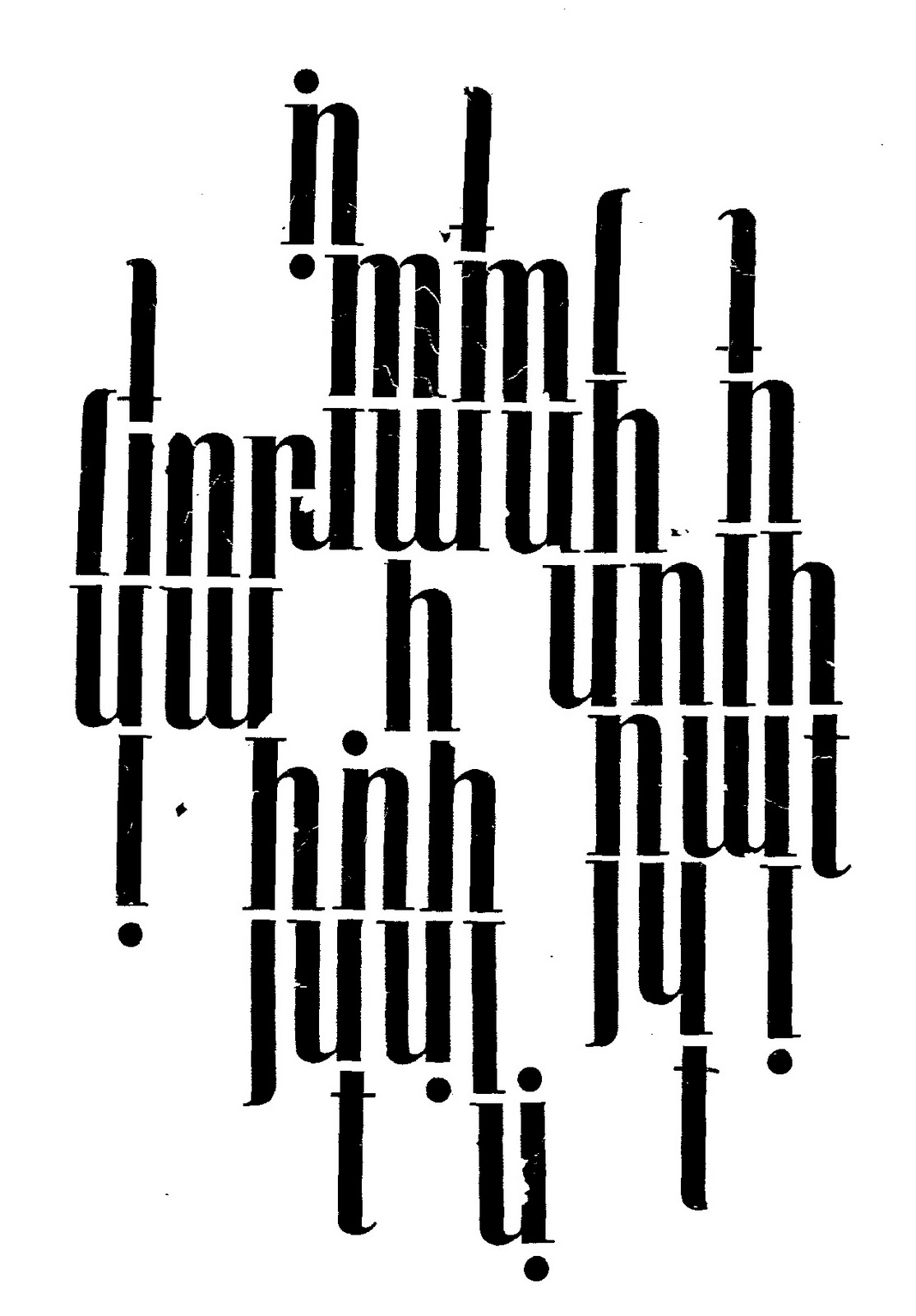
NO PRESS is proud to announce the publication of “pentaphtong” by Jaap Blonk. Published in an edition of 50 copies, this leaflet will be available at readings (and via the post) through-out the spring; keep an eye out!

NO PRESS is proud to announce the publication of “surprising poetry” by Judith Copithorne, one of the pioneer Canadian Concrete poets. Published in an edition of 100 copies, this leaflet will be available at readings (and via the post) through-out the spring; keep an eye out!

rob mclennan’s above/ground press has just published

ECONOMIES OF SCALE: rob mclennan interviews derek beaulieu on NO PRESS / derek beaulieu interviews rob mclennan on above/ground press
with a selection of new work by both authors

$5

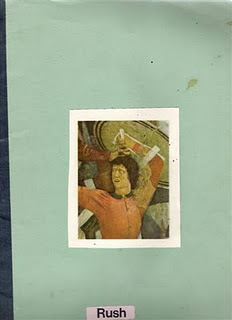
The publication of bill bissett’s Rush: what fuckan theory; a study of language in 1972 firmly ushered Canadian poetics into the postmodern era. Out of print for 40 years – and reissued here complete with an interview with bissett about the book’s creation and a critical afterword by derek beaulieu and Gregory Betts – Rush embodies a collagist, multi-conscious approach to art that recognizes no division between the work and the world, the author and his sexuality, his breath, his influences; the theory and the practice. Arguing that “a new line has startid,” Rush captures the urgency of a new model of production that resists the closure and mastery of any one mind. It is an elegant rejection of aesthetic ego and all presumptions of authority. Rush: what fuckan theory; a study of language is a vital, vocal protest against business as usual and the exploitation of the individual from one of Canada’s most important avant-garde poets.

bill bissett opened Canadian poetry to postmodernism and from there proceeded in every direction all at once. Since his invention of the blewointment press in 1963, bissett has worked diligently to explode all boundaries of author, text, and context, radically disrupting static and disciplinary modes of art making. Read, taught, studied, and imitated all around the world, he now lives in Toronto, painting and writing somewhere between painting and poetry.

derek beaulieu is the author of nine books of poetry and conceptual fiction, editor of the acclaimed small presses housepress and No Press. He is an instructor at Mount Royal University and the Alberta College of Art + Design.

Gregory Betts is the Director of Canadian Studies and the Graduate Program Director of Canadian and American Studies at Brock University. He is the author of five books of poetry, and the editor of four books of experimental Canadian writing.

112 pages | 7×10 inches | paperback
ISBN 9781927040416
EPUB ISBN 9781927040454

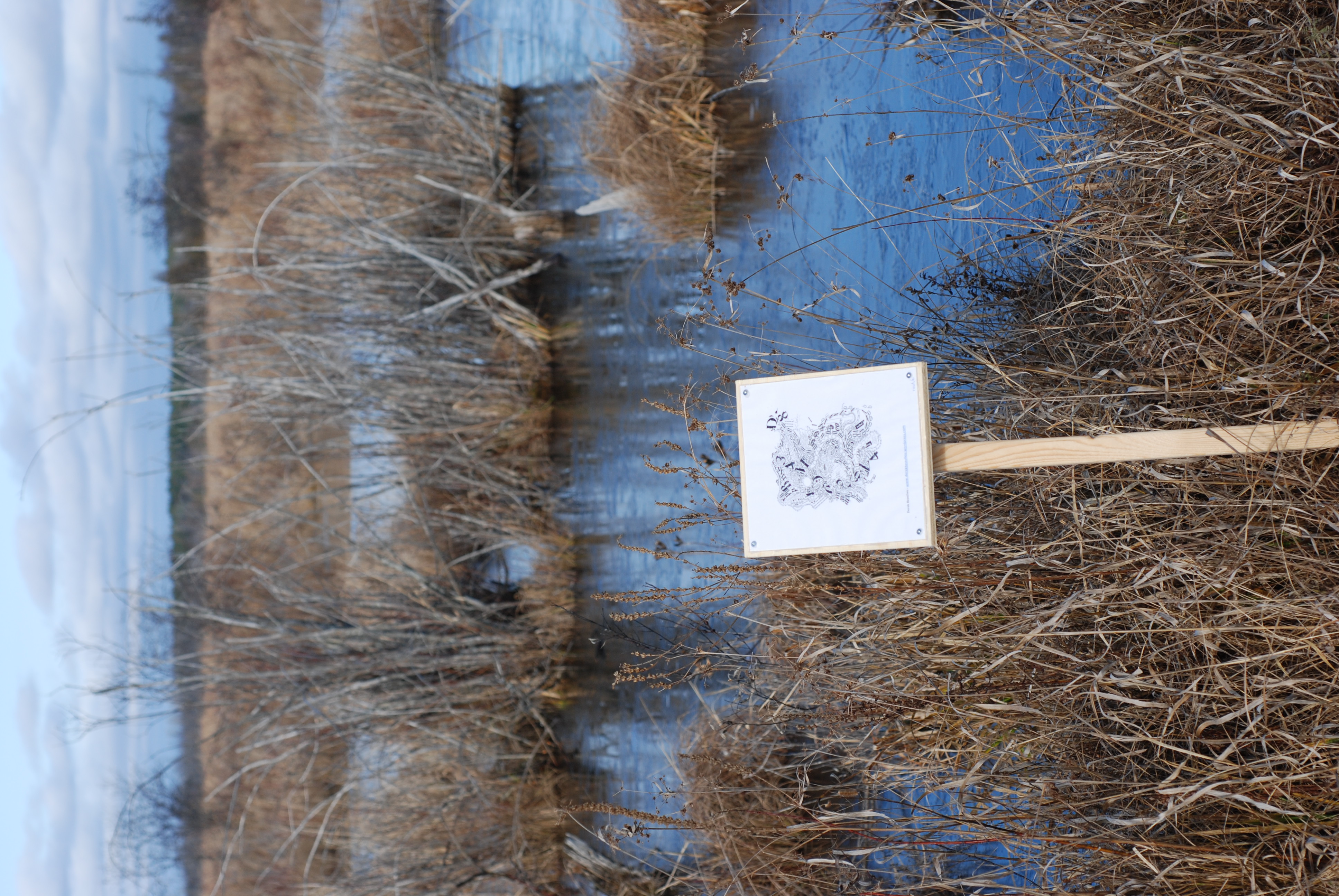
Chris Turnbull, the editor of Rout/e magazine has just included a visual poem of mine as part of a poetic route. Turnbull wrote that my poem was planted “along the Dwyer Hill entrance point to Marlborough Forest.”

My poem “edges the first water section of the trail. It is often near flooded, the left and right sides of the swamp (track bisecting) quite dramatically different. It’s one of the first places the geese return to, and [Turnbull has] sighted blandings turtles (endangered), water snakes, marsh wrens, and muskrat in abundance. And, of course, frogs among other things.”

Better co-ordinates soon, but “if you go to Google Earth, to Dwyer Hill, locate roughly half way between Flood Road and Heaphy Road and head for the chunk of obvious water. The trail is unobservable…”