 rob mclennan has been publishing a “12 or 20 questions” interview series on his blog for several years now. In each, he interviews writers and pblishers with a series of pre-set questions. I felt it was time to turn the conceit on to mclennan’s practice and lobbed 10 questions at him about his above/ground press:
***
The author of more than 20 trade books of poetry, fiction and non-fiction in a number of countries, rob mclennan has published work in over two hundred trade journals in 14 countries and three languages. His most recent poetry titles are Glengarry (Vancouver: Talon, 2011) and kate street (Chicago: Moira, 2011) and a second novel, missing persons (Toronto: The Mercury Press, 2009). He spent the 2007-8 academic year in Edmonton as writer-in-residence at the University of Alberta, and maintains an active blog for reviews, essays, interviews and other notices. In 2008, ECW Press released a collection of his literary essays, Subverting the lyric: essays, the same year Arsenal Pulp Press produced his expansive tourist guide, Ottawa: The Unknown City. In 2012, Ireland’s Salmon Publishing will be producing a volume of selected poems.
After nearly eight months of producing chapbooks under different press names, above/ground press officially started with its first two publications in August 1993, and has published over 550 publications. The press includes chapbooks, broadsides, nearly 50 issues of the long poem magazine STANZAS, 6 issues of Missing Jacket and drop, and many of the 15 issues of the writers group occasional, The Peter F. Yacht Club. In addition to his small press, mclennan co-edited two years of Carleton University’s The Carleton Arts Review (1993-1995), founded the semi-annual ottawa small press book fair in 1994, the Ottawa poetry pdf annual ottawater in 2005, the online poetics journal Poetics.ca (with Stephen Brockwell), the trade publishing house Chaudiere Books (with Jennifer Mulligan) in 2006, The Garneau Review (2008), and seventeen seconds: a journal of poetry and poetics. He has also edited numerous books, journals and anthologies for Insomniac Press, Black Moss Press, Broken Jaw Press, Vehicule, unarmed journal, Jacket magazine, Dusie and Guernica Editions.
1 – Why did you begin above/ground? What was the impetus for its creation—and do you think your publishing mandate has evolved since its inception? If so, how?
It’s been fun to make and distribute books. How could anyone not want to? Sending out books and receiving others in return. Very early on, I deliberately wanted to keep costs low and copies abundant, partly due to my own financial constraints; keeping chapbooks cheap enough to give away, as opposed to horde. Why bother making books, otherwise? Part of this was to promote contemporary writing generally, and my own writing specifically. Also, there was nothing more frustrating than hearing someone say they hated poetry, only to discover they hadn’t actually read any. How can anyone speak with such authority and no knowledge? So I would give them a poem handout or a chapbook, depending. Over the years, you’d be surprised at the number of people who have responded positively, even if only as much as purchasing a further book, or handing over a compliment, tinged with shock. When a drywaller who doesn’t have a book to his name tells you, a week later, that he liked your poem, it carries an awful lot of weight. I’ve never been the kind of writer interested in altering the work for the sake of accessibility, focusing more on altering publishing, bringing it directly out into the world. Why should art be dumbed-down for the sake of furthering audience? It’s an insult to both art and audience.
Originally above/ground came out of an awareness that small publishing existed in other places, other times, but there didn’t seem to be anything going on at all in the city. The days of Oroboros and Anthos magazine/Anthos Books were long behind, and publications such as the Friday Circle Chapbooks and hole books hadn’t yet begun. I was only peripherally aware of hole, and had no clue about their Transparency Machine readings at Gallery 101. Despite my interest in what was happening, I was still a new co-parent home with our toddler Kate, and starting the daycare out of our tiny apartment. I had started participating in the TREE Reading Series, with regulars, I later realized, who were seemingly only aware of themselves. Writing and publishing and simply existing in the world is supposed to be a conversation, and I didn’t notice too many of them actually listening, which I found baffling. Alternately, to be great, you have to have, among other qualities, a wider scope than everyone else around you. What I was aware of was a number of writers who could have benefited from a small chapbook publisher, but weren’t necessarily interested in doing the work themselves. For some reason, I took this on.
My mandate has evolved, especially when you consider its been nearly two decades since I began, but I think the core interests are still the same, working to fill the spaces that other publishing doesn’t, and to provide connections between readers, writers and even communities. My interests have matured, and I’m far more critical of the work that passes across my desk. I’m interested in poetry that has difficulty appearing in other venues, interested in seeing more by particular authors I might catch a single poem by in an issue of filling Station or Bywords or The Capilano Review or the like. These days, my excitement hinges on new and forthcoming titles by Monty Reid, Paige Ackerson-Kiely, Ken Norris, Ross Brighton, Robert Kroetsch, Dennis Cooley and Lary Bremner. There are still plenty of others I’ve been trying to get another or first chapbook out of for some time, predominantly women writers, who I find notoriously difficult to get work out of (although it’s almost always far more polished than writing by their male equivalents when I finally do).
2 – What do you consider the role and responsibilities, if any, of small publishing in general and of above/ground in specific?
I consider my roles as editor/publisher to critically encourage and actively engage with the writers and writing that surround me, not necessarily exclusively tied to geographic concerns. I consider one of my roles that of cheerleader/coach, and regularly push various poets to submit when I think they’re ready for a chapbook, whether a first overall, or simply first through the press, which much of time reaches a far wider audience than many of their small self-published beginnings. It’s been fun the past few years to push at Pearl Pirie, Roland Prevost, Marcus McCann, Nicholas Lea, Amanda Earl and Marilyn Irwin, for example, simply to see where they might end up. There’s lots of talent in this town, and sometimes the best thing you can do for someone is encourage. Hell, I think anyone interested in writing should experiment with their own small publishing. It can often encourage a clarity about writing and the process generally that might not otherwise come.
Another part of what I enjoy is the gift economy, and for years, I’ve been handing envelopes of recent above/ground publications to visiting authors, or poets in other cities I might be visiting. When I first read in Buffalo, I made a point of putting together a packet of various publications for Steve McCaffery that I thought might appeal, including what I’d produced by bpNichol, Donato Mancini, Chris Turnbull and Max Middle. When I heard that Vehicule Press was producing a selected poems by D.G. Jones in 2002, I made a point of sending off the little chapbook of his I’d just produced to Signal Editions editor Carmine Starnino. It’s a way to get the work out in a more direct, more personal way, and I would think that the publications might be viewed with more meaning, perhaps.
3 – What is your design aesthetic? How does that aesthetic compliment or respond to the work that you publish? Why have you chosen the format you have?
Originally I was trying to keep production values simple and inexpensive for the sake of highlighting distribution. I loved what presses such as High Ground Press and mothertongue were producing, but had a problem with chapbooks produced in exclusive runs that sold for nearly $100 each. I found that such preciousness became self-defeating when producing a literary work that should have, first and foremost, been available to readers. There has to be a middle ground. Have you seen what Maggie Helwig was producing in the late 1980s and into the 90s through her Lowlife? I love the rough edges of her productions, chapbooks by herself, Michael Dennis and Lynn Crosbie. I far prefer rough work to preciousness.
I try to keep the design as simple as possible. Certainly, there’s room for improvement, but I enjoy the simple grace of an uncut cover, straight image and playing with the (frustratingly) limited colour options that Ottawa copyshops provide. I prefer uncomplicated, and usually produce runs of 200-300 copies, deliberately leaning on the side of distribution over over-production.
4 – What do you believe above/ground does that other presses do not? In other words: what is the niche for above/ground?
My tastes are pretty broad, so I attempt to engage with different communities over a wide range. There was something particularly entertaining to me a few years ago when I produced a broadsheet of a visual poem by you at the same time as I produced a more formally-constructed poem by Montreal poet Carmine Starnino. I knew full well that there would be various readers out there receiving their usual above/ground press subscription envelope who would enjoy the work in one and be angry or confused by the other, but what really appealed were those who might enjoy both, perhaps engaging with one for the very first time. For the longest time I was very aware of producing more formally-adventurous work in the pages of STANZAS than in the regular chapbook series, and a number of authors that might have had regular above/ground press chapbooks had no chance to get into the journal, but I’ve since folded the mandate of STANZAS more into the press as a whole. I keep hoping I can find a press, perhaps, to let me edit an anthology as a last hurrah for the journal, much the way Talonbooks produced Imago 20 in 1974, but I haven’t yet had time to pitch anyone properly on the idea.
But still. I’d say a certain part of my niche is producing works closer to the aesthetic of filling Station, BookThug, NO Press, The Capilano Review and CUE Books, without ignoring more formally-conservative lyric modes. My niche is to bridge the gap between the extremes, in form and geography. Basically, I publish what I like, and I like an awful lot.
Is above/ground in conversation with a particular community (either aesthetic or geographic)? Do you see it responding to particular presses, venues or spaces?
Originally, thanks to the University of Ottawa library shelves, I was aware of such publications of bpNichol’s chapbook Beach Head, aware of blewointment and Open Letter. I was fascinated by the ease at which these publications could exist, and wondered why there weren’t stacks of writers around me in Ottawa doing the same. Mags & Fags on Elgin Street has always had the best literary magazine section in the city, so I pretty quickly found small, odd publications such as Bywords and Rob Manery and Louis Cabri’s hole magazine, later discovering Maggie Helwig’s Lowlife Publishing, Joe Blades’ New Muse of Contempt and various other contemporaries. It felt like a wonderful goal, to be part of such publishing, whether as author or publisher or both.
STANZAS was a direct response to George Bowering’s long poem magazine Imago (1964-1974), and I managed some 46 or 47 issues before the whole thing fell apart, distributing hundreds of copies of each issue gratis. When I started, I was very interested in the idea of the long poem, and trying to figure out what that meant. I didn’t see that many opportunities for literary journals for such, still favouring the mass of single-page lyrics. I wanted to provide a space, not just for the poem to exist in print, in pre-trade collections, but to exist for me as a reader and writer. I wanted to know what was out there I was missing.
I recall early on enjoying the idea of TISH as a newsletter, “the news that must stay news,” and bpNichol’s gift economy of grOnk and Ganglia. Finance shouldn’t be a barrier, and distribution needed to remain fluid. Handouts allowed more opportunities than attempting to sell in stores that didn’t want, and would return six months later, damaged.
Besides, a free journal helped advertise the chapbooks I attempted to sell. I didn’t want to be producing items that only filled boxes in my apartment. Gary Geddes informed me that the earliest incarnation of Cormorant Books, his Quadrant Editions, kept afloat through subscription, and thought that the best of ideas, and I’ve been offering annual subscriptions since. This was probably in 1993 or 4, as we drank from bottles of Sleeman’s in the treehouse in what is now their former front yard in Dunvegan, Ontario, bare miles away from my parent’s house.
Originally my response was quite direct, responding to a perceived lack of Ottawa small publishing, but I’ve since broadened my scope considerably. Over the past decade or so, my community of Canadian publishers have included your own housepress/NO Press activity, jwcurry’s extensive range of publications, Jason Dewinetz’ Greenboathouse, Rob Budde’s wink books, Jay MillAr’s BookThug, Jon Paul Fiorentino’s Snare Books, kemeny babineau’s LaurelReedBooks, Amanda Earl’s AngelHousePress, Faulker and Nash’s The Emergency Response Unit, Cameron Anstee’s Apt. 9 Press, Nicole Markotić’s Wrinkle Press (to name but a few) and smaller, more occasional publications by ryan fitzpatrick, kevin mcpherson eckhoff and Natalie Simpson. There used to be a lot more Canadian small/micropress activity, and I’m not entirely sure why certain energies have diminished. There are plenty of non-Canadian touchstones I’ve been slowly working to engage over the past few years as well.
6 – What is your editorial policy; how do you see what you accept for publication shaping both the press and a larger reading “public”?
My editorial policy is predominantly marked by what I’d like to see more of, and almost everything I produce now is solicited. I regularly send out emails suggesting to various individuals that “isn’t it about time we think about a chapbook?” Still, I have to be wowed. If I’m spending my time, effort and money on these small items, they have to be amazing, and I have to be able to distribute each one with pride. If I think that reading more pieces by Natalie Simpson or Rob Budde, say, will invigorate a number of writers around me, its somehow easier to simply ask either of them for a submission and start distributing the work locally than, say, trying to figure out how to find the money to purchase a bunch of copies of their already-produced works for give-away. I know Warren Tallman did such at Simon Fraser, something I admire greatly, and was even able to get a copy of bpNichol’s gIFTS: The Martyrology Book(s) 7& with a “Simon Fraser University Library, This Book is a Gift from Warren Tallman 1921 – 1994” insert, but those who can and are willing to do such are extremely rare.
As my work with side/lines: a new canadian poetics (2002), or even the monthly reading series I ran during my 2007-8 writer-in-residence year at the University of Alberta reminded people, part of what I’ve always taken as my editorial mandate has been in introducing writers from different communities to each other. So much more can get accomplished if we are just more aware of each other, in our individual pockets of physical and/or intellectual space, sharing and producing work.
7 – What is the interaction between smallpress publishers like above/ground and NO PRESS and larger publishing venues (the publishers of national distributed perfect bound books)?
I’m not entirely sure, to be honest. We’re all doing different publishing with different goals, despite whatever possible overlap. I’m very aware of my publications opening or extending particular conversations. Maybe some authors I’m publishing are well known in one circle, but not necessarily another, including my own, so hopefully some readers might be introduced to an author that intrigues them, and they might look over to the rest of what that author has already done. My publications don’t exist in opposition to trade publishing, but beside and between.
8 – Who is reading above/ground? Why do they do so?
There’s so much going on that readers require a series of filters. It’s why Ron Silliman gets so many daily hits on his blog, the sheer amount of people who realize the quality of his recommendations. One reads The Capilano Review, say, for one kind of work, and The Malahat Review for another. I would imagine that readers of above/ground (I require a print run of 100 just for subscribers and immediate trades) engage for the sake of its range, not just of writing style and geographic communities, but a first or second chapbook by a newer author (Cameron Anstee, Chris Turnbull, Marilyn Irwin) alongside another by a more established author actively publishing (George Bowering, Monty Reid, Phil Hall) beside that rare chapbook by a writer we don’t hear from nearly often enough (D.G. Jones, Nelson Ball, John Newlove). Thanks to jwcurry, I was even able to produce the first proper issue of a particular bpNichol chapbook (as well as a little broadsheet at the same time), KON 66 & 67, one he originally produced very poorly through Ganglia. The news, as I said, that wants to stay news. I’ve been very deliberate at trying to produce first chapbooks by new authors to help give that initial push that might keep them writing, keep them in the game.
On the other hand, I think my engagement with the broader literary community offers readers small items that otherwise might not have seen the world, and possibly, above/ground can provide homes to certain more experimental works by writers who don’t often stray into that kind of territory. Until her third trade poetry collection, Pavilion (2002) appeared, my favourite of Stephanie Bolsters’ works was still the chapbook I produced, her Three Bloody Words (1996). And despite whatever else she achieves, I find my favourite of Jeanette Lynes’ works is still her above/ground press chapbook, inglish prof with her head in a blender. turned on. High. (2001). There seems an experimentation in some of the poems in that chapbook that the rest of her poetry collections don’t seem to have, and I’m not entirely sure why.
9 – How has publishing above/ground affected your own poetic?
I would think that my years of above/ground have altered my attentions for longer projects, as opposed to individual pieces. I spent years writing chapbook-length projects throughout the 1990s that have evolved into larger works of longer attention. I don’t know if I might have gone in the same direction had I not been a small publisher.
10 – As I’ve mentioned in your interview with me, Bob Cobbing stated “The world has quite enough poetry already. Probably too much. Far too much. The only excuse for being a poet today is to add to the quality of poetry, to add a quality which was not there before”—how would you respond to that? What is the role of the publisher in a culture of plentitude?
The role of the publisher, in many ways, is one of filter. If you understand my interest, my aesthetic, and trust my judgment, then you know what you’re in for. I’ve long admired Ottawa writer John Metcalf’s editorial position, first at The Porcupine’s Quill, Inc., and more recently at Biblioasis, and have known for a long time to trust it. Certainly, you’re getting a particular kind of writing, but damn, its going to be worth reading, if that type of writing is your thing. There aren’t that many editors in literary publishing I’d trust as much. Karl Siegler at Talonbooks, certainly. Michael Holmes at ECW Press is up there, those years of Bev Daurio at The Mercury Press, Melanie Little (formerly Freehand Books, now senior fiction editor at Anansi) as well. There are probably others I can’t think of, right now.
Proliferation simply means one has to learn to differentiate the good and the bad, like any system. What happened when literature exploded because of the Gestetner? Photocopiers? The internet? Many more are doing it, certainly, but that doesn’t necessarily mean many more are doing it better. The hard part, and often the most entertaining, is in digging deep into the piles, and seeing just what out there is really exciting, is really worth the trouble.

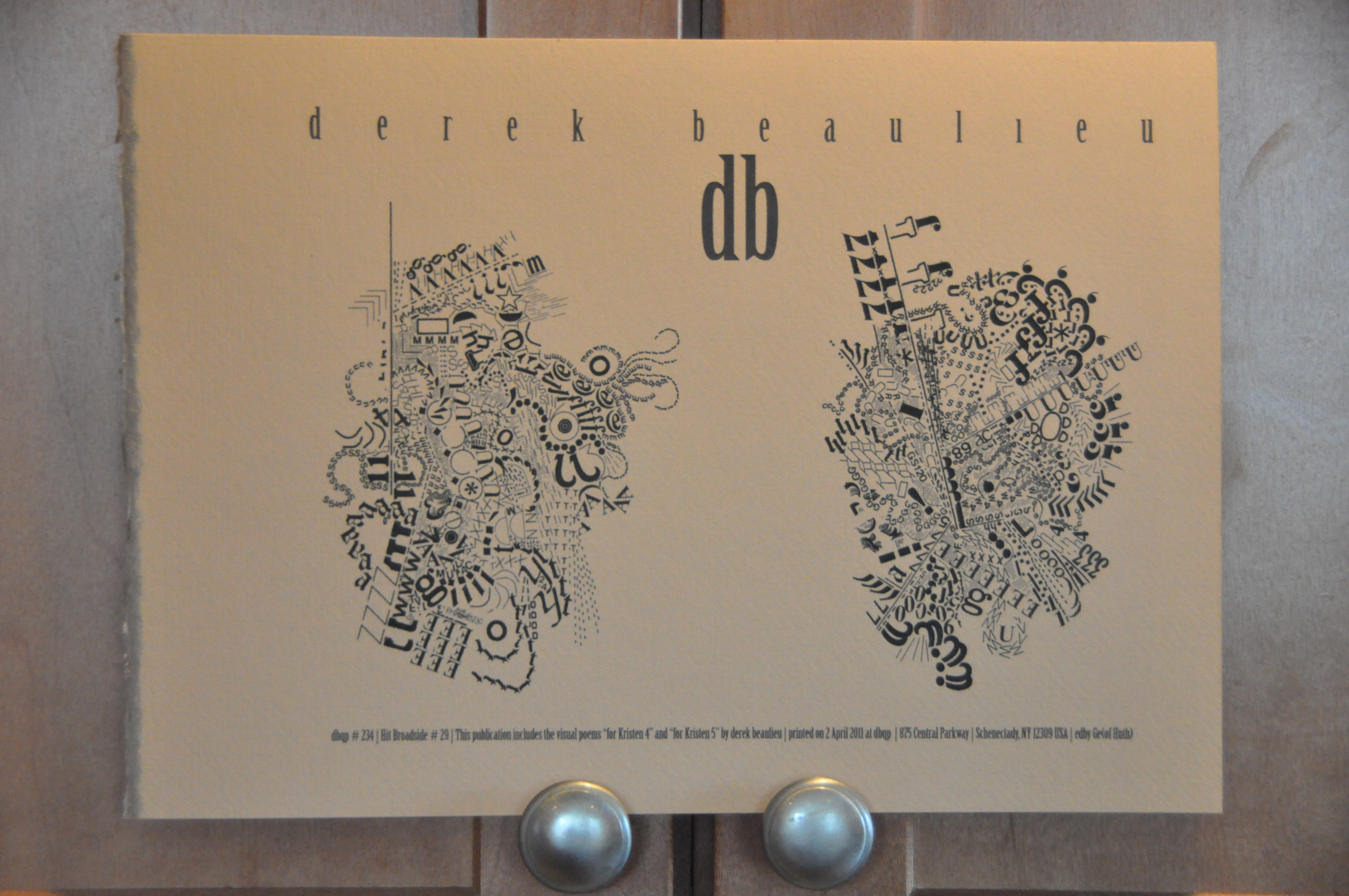 Geof Huth has just released a limited edition broadside of 2 of my visual poems. “db” (as titled by Huth) is available for US$2 postpaid, most of which cost will be mailing costs (he’s also open to trades). More information on the work, and how to order, can be found here.





 derek beaulieu's blog