No press is proud to announce the publication of CHAPTER VIII: THE FUN HOUSE MIRROR STAGE by Jake Kennedy.

This Kennedy’s first published excerpt from his bio-fiction on the life of Madeline Gins, completely authorized by Gins herself.

Published in an edition of 50 copies (25 of which are for sale), this leaflet sells for $2.00

To order, please contact derek beaulieu.

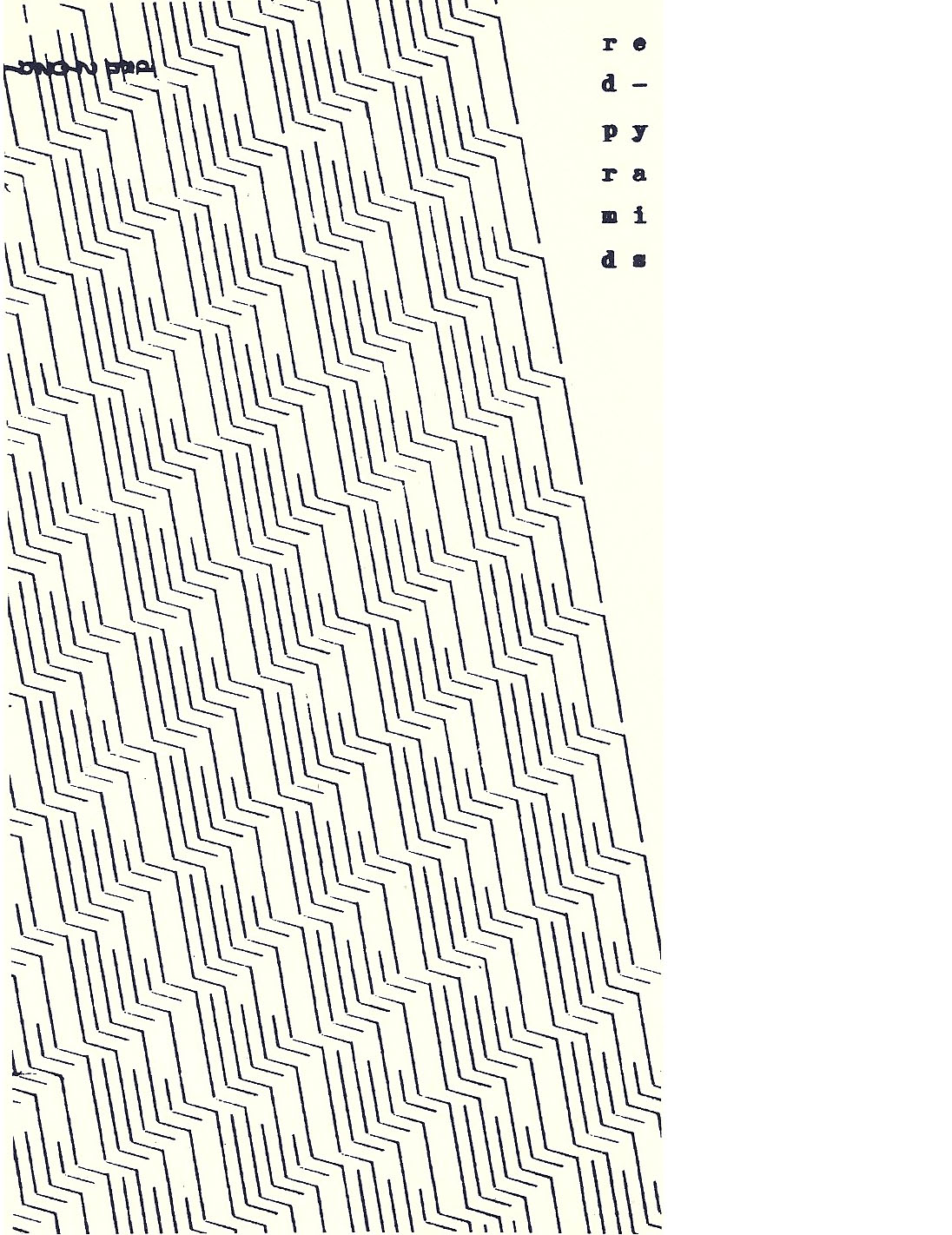
Bob Cobbing's "tyger 1" (1971)

Bob Cobbing (1920–2002) was a (if not the) master of concrete and visual poetry. He began working in typewriter and duplicator monotypes (single-run prints) in 1942, sound poems in 1954 and also initiated his press Writers Forum press in 1954 (more on Writers Forum in a forthcoming column). He worked continuously in those forms (and more) until his death in 2002. Cobbing’s influence and notoriety in Canadian poetry peaked under bpNichol’s efforts in the late 1970’s (Nichol published Cobbing’s Sensations of the Retina in 1978 and shepherded his 1976 book bill jubobe: selected texts of bob cobbing, 1942–1975, as edited by Cobbing and Sean O’Huigin, through Coach House Books). His work deserves further, and on-going, exploration.

I plan on returning to Cobbing’s work with some frequency as part of this ‘an irresponsible act of imaginative license’ series, but for the time being, I want to turn my attention to a GLOUP and WOUP, a 1974 collection that Cobbing edited (Kent, UK: Arc Publications, 1974). A extremely difficult collection to find in the 21st-century, GLOUP and WOUP documents the efforts by two geographically distinct groups of visual poets in the UK in the late 1960s/early 1970s: the GLOUcestershire grouP—as represented by Dom Sylvester Houédard (1924–1992), John Furnival (1933–) and Kenelm Cox (1927–1968) and the Westminster grOUP—as represented by Tom Edmonds (1944–1971) and Cobbing himself.

Much visual poetry from the 1960s and 1970s retains a whiff of hippie-like optimism and faith in universal, liberatory, language. Most collections of concrete poetry from this period have not dated well (a problem common to much poetry: it doesn’t date well), and there is often a great deal of repetition between the major anthologies of the time (the best of which can now most easily be found, of course, on ubuweb). GLOUP and WOUP is not immune to these charges, but none-the-less does include some vital, rarely seen, work.

Published in a printed pink gate-fold wrapper, GLOUP and WOUP is a gathering of single-fold poetic statements and introductions along-side a series of roughly 7 ½” square broadsides printed black and white on lovely matte-finish cardstock.

The collection opens with Cobbing’s own 5-poem selection, each of which represents a disparate facet of his varied concrete oeuvre. Typical of his work are dense black overprinted pieces that combine repeated texts, crumpled and distorted page fields and collaged advertising lettering. Its certainly unreasonable to sum up Cobbing’s work in 5 pieces and I know of at least one visual poet who has found that as he’s explored his own practice he was confronted with the fact that Cobbing had covered most bases, exhaustively, more than 50-year prior. Cobbing’s “tyger 1” (1971) is pictured at top-left.

Kenelm Cox is new to me, and his work is machine-centred and focused on the “process of becoming, existing, disintegrating and thereby becoming something else” but wanted to “exorcize some of the machine’s terrifying aspects—and give it some charm.” My work (especially in fractal economies) has been more focused on those ‘terrifying aspects’ of mechanistic poetry—especially in light of increased automation and mechanization in correspondence and communication. Cox argues that he is open to his work being “funny, that is part of being friendly, but […] would like it to have some elegance too” and thus his contributions to GLOUP and WOUP are primarily photographs of letter-based mobiles and simple clock-like machines. Approachable, audience-friendly, Italian Futurism (which is an oxymoron if there ever was one).

Tom Edmonds was also a new addition to my reading, and his contribution to GLOUP and WOUP are, like Cox, are sculptural in tone though Edmunds display a greater debt to Ian Hamilton Finlay’s glass and text-based work. Edmunds constructs cool shadow-boxes with ordered sheets of glass, each inscribed with textual fragments. The resultant pieces have an intriguing engagement with depth, moving for the page as 2-dimensional space to a 3D conceptualization of poetry. (See Edmunds’s “compromise poem box” (1969) on the right…)

Tom Edmunds's "compromise poem box" (1969)

John Furnival is the most problematic inclusion in the collection. His work—which exuberantly overwhelms the reader with panels of hand-lettering arranged in architectural structures—sadly typifies many concrete poetry clichés. The panels, which the author admits are “still very confused, which [he] take[s] to be an artist’s privilege” centre on two overly enticing images for visual poets—the Tower of Babel and John 1:1 (“In the beginning was the word, and the word was with God…”). Placing both of these images as ejaculate from a huge textual phallus, however, quickly negates any astonishment the viewer may have towards the process of erecting these structures in the first place.

Dom Sylvester Houédard (who I also plan to write on in future columns) is, like Cobbing, also a sadly under-discussed and under-appreciated master of concrete poetry. His inclusion in GLOUP and WOUP is the high point. His typewriter abstracts—typescracts—are the most technically complex examplars of clean concrete. Sadly, his work is rarely reproduced in colour (and this is no exception), as often worked with multi-coloured typewriter ribbons. As concise as Houedard’s work is, the realization that each piece was created on a manual typewriter (see Houedard’s “typestract the five buddhas” (1967) on right…).
Dom Sylvester Houedard's "typestract the five buddhas" (1967)

GLOUP and WOUP closes with a “Bibliography and Sources of Comments” leaflet which provides yet more openings for future research. I’ve searching out more than a few titles. Compared to the major anthologies of the 1960s/70’s (Mary Ellen Solt’s, Stephen Bann’s, Emmett Williams’s, etc.) GLOUP and WOUP has a very focused editorial mandate, but the 5 poets included make this collection an admirable model, exemplifying both the triumphs and pratfalls of historical concrete poetry.
In any case, we must make no mistake as to the difficulties such a revolution will encounter. They are considerable. The entire caste system of our literary life (from publisher to the humblest reader, including bookseller and critic) has no choice but to oppose the unknown form that is attempting to establish itself. The minds best disposed to the idea of a necessary transformation, those most willing to countenance and even welcome the values of the experiment, remain, nonetheless, the heirs of a tradition. A new form will always seem more or less an absence of any form at all, since it is unconsciously judged by reference to the consecrated forms. A Canadian critic dismisses contemporary craft as “certified by use of fragmentation, layered texts, collage, and the embrace of—why not say it?—nonsense. [A t]heoretically self-pleasuring […] zoo of rampant esotericisms.” This brief judgment is to be found in an anthology of poetry, evidently written by a specialist.

The newborn work will always be regarded as a monster, even by those who find experiment fascinating. There will be some curiosity, of course, some gestures of interest, always some provision for the future. And some praise; though what is sincere will always be addressed to the vestiges of the familiar, to all those bonds from which the new work has not yet broken free and which desperately seek to imprison it in the past.

For if the norms of the past serve to measure the present, they also serve to construct it. The writer herself, despite her desire for independence, is situated within an intellectual culture and a literature that can only be those of the past. It is impossible for her to escape altogether from this tradition of which she is the product. Sometimes the very elements she has tried hardest to oppose seem, on the contrary, to flourish more vigorously than ever in the very work by which she hoped to destroy them; and she will be congratulated, of course, with relief for having cultivated them so zealously.

Hence it will be the literary specialists (novelists, poets or critics, or over-assiduous readers) who have the hardest time dragging themselves out of its rut.

Even the least conditioned observer is unable to see the world around her through entirely unprejudiced eyes. Not, of course, that I have in mind the naïve concern for objectivity which the analysts of the (subjective) soul find it so easy to smile at. Objectivity in the ordinary sense of the word—total impersonality of observation—is all too obviously an illusion. But freedom from observation should be possible, and yet it is not. At every moment, a continuous fringe of culture (psychology, ethics, metaphysics, etc.) is added to words, giving them a less alien aspect, one that is more comprehensible, more reassuring. Sometimes the camouflage is complete: a word vanishes from our mind, supplanted by the emotions which supposedly produced it, and we remember a landscape as austere or calm without being able to evoke a single outlines, a single determining element. Even if we immediately think, “That’s literary,” we don’t try to react against the thought we accept the fact that what is literary (the word has become pejorative) functions like a grid or screen set with bits of different coloured glass that fracture our field of vision into tiny assimilable facets.

And if something resists this systematic appropriation of the visual, if an element of the world breaks the glass, without finding any place in the interpretative screen, we can always make use of our convenient category of “the experimental” in order to absorb this awkward residue.

No press is proud to announce the publication of SIX PANELS by Gary Barwin.

A beautiful visual poem, this visual poem is presented as 6-panel suite combining typography and anatomy…

Published in an edition of 50 copies (25 of which are for sale), this leaflet sells for $1.50

To order, please contact derek beaulieu.

Building upon my “Pulled from my Shelves” series which I recently completed for Sina Queyras’s Lemon Hound site (indexed here) this “an irresponsible act of imaginative license” series will explore concrete and conceptual literary projects. These occasional columns will be a place for discussion (and I encourage comments), reviews and interviews around books that I think deserve increased attention.
“Ever tried. Ever failed. No matter. Try Again. Fail again. Fail better.” – Samuel Beckett
The traditional poetic impulse is a refutation of language’s inherent failures. It is the attempt to make language perform the impossible; to lucidly reconnoiter the ineffable. Metaphorical language is an acknowledgement of language’s inherent downfall. Language is too tied to thingness, to objects and gestures (as Robbe-Grillet argues) to plumb the depths of the “human soul.” This is not to say that metaphorical language does not have moments of beauty and grace, but those moments are the result of a larger failure. As poets, we attempt to bend language to our lyrical will. What results is inevitably a failure, but the poem lies in the degree to which the poem fails.
kevin mcpherson eckhoff’s Rhapsodomancy (Toronto: Coach House, 2010) explores language’s inherent failures and surveys how those failures become poetic. Through the use of two abandoned languages—Shorthand (created by Sir Isaac Pitman in 1837) and Unifon (created by John Malone in the 1950s)—Rhapsodomancy visually ties concrete poetry (a ostracized poetic form) to other marginalized spaces: slight-of-hand, comic strips, optical illusions and apantomancy (the divination of the future through scattered objects).
Rhapsodomancy’s “Disavowals: Optical Allusions” recreate traditional optical illusions with Unifon characters. Each of the fourteen visual poems playful challenge the reader to define their own poetic foreground/background relationship; the pillar of “I” warps, one of the arms of “E” falls into emptiness, the “O” is a linguistic Gordian knot. The “optical allusions” in “Disavowals” belie the illusion of poetry; strain your eyes as much as you’d like, vertigo is inevitable.
As hopeful as apantomancy (the divination of the future from astrology, palm-reading, tea-leaf reading revealing more about the reader than the read) may be, poetry is just as naïvely optimistic. Poets have become literary palm-readers, not because they can divine or influence the future (gone are the days when poets were members of the court or endowed by the ruling classes to celebrate and immortalize their accomplishments), but because they are the literary equivalent of tarot-reader in a secluded tent at a creative anachronist fair. Poetry has become Shorthand and Unifon, one more language largely abandoned to specialist and anachronists who pine for a return to an imagined poetic heyday.
Rhapsodomancy revels in the exuberant, playful poetics of failure. The meaning we have “stamped on [the] lifeless things” of poetry is merely an illusion, a “now you see it, now you don’t.” No longer is poetry the beautiful expression of an emotive truth; it has become the archæological re-arrangement of the remains of an ancient civilization. Faced with the “two vast and trunkless legs of stone” of Shorthand and Unifon (and by extension of poetry itself), mcpherson eckhoff realizes that “[r]ound the decay / of that colossal wreck, boundless and bare / The lone and level sands stretch far away” and sits down to make sandcastles in the rubble.

rob mclennan  has interviewed me about my NO PRESS imprint for his blog as part of his “12 or 20 questions” series.

It seems hardly reasonable at first glance to suppose that an entirely new literature might one day—now, for instance—be possible. The many attempts made these last thirty years to drag literature out of its ruts have resulted at best, in no more than isolated works. And—we are often told—none of these works, whatever its interest, has gained the adherence of a public comparable to that of the bourgeois novel. The only conception of the novel to have currency today is, in fact, that of Dickens.

Or that of Charlotte Brontë. Already sacrosanct in her day, psychological analysis constituted the basis of all prose: it governed the conception of the book, the description of the characters, the development of its plot. A “good” novel, ever since, has remained the study of a passion—or of a conflict of passions, or of an absence of passion—in a given milieu. Most of our contemporary novelists of the traditional sort—those, that is, who manage to gain the approval of their readers—could insert long passages from Jane Eyre or Great Expectations into their own books without awakening the suspicions of the enormous public which devours whatever they turn out. They would merely need to change a phrase here and there, simplify certain constructions, afford an occasional glimpse of their own “manner” by means of a word, a daring image, the rhythm of a sentence …. But all acknowledge, without seeing anything peculiar about it, that their own preoccupations as writers date back several centuries.

What is so surprising about this, after all? The raw material—the English language—has undergone only very slight modifications for three hundred years; and if society has been gradually transformed, if industrial techniques have made considerable progress, our intellectual civilization has remained much the same. We live by essentially the same habits and the same prohibitions—moral, alimentary, religious, sexual, hygienic, etc. And of course there is always the human “heart,” which as everyone knows is eternal. There’s nothing new under the sun, it’s all been said before, we’ve come on the scene too late, etc., etc.

The risk of such rebuffs is merely increased if one dares claim that this new literature is not only possible in the future, but is already being written, and that it will represent—in its fulfillment—a revolution more complete than those which in the past produced such movements as romanticism or naturalism.

There is, of course, something ridiculous about such a promise as “Now things are going to be different!” How will they be different? In what direction will they change? And, especially, why are they going to change now?

The art of literature, however, has fallen into such a state of stagnation—a lassitude acknowledged and discussed by the whole of critical opinion—that it is hard to imagine such an art can survive for long without some radical change. To many, the solution seems simple enough: such a change being impossible, the art of the literature is dying. This is far from certain. History will reveal, in a few decades, whether the various fits and starts which have been recorded are signs of a death agony or of a rebirth.

Avenue Magazine has an article on my work in the January 2011 issue. The article focuses on my Letraset visual poetry, and can be accessed here.

Taking inspiration from Sina Queyras’s “most engaging books of 2010” blogpost, I thought I would throw my ring into the hat with a similar – though divergent – list of my own. There’s lots I haven’t yet read, but of what I have read so far this year, this is the cream of the crop….

THE TOP (Baker’s) DOZEN FOR POETRY

Backer, Heimrad. transcript. London: Dalkey Archive Press, 2010.

Ball, Jonathan. Clockfire. Toronto: Coach House, 2010.

Fiorentino, Jon Paul. Indexical Elegies. Toronto: Coach House, 2010.

Goldstein, Mark. Tracelanguage: A Shared Breath. Toronto: Bookthug, 2010.

Hajnoczky, Helen. Poets and Killers. Montreal: Snare, 2010.

Kennedy, Jake. The Lateral. Montreal: Snare, 2010.

Laliberte, Mark. brickbrickbrick. Toronto: Bookthug, 2010.

mcpherson eckhoff, kevin. Rhapsodomancy. Toronto: Coach House, 2010.

Murray, George. Glimpse: Selected Aphorisms. Toronto: ECW, 2010.

Place, Vanessa. Tragodia: 1. Statement of Facts. Los Angeles, Blanc Press, 2010.

Truscott, Mark. Nature. Toronto: Bookthug, 2010.

Wershler, Darren and Bill Kennedy. Update. Montreal: Snare, 2010.

Zolf, Rachel. Neighbour Procedure. Toronto: Coach House, 2010.

A COUPLE OF FICTION

Mason, Zackary. The Lost Books of the Odyssey. New York: FS&G, 2010.

Morris, Simon. Getting Inside Kerouac’s Head. York: Information as Material, 2010.

A COUPLE OF NON-FICTION/ THEORY

Dworkin, Craig. The Perverse Library. York: Information as Material, 2010.

Perloff, Marjorie. Unoriginal Genius: poetry by other means in the new century. Chicago: University of Chicago Press, 2010.

COLLECTIONS / SELECTEDS / COLLECTEDS

Bernstein, Charles. All the Whiskey in Heaven. New York: FS&G, 2010.

Walser, Robert. Microscripts. New York: New Directions, 2010.

No press is proud to announce the publication of FOR KURT SCHWITTERS by Andrei Molotiu

Two great tastes that taste great together — Molotui’s abstract comic interpretation of Schwitter’s asemic sound poem!

Published in an edition of 50 copies (25 of which are for sale), this leaflet sells for $1.50

To order, please contact derek beaulieu.