 Pages employee Mitzi Stone’s home was recently hit by lightning and she has suffered the loss of her home and all her possessions. She has been a great supporter of books, reading and the arts in Calgary for years — and is always at Pages for great conversations, recommendations and support. Pages is accepting donations on her behalf to help her rebuild her life and her library. If you’d like more information please call Pages at (403) 283-6655 or contact them here.
 Berfrois Magazine online has recently published a poem of mine — check it out here.
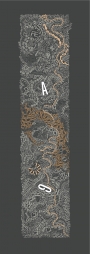 Audiatur Print (Norway) has just released a new print of my work, as designed Judith Naerland. More information can be found here (in Norwegian)

 Lori Emerson has just interviewed me on her blog about concrete poetry, technology and obsolescence…
 The Calgary Herald takes an interest in my work in a piece entitled “alt.poet: Derek Beaulieu thinks outside the linguistic box“
No Press is proud to announce the publication of
COPYS
By Craig Dworkin
‘My idea for these poems is that they be like cigarettes. On the one hand, briefly intense and repaying as much focused contemplation as you want to give them — each is in fact composed according to a rigorous and elided formal logic — but then also, at the very same time, merely discardable amusements: quickly read and easily forgotten, thrown away without a second thought as soon as they are finished.’ — Craig Dworkin
Originally published in the UK by Matchbox in May 2007, No press is proud to return this rarely-seen edition to print.
Published in a limited edition of 50 copies (25 of which are for sale) each copy consists of 34 loose cards in a hand-typed envelope.
Copies are available for $8.00 each (including postage).
To order, please contact derek beaulieu
This past spring, a.rawlings spent time in Toronto’s Malvern Collegiate Institute and facilitated over thirty interviews between high-school students and Canadian poets. The Great Canadian Writer’s Craft: High-school students interview Canadian poets is now available online and features interviews with poets from across Canada (including myself).
Four videos of my performance May 29, 2011 in Calgary’s Riley Park as part of the filling Station / Pooka Press Pub Crawl (as recorded by Helen Hajnoczky):
 Ara Shirinyan’s Your Country is Great: Afghanistan – Guyana (Futurepoem books, 130 pp., $15.00) is a poetic engagement with travel writing and geopolitics, where every country from Afghanistan to Guyana (I assume there will be a second volume for the remaining countries) is defined solely through the flattened language of the internet.
Your Country is Great mines online citations of each country’s qualities and gathers them into mind-numbing scripts of unceasing inanities, “instead of accepting current notions of language as a medium of differentiation” Shirinyan “demonstrates its leveling quality, demolishing meaning into a puddle of platitudes.”
Your Country is Great is composed of 81 different poems, one per country, each of which is written solely through internet searches on “[country name] is great.” The results—with all the typographic and syntactic errors intact—are then simply arranged. Shirinyan’s only concession to the ‘poetic’ is enforcing line breaks.
Shirinyan empties the word “great” of all context and force, flattens it to the level of punctuation – suddenly every place on earth is “great”: “I don’t need no dude to say / that Barbados is great / for me to know that”, “”Belarus is great and amazing”, “”Brazil is great; amazing food, intelligent people”, “Canada is great!”, “Ecuador is great!: / ‘don’t be afraid.’” The platitudes are unceasing, but this communal writing also undermines itself.
The barrage of ‘greatness’ empties as the internet’s choir of voices offers such caveats to praise as “’living’ in Belgium is great, / although the deathmetal scene is / not that big over there” and “the need to reduce fat intake in Belgium / is great / and a thorough approach / is desirable.” The rhetoric of travel narratives, and even postcards home from wandering tourists (the mindless prattle of “Having a great time, wish you were here!”), are flattened into a sameness where every destination no matter how mundane is “great” simply because “The people are great, / a lot like us.”
Shirinyan’s Your Country is Great: Afghanistan – Guyana poeticizes the mundane, and makes the language of hyperbole tangible by emptying out its strength. This book is great.
 derek beaulieu's blog