 Seen of the Crime: essays on conceptual writing [PDF] is now online through ubuweb (and thank you so much to Snare Books for the original edition):
No press is proud to announce the publication of Last Words from ‘Sentences My Father Used’ by Charles Bernstein.
Produced in a limited edition of 80 handbound copies, Last Words from ‘Sentences My Father Used’ is produced on 4 gate-folded long, narrow pages.
“Last Words from ‘Sentences My Father Used’ takes the final word in each of the 179 lines of “Sentences My Father Used” from Controlling Interests (New York: Roof Books, 1980, reprinted 2004). It is published here for the first time and will be collected in Recalculating (Chicago: University of Chicago Press, 2013).” — Charles Bernstein.
Last Words from ‘Sentences My Father Used’ is available for $5. Please email derek@housepress.ca to order.


 The publication of bill bissett’s Rush: what fuckan theory; a study uv language in 1972 firmly ushered Canadian poetics into the postmodern era. Out of print for 40 years – and reissued here complete with an interview with bissett about the book’s creation and a critical afterword by derek beaulieu and Gregory Betts – Rush embodies a collagist, multi-conscious approach to art that recognizes no division between the work and the world, the author and his sexuality, his breath, his influences; the theory and the practice. Arguing that “a new line has started,” Rush captures the urgency of a new model of production that resists the closure and mastery of any one mind. It is an elegant rejection of aesthetic ego and all presumptions of authority. Rush: what fuckan theory; a study uv language is a vital, vocal protest against business as usual and the exploitation of the individual from one of Canada’s most important avant-garde poets.

Local Colour : Ghosts, variations
(Malmö: In Edit Mode Press, 2012)
ISBN: 978-91-977853-4-1
First edition: 200 copies
Release date: December 17, 2012
Retail price: €65
Pre-order your copy now at a discount : €50.
 LOCAL COLOUR : Ghosts, variations is a collaboration between In Edit Mode Press and Canadian poet Derek Beaulieu. The publication takes as its point of departure, Paul Auster’s novella Ghosts, and, in particular, Derek Beaulieu’s reworking of Auster’s text, Local Colour, which he describes as follows:
‘Local Colour’ is a page-by-page interpretation of Paul Auster’s 72-page novella ‘Ghosts’. ‘Ghosts’ concerns itself with Blue, a private detective hired by a mysterious character named White to transcribe the actions of Black, a denizen of Brooklyn Heights living on Orange Street. As Blue reports his findings, the reader becomes more aware of the intricate relationship between Black and White, and a tactile awareness of the role of colour spreads through the narrative. With ‘Local Colour’, I have removed the entirety of Auster’s text, leaving only chromatic words—proper nouns or not—spread across the page as dollops of paint on a palette. Taking inspiration from Kenneth Goldsmith’s Gertrude Stein on Punctuation (Abaton Books, 2000) what remains is the written equivalent of ambient music—words which are meant to be seen but not read. The colours, through repetition, build a suspense and crescendo which is loosened from traditional narrative into a more pointillist construction.
Focusing on the tension created in Beaulieu’s manuscript – and alluded to in the description of his process – between the textual narrative and the relatively abstract graphical mark, and the opening it seems to provide towards a sonic realm, we are now hoping to solicit a series of textual, aural, oral, musical, and other interpretations, as well as more machinic ‘utilisations’, of Beaulieu’s manuscript. What interests us, in particular, is the way in which Local Colour seems to split Auster’s narrative text open, deterritorialising it, serially, by rendering it purely graphical, freeing it up, in the same gesture, to an excess and a bifurcation of meaning. Seeking to extend and amplify this ambition, we are now opening the project up for others – writers, poets, musicians, artists – to split Beualieu’s manuscript open, to deterritorialise the coloured rectangles of his manuscript by textual, aural, narrative, graphical and other means.
Local Colour: Ghosts, variations collects and counterposes a wide array of strategies and approaches. It features both textual and aural contributions and contributions that combine text and sound. We hope it will prove an ambitious, vigorous collection that oscillates and moves between textual narrative, graphical mark, and aural impression, exploring these different realms whilst rendering uncertain any easy distinction between them.
CONTENTS (IN PRINT) :
Derek Beaulieu, Local Colour (printed book)
Steve Giasson, Couleur Locale (printed book)
Cia Rinne, Securiousity (printed booklet)
Peder Alexis Olsson, Title TBA (print)
Jörgen Gassilewski, After Image (print)
Craig Dworkin, Unseen Colour (print)
Elisabeth Tonnard, Monochromatic Bits (print)
Martin Glaz Serup, Title TBA (printed book)
Eric Zboya, Untitled # 1 & 2 (Local Colour) (prints)
Ola Ståhl, Colour’s Gravity (printed book and prints)
Magda Tyzlik-Carver & Andy Prior, Ghost Machine (printed booklet)
CONTENTS (ON CD) :
Pär Thörn, Sound Interpretation of Derek Beaulieu’s ‘Local Colour’(sound piece)
Cecilie Bjørgås Jordheim, First of all there is Blue, Brown and I got ham, White and Blue (this section includes education) (sound pieces)
Ola Lindefelt, Title TBA (sound piece)
Andreas Kurtsson, Voice Range, Dialect Genre (sound piece)
Helen White, Local Ghosts (sound piece)
Ola Ståhl, Colour’s Gravity (recorded speech)
Gary Barwin, Local Colour (sound piece)
Ola Ståhl & Carl Lindh, Music Box (sound piece)
Magda Tyzlik-Carver & Andy Prior, Ghost Machine (software and videos)
 October 12, 2012–February 3, 2013
Postscript: Writing After Conceptual Art features the work of over fifty artists and writers exploring the artistic possibilities of language. Presenting works from the 1960s to the present, the exhibition includes paintings, sculpture, installation, video and works on paper that raise questions about how we read, look at, hear, and process language today. A major current underlying the exhibition argues that the field of literature known as “conceptual writing” can be seen as engaging in a provocative dialogue with the field of contemporary art, producing new insights into the meaning of both literature and art. Co-curated by Nora Burnett Abrams and Andrea Andersson, Postscript is the first exhibition to examine the work of conceptual writing, investigating the roots of the movement in the art of the 1960s and 70s and presenting contemporary examples of text-based art practices.
Artists and writers featured in the exhibition include: Mark Amerika & Chad Mossholder, Carl Andre, Fiona Banner, Erica Baum, Derek Beaulieu, Caroline Bergvall, Jen Bervin, Jimbo Blachly & Lytle Shaw, Christian Bök, Marcel Broodthaers, Pavel Buchler, Luis Camnitzer, Ricardo Cuevas, Tim Davis & Robert Fitterman, Monica de la Torre, Craig Dworkin, Tim Etchells, Ryan Gander, Michelle Gay, Kenneth Goldsmith, Dan Graham, Alexandra Grant, James Hoff, Seth Kim-Cohen, Sol LeWitt, Glenn Ligon, Tan Lin, Gareth Long, Michael Maranda, Helen Mirra, Jonathan Monk, Simon Morris, João Onofre, Michalis Pichler, Paolo Piscitelli, Vanessa Place, Kristina Lee Podesva, Seth Price, Kay Rosen, Joe Scanlan, Dexter Sinister, Frances Stark, Joel Swanson, Nick Thurston, Triple Canopy, Andy Warhol, Darren Wershler, and Eric Zboya.
 I am one of the keynote speakers at the PUBLIC POETICS conference this coming Sept 20-23 at Mount Allison University
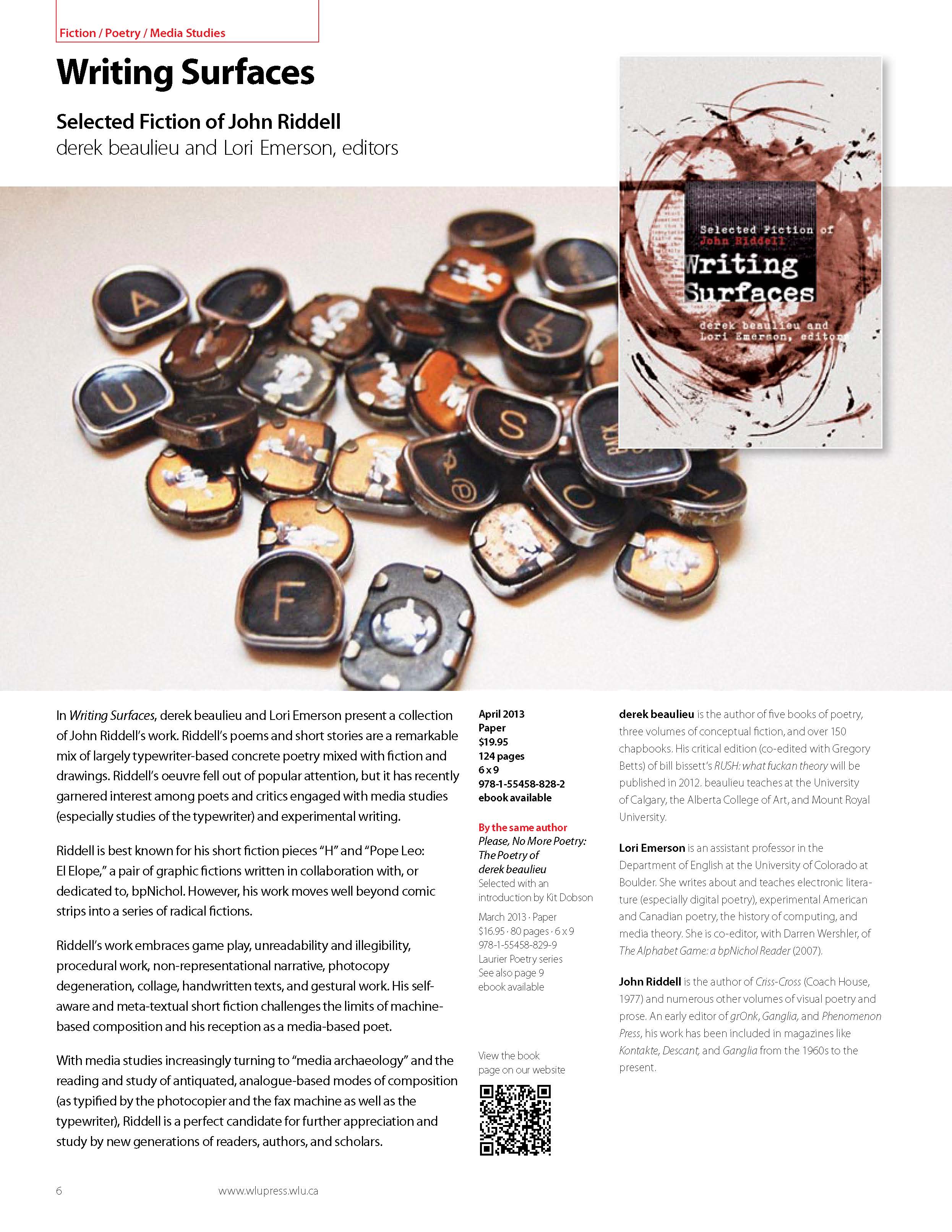 Lori Emerson and I are proud to be editing Writing Surfaces: The Fiction of John Riddell through Wilfrid Laurier University Press to be published April 2013. To pre-order a copy, please contact your local independent bookstore…
Introduction: Media Studies and Writing Surfaces
derek beaulieu and Lori Emerson
Writing Surfaces: The Fiction of John Riddell brings an overview of the work of John Riddell to a 21st-century audience, an audience who will see this volume as a radical, literary manifestation of media archaeology. This book is also, in the words of the promotional material of Riddell’s 1977 Criss-cross: a Text Book of Modern Composition, a “long-over-due debut by one of our most striking new fictioneers.”
Since 1963 John Riddell’s work has appeared in such foundational literary journals as grOnk, Rampike, Open Letter and Descant as part of an on-going dialogue with Canadian literary radicality. Riddell was an early contributing editor to bpNichol’s Ganglia, a micro-press dedicated to the development of community-level publishing and the distribution of experimental poetries. This relationship continued to evolve with his co-founding of Phenomenon Press and Kontakte magazine with Richard Truhlar (1976) and his involvement with Underwhich Editions (founded in 1978): a “fusion of high production standards and top-quality literary innovation” which focused on “presenting, in diverse and appealing physical formats, new works by contemporary creators, focusing on formal invention and encompassing the expanded frontiers of literary endeavour.”
Writing Surfaces: The Fiction of John Riddell reflects Riddell’s participation in these Toronto-based, Marshall McLuhan-influenced, experimental poetry communities from the 1960s until roughly the mid- to late-1980s. These communities, and the work of contemporaries bpNichol, Paul Dutton, jwcurry, Richard Truhlar and Steve McCaffery, give context to Riddell’s literary practice and his focus on ”pataphysics, philosophically-investigative prose and process-driven visual fiction. While many of his colleagues were more renowned for their poetic and sound-based investigations, Riddell clearly shared both Nichol’s fondness for the doubleness of the visual-verbal pun and Steve McCaffery’s technical virtuosity and philosophical sophistication. In his magazine publications, small press ephemera, and trade publications, Riddell created a conversation between these two sets of poetics and extended it to the realm of fiction (exploring a truly hybrid form that is poetry as much as it is fiction). Riddell’s work as fiction works to explore the development and accretion of narrative in time-based sequence, a fiction of visuality and media. Writing Surfaces is the documentation of Riddell pushing his own writing to the very limit of what conceivably counts as writing through writing.
While it’s true that the title “writing surfaces” carries with it the doubling and reversibility of noun and verb, reminding us how the page is as much a flat canvas for visual expression as it is a container for thought, the first title we proposed for this collection was “Media Studies.” The latter, while admittedly too academic-sounding to describe writing as visually and conceptually alive as Riddell’s, could still describe Riddell’s entire oeuvre; the term not only refers to the study of everyday media (such as television, radio, the digital computer and so on) but it can—in fact should—encompass the study of textual media and the ways in which writing engages with how it is shaped and defined by mediating technologies. In other words, Riddell’s work is a kind of textbook for the study of media through writing, or, the writing of writing.
The best-known example of Riddell’s writing of writing is “Pope Leo, El ELoPE: A Tragedy in Four Letters,” initially published in April 1969 with mimeograph illustrations by bpNichol through Nichol’s small but influential Canadian magazine grOnk. It was published again, with more refined, hand-drawn, illustrations, once again by Nichol, in the Governor General’s Award winning anthology Cosmic Chef: An Evening of Concrete (1970, the version included here) and in a further iteration in Criss-Cross: A Text Book of Modern Composition with illustrations by Filipino-Canadian comic book artist Franc Reyes (who would later pencil and ink Tarzan, House of Mystery and Weird War for dc comics and was involved with 1970s underground Canadian comix publisher Andromeda). “Pope Leo” relates a stripped-down comic-strip tale of the tragic murder of Pope Leo; the narrative unfolds partly by way of frames within frames, windows within windows, telling a minimalist story in which the comic-strip frame is nothing but a simple hand-drawn square with the remarkable power to bring a story into being. The anagrammatic text is an exploration of the language possibilities inherent in letters ‘p,’ ‘o,’ ‘l,’ and ‘e’ (hence the sub-title, “a tragedy in four letters”)—sometimes using one of the letters twice, sometimes dropping one, always rearranging, always moving back and forth along the spectrum of sense/nonsense: “O POPE LEO! PEOPLE POLL PEOPLE! PEOPLE POLE PEOPLE! LO PEOPLE.”
With a/z does it (1988), Riddell’s writing of writing focuses even more on the investigation of the possibilities of story that lie well beyond the form of the sentence, paragraph, the narrative arc. Rather than playing with the visual story structure of the frame and the verbal structure of the anagram as means by which to create a narrative, with pieces like “placid/special” Riddell first creates grid-like structures of text with the mono-spaced typewriter font and then uses a photocopier to document the movement of the text in waves across the glass bed. The resultant text is the visual equivalent of his earlier fine-tuned probing of the line between sense and nonsense in “Pope Leo.” These typewriter/photocopier pieces record both signal and noise as columns of text waver in and out of legibility. Semantically, these mirage-like texts focus on the words ‘placid’ (the lines of text reminding us of the symmetrical reversibility of ‘p’ and ‘d’ which begin and end the word), ‘love’ (with just the slightest suggestion of ‘velo’ at the beginning and end of each wave), ‘first,’ ‘i met,’ ‘special,’ ‘evening’ and ‘light’ (appearing as a hazy sunset moving down the page), and conclude with ‘relax’ and ‘enjoy.’ The paratactical juxtaposition of the two pages in “placid/special” creates the barest suggestion of a narrative about lovers enjoying an evening together while at the same time each page is in itself an even more minimalist story told through experiments with the manipulation of writing media.
Riddell’s writing of writing that is simultaneously sense and nonsense, verbal and visual, self-contained and serial—that demands to be read at the same time as it ought to be viewed—nearly reaches its zenith in later work such as E clips E (1989). In particular, “surveys” is writing only in the most technical sense with its Jackson Pollock-like paint drippings and scattered individual letters, all counter-balanced by neat, hand-drawn frames.
Just as Riddell’s compositions challenge how writers and readers form meaning, the original publications of many of the selections in Writing Surfaces, and Riddell’s larger oeuvre, were also physically constructed in a way that would demand reader participation. Riddell’s original publications include small press leaflets (Pope Leo, El ELoPE: A Tragedy in Four Letters), business card-sized broadsides (“spring”), chapbooks (A Hole in the Head and Traces) and pamphlets (How to Grow Your Own Light Bulbs). His work also extends into books as non-books: posters which double as dart boards (1987’s d’Art Board), novels arranged as packages of cigarettes (1996’s Smokes: a novel mystery) and decks of cards to be shuffled, played and processually read (1981’s War (Words at Roar), Vol.1: s/word/s games and others). Inside books with otherwise traditional appearances Riddell insists that his readers reject passive reception of writing in favour of a more active role. While outside of the purview of Writing Surfaces, 1996’s How to Grow Your Own Light Bulbs includes texts that must be excised and re-assembled (“Peace Puzzle”); burnt with a match (“Burnout!”); and written by the reader (“Nightmare Hotel”). Copies of the second edition of Riddell’s chapbook TRACES (1991) include a piece of mirrored foil to read the otherwise illegible text.
Riddell’s compositions do not just question the traditional role of the author; they attempt to annihate it. With “a shredded text” (1989) Riddell fed an original poem into a shredder, which then read the text and excreted (as writing) the waste material of that consumption. The act of machinistic consumption creates a new poem—the original was simply the material for the creation and documentation of the final piece. With “a shredded text” Riddell acts as editor to restrict the amount of waste that enters the manuscript of the book. The machine-author becomes a reader and writer of excess and non-meaning-based texts while the human-author becomes the voice of restraint and reason attempting to limit the presentation of continuous waste-production as writing. If, as Barthes argues, “to read […] is a labour of language. To read is to find meanings,” then the consumption and expulsion of texts by machines such as photocopiers and shredders produces meanings where meanings are not expected by fracturing the text at the level of creation and consumption—an act which is simultaneously both readerly and writerly.
Riddell’s oeuvre is almost entirely out of print and unavailable except on the rare book market. Working within the purview of 1970s and 1980s Canadian small presses means that Riddell’s writing proves elusive to a generation of readers who have come of literary age after the demise of such once-vital publishers such as Aya Press (which was renamed The Mercury Press in 1990 and has also ceased publishing), Underwhich Editions, Ganglia, grOnk and the original Coach House Press. As obscure as his original books may be, Riddell’s work remains a captivating example of hypothetical prose; dreamt narratives that have sprouted from our abandoned machines. With no words and no semantic content, we are left to read only the process of writing made product—a textbook of compositional method using writing media from the pen/pencil, the sheet of paper, the typewriter, the shredder, photocopier, to even the paintbrush. The medium is the message.
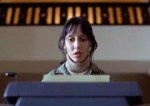
All Work and No Play Makes Jack a Dull Boy
“In Stanley Kubrick’s 1980 film adaptation of Stephen King’s The Shining, author Jack Torrance slowly loses his grip on sanity while ensconced in a winter-long residency as caretaker for the seasonally-closed Overlook Hotel. Over the season Jack, a struggling novelist, uses the solitude (interrupted only by his wife Wendy and son Danny) to attempt to construct his new novel. Only a few pages of Torrance’s efforts are revealed in The Shining, but every page consists wholly and entirely of the phrase “All work and no play makes Jack a dull boy” repeated ad infinitum over a presumably several-hundred-page manuscript. In the filmic reveal of Torrance’s creative masterpiece, Wendy emotionally collapses as she finally realizes the extent of her husband’s crumbling rationality. Under the mental anguish of this Sisyphean task of nonlinearity, Jack Torrance’s grip on reality is weakened, much as readers feel the strain of such a non-traditional manuscript.”
Rabble, an imprint of Insert Blanc Press, is co-edited by Holly Myers and Mathew Timmons. Rabble prints single author issues of critical essays of about 1500 words on a subject of the author’s choosing. The subject will be an artwork (or series of artworks), but broadly defined: could be visual art, literature, music, architecture, film, design; could be contemporary or historical. The essay will be printed in pamphlet form, with room for a couple full color images, and distributed at a reasonable price.
Rabble seeks to be a venue through which to interrogate the nature of criticism, a laboratory for prodding at the boundaries of criticism as a form. The idea is to begin with a framework that reduces criticism down to its two fundamental components—the thing that’s been made and the person who responds to the thing that’s been made (i.e., the art work and the critic)—and then to invite a lot of smart people to take up that framework as they see fit. We’re not looking for the average book or exhibition review, but something that tests out a new direction, whatever that means to the individual author.
We have great confidence in the potential of Rabble to make a lasting contribution to the cultural discourse on the West Coast and beyond. It is our hope that, in charting a path between the two prevailing poles of the genre—the ever-narrowing shutters of print journalism on the one hand and the ponderous obscurity of the academy on the other—Rabble will go some way in restoring the sheer excitement of criticism.
 derek beaulieu's blog