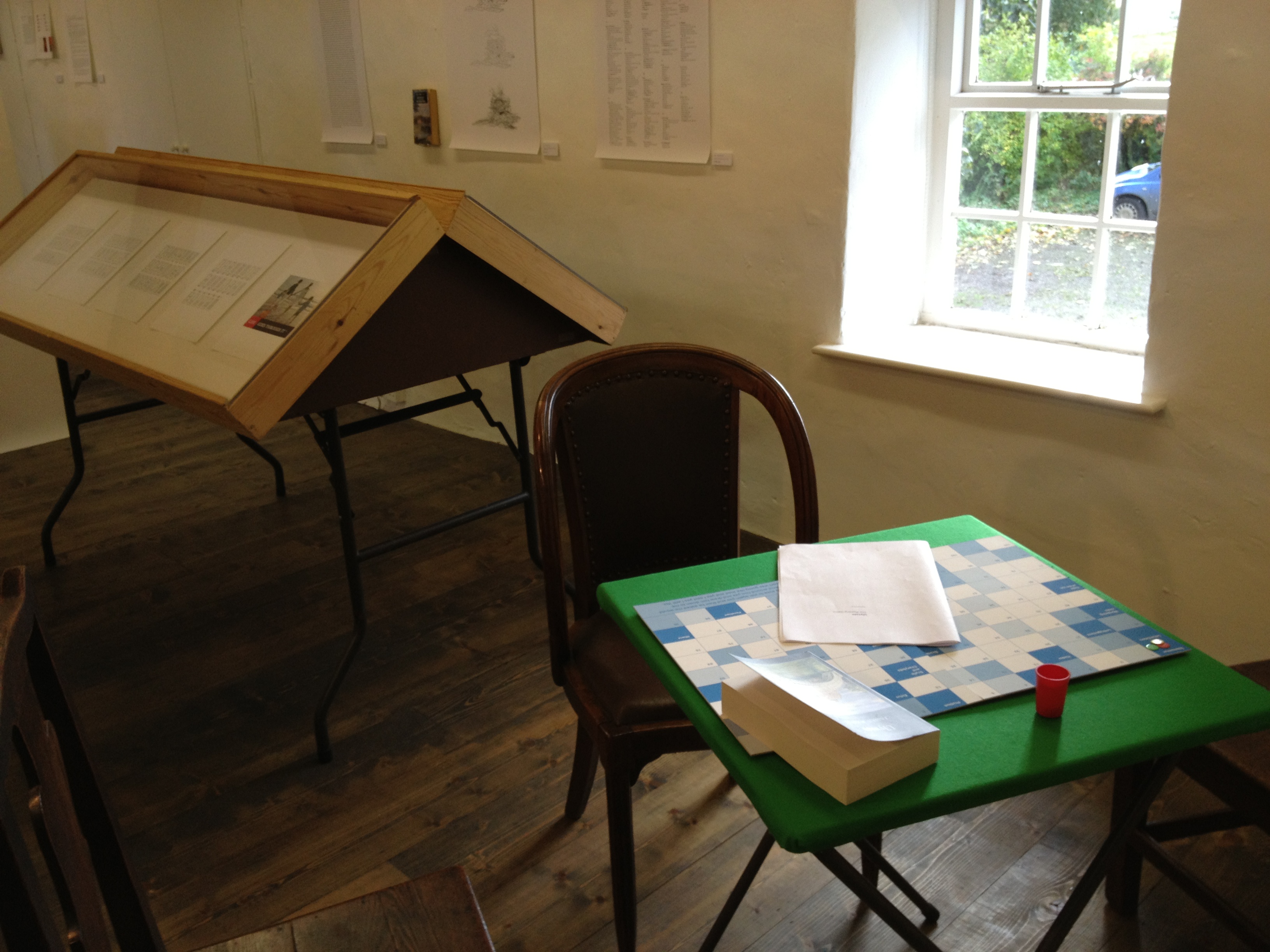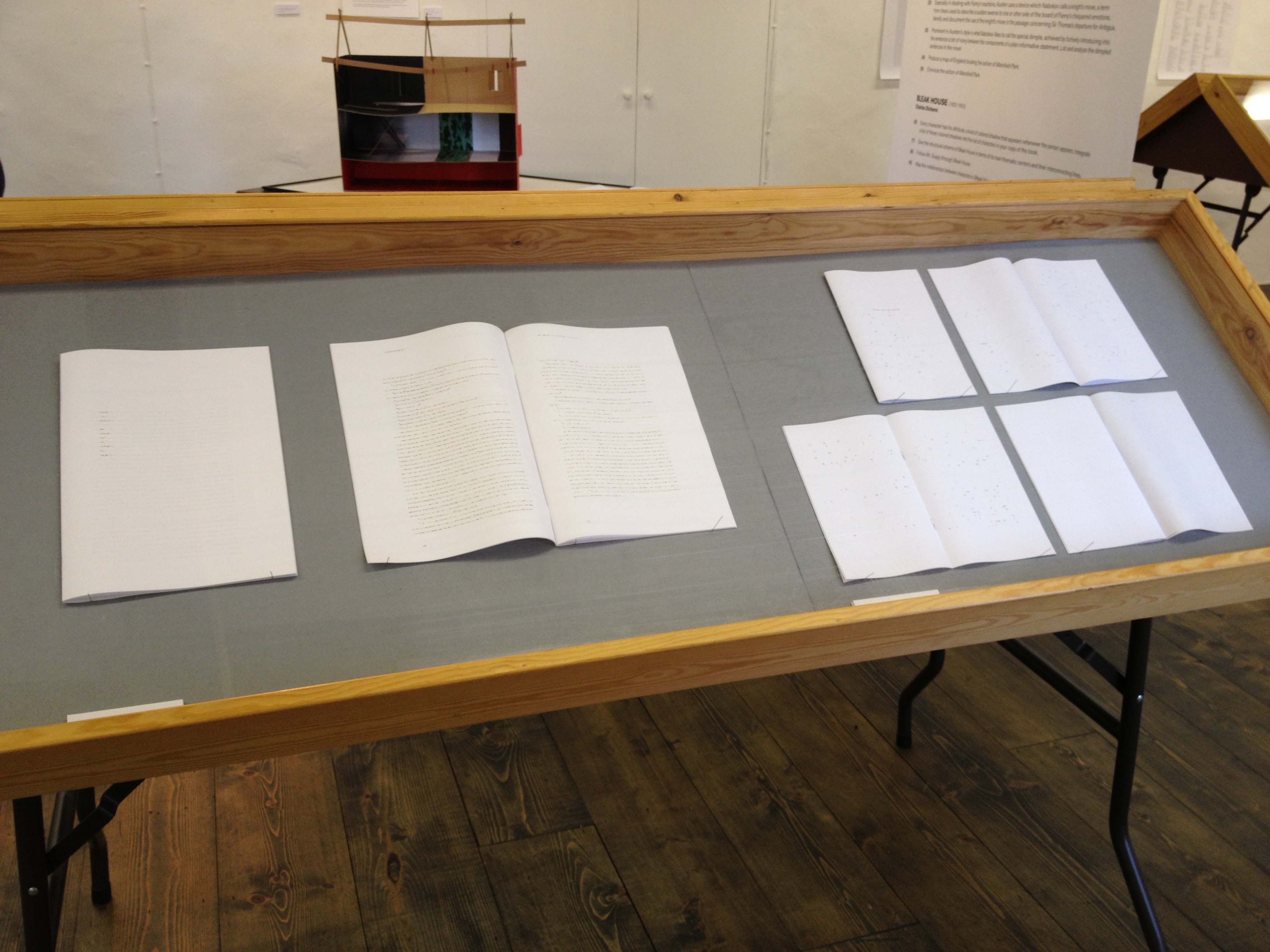
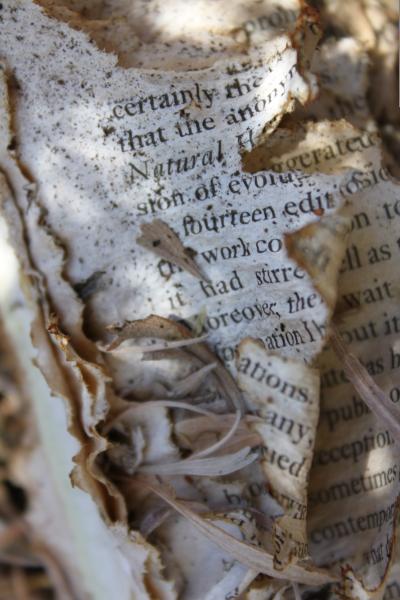
The exhibition The Nabokov Paper – An experiment in novel-reading (accompanied by the book of the same name, For more details contact – thenabokovpaper@gmail.com) opened on October 26th at Shandy Hall …

In April 2012, ten artists, eight writers, six university professors, three translators, two architects, a librarian, a curator, a graphic designer, an illustrator and a computer engineer each selected a question on one of seven course texts: Jane Austen’s Mansfield Park, Charles Dickens’s Bleak House, Gustave Flaubert’s Madame Bovary, Robert Louis Stevenson’s Dr Jekyll and Mr. Hyde, Franz Kafka’s “The Metamorphosis”, Marcel Proust’s Swann’s Way, and James Joyce’s Ulysses. The responses they turned in take the form of writing, drawing, painting, film, graphs, indexes, lists, maps, newly designed editions, objects, scale-models, a lecture and a reading game. This work, together with an introduction to the aims of the project, is presented in The Nabokov Paper – a publication that acts both as a record of the experiment and an invitation to undertake it again.

Contributors: Graham Allen, James Arnett, Abraham Asfaw, Anne Attali, Katarzyna Bazarnik, Derek Beaulieu, Paul Becker, Christian Bök, Shanna Bosley, Stephen Bury, Chloe Briggs, Kate Briggs, Maurice Carlin, Jennifer Carr, Guillaume Constantin, Jamie Crewe, Véronique Devoldère, Lucia della Paolera, Craig Dworkin, Zenon Fajfer, Helen Frank, Céline Guyot, John Hamilton, Sharon Kivland, Gianni Lavacchini, Anna-Louise Milne, Forbes Morlock, Simon Morris, Amy Pettifer, Lucrezia Russo, Olivia Sautreuil, Nick Thurston, Jane Topping, Madeleine Walton, Patrick Wildgust, Robert Williams and Jack Aylward-Williams, Sarah Wood, Gillian Wylde.

IMG_6173 IMG_6208 IMG_6210 IMG_6238 IMG_6246 IMG_6226


antonovskyNo Press is proud to announce the publication of a rare opportunity to gain insight in to the range of visual poetry produced in Ukraine. rarely seen in North America, these authors seek dialogue with contemporary international practice while responding to the tradition of visual poetry in Eastern Europe.

TWO FROM UKRAINE a collection of visual poems by Andrí Antonovsky and Volodymyr Bilyk

Each copy of TWO FROM UKRAINE includes:

Scobes by Volodymyr Bilyk (a 16-page visual poetry suite in a hand-stitched edition)

робота така робота by Andrí Antonovsky (a 16-page full-colour collection of Antonovsky’s visual poetry collages in a hand-stitched edition)

bilykComadots by Volodymyr Bilyk (a 4-page visual poetry suite pamphlet)

all of which are gathered in a rubber-stamped envelope and published in a strictly limited edition of 60 copies.

TWO FROM UKRAINE is now available for $12ea.

To order please email derek beaulieu

pattern-05No Press is proud to announce the publication of Braydon Beaulieu’s FLIGHT PATTERNS.

Produced in a limited edition of 60 hand-bound copies.

Through simple iconography, Flight Patterns maps Beaulieu’s reading patterns while reading Batwoman: Elegy — a visual poetry exploration of reading patterns and panel-ology wher action is suveyed by teh barest of lines and graphic gestures.

FLIGHT PATTERNS is now available for $4ea.

To order please email derek beaulieu

img276-lrgThe Nabokov Paper – An experiment in novel-reading

26th October 13 – 22nd November 13

Project by
Kate Briggs and Lucrezia Russo

Published by
information as material

With work by
Graham Allen, James Arnett, Abraham Asfaw, Anne Attali, Katarzyna Bazarnik, Derek Beaulieu, Paul Becker, Christian Bok, Shanna Bosley,
Stephen Bury, Chloe Briggs, Kate Briggs, Maurice Carlin, Jennifer Carr, Guillaume Constantin, Jamie Crewe, Veronique Devoldere,
Lucia della Paolera, Craig Dworkin, Zenon Fajfer, Celine Guyot, John Hamilton, Sharon Kivland, Gianni Lavacchini, Anna-Louise Milne,
Forbes Morlock, Simon Morris, Amy Pettifer, Lucrezia Russo, Olivia Sautreuil, Nick Thurston, Jane Topping, Madeleine Walton, Patrick Wildgust,
Robert Williams and Jack Aylward-Williams, Sarah Wood, Gillian Wylde.

Opening and book launch
Saturday, October 26, 2013 / 3pm

For more details contact – thenabokovpaper@gmail.com

how-to-writePearl Pirie’s review of How to Write has just been syndicated on The Canadian Women in the Literary Arts (CWiLA) Blog.

How To Write has immediate power as a kind of one-off joke, a reveal that hits the reader immediately upon engaging with the text; the surface of the book is so clever and punchy that it’s easy to take that for all that it is. But instead of leaving it there, Pirie digs as deeply as she is able, and comes up with great richness as a result. It’s an excellent celebration of the possibilities of literary criticism in long form.

vp_header11UbuWeb’s Visual Poetry section has just been updated with over 80 new texts including exceedingly rare editions of d.a.levy’s magazines The Buddhist Thirdclass Junkmail Oracle and The Marrahwanna Quarterly and Ed Sander’s Fuck You: A Magazine of the Arts. Complementing these magazines are PDFs of scarce editions by Canadian visual poets David UU, John Riddell and bpNichol; Americans Johanna Drucker and Rosmarie Waldrop and International practicioners such as Max Ernst, Marcel Broodthaers and Bob Cobbing. This update focuses on small press magazines and highlights rarely-seen radical work in collage, overprinting and machine-based visual poetry.

UbuWeb began as an online repository for concrete and visual poetry scanned from aging anthologies and re-imagined as back-lit transmissions from a potential future. As the archive has progressed, the concentration on visual poetry has waned in favour of an reconnoitering of diverse avant-gardes. UbuWeb’s Visual Poetry section exposes little-seen exemplars of historical praxis and models of contemporary insight to a wider audience. This section includes anthologies, ephemeral publications, criticism and sporadic journals dedicated to visual poetry. Due to the elusive and ephemeral nature of concrete and visual poetry publications, there is a perceived lack of innovation in the genre. Without exposure to radical practice, artistic precedent and innovative models, concrete poets too often fall back upon familiar tropes and unchallenging forms. UbuWeb’s Visual Poetry section is not presented under the rubric of historical coverage or indexical completeness, but rather as a document of isolate moments of what Haroldo de Campos argued was a “notion of literature not as craftsmanship but […] as an industrial prcoess” where the poem is a “prototype” rather than the “typical handiwork of artistic artistry.” — derek beaulieu

db_textportraitCalgary’s FFWD magazine has interviewed me about Please, No More Poetry and the changing face of poetics

beaulieu-emersonCounterpath is seeking performance, film, sound, writing, and
visual work that directly responds to or reads Writing Surfaces: The
Selected Fiction of John Riddell (2012, Wilfrid Laurier University
Press).
John Riddell’s work embraces game play, unreadability and
illegibility, procedural work, non-representational narrative,
photocopy degeneration, collage, handwritten texts, and gestural
work. His self-aware and meta-textual short fiction challenges the
limits of machine-based composition and his reception as a
media-based poet.
Riddell is best known for “H” and “Pope Leo, El ELoPE,” a pair of
graphic fictions written in collaboration with, or dedicated to,
bpNichol, but his work moves well beyond comic strips into a
series of radical fictions. In Writing Surfaces, derek beaulieu and
Lori Emerson present “Pope Leo, El ELoPE” and many other works
in a collection that showcases Riddell’s remarkable mix of largely
typewriter-based concrete poetry mixed with fiction and drawings.
Riddell’s oeuvre fell out of popular attention, but it has recently
garnered interest among poets and critics engaged in media studies
(especially studies of the typewriter) and experimental writing. As
media studies increasingly turns to “media archaeology” and the
reading and study of antiquated, analogue-based modes of
composition (typified by the photocopier and the fax machine as
well as the typewriter), Riddell is a perfect candidate for renewed
appreciation and study by new generations of readers, authors, and
scholars.
Counterpath will host an evening of approximately 5 performances of 10-15 minutes each on
December 14, 2013, at 7 p.m.

Please send a proposal of not more than 250 words to Counterpath
program coordinator Oren Silverman (os@counterpathpress.org) by October 31, 2013.

beaulieu_courtesyDerekBeaulieu_web The University of Calgary’s Gauntlet newspaper has interviewed me on “Advice for aspiring poets” in which i plead that emerging poets should “Make it fucked up, make it strange, make it digital, make it infected…”

jordheimCecile Bjørgås Jordheim has a new performance of her “First of All There is Blue” which was inspired by my novel Local Colour: Ghosts, variations:

Konsert–performance
Torsdag 19. september kl. 21.00
Kunstnernes Hus, Foajé
Gratis inngang

Cecile Bjørgås Jordheim, Stine Janvin Motland (vokal) og Jo Fougner Skaansar (kontrabass)

The project is based on the first paragraph in Paul Auster’s novella Ghosts. The composition consists of 3 short movements. The first movement is the original text straight from the book, the two following movements are versions of the paragraph that has been trough Google Translate so many times that the text is altered into strange sentences and meanings. The composition was done by isolating the letters C, D, E, F, G, A, B in the text and using them in a notational system to indicate pitch. The absence of the characters in between the chosen letters indicate the durations/note values.

More information, and a recording of a previous iteration of the performance, can be found here.

The project was initiated by Canadian poet Derek Beaulieu and In Edit Mode Press in Malmö, Sweden and is entitled Local Colour: Ghosts, variations. The collection takes as its point of departure Paul Auster’s novella Ghosts, and Beaulieu’s reworking of Auster’s text, Local Colour. It invites a number of writers, poets, musicians and artists to contribute with further reworkings, intermedial translations and editing projects exploring various intersections between Auster’s text and Beaulieu’s graphic interpretation. The resulting volume consists of four bound volumes, a series of pamphlets and prints, an audio-CD and a piece of computer software.