
PennSound has just created an author page for me, featuring my reading at the Kelly Writers House March 31, 2011.
Archives for posts with tag: visual poetry
 On April 27 and 28th I will be installing an original concrete poem in the windows of the Bury Art Gallery as part of the Text Festival. In addition to that installation, the festival includes my Prose of the Trans-Canada and my Box of Nothing.
The Festival also includes visual poetry from Satu Kaikkonen, Eric Zboya, Geof Huth and a tonne of other international poets; performances by Christian Bok, Ron Silliman, Karri Kokko, Jaap Blonk and more; installation work by Pavel Buchler, Simon Morris and many others. This is the 3rd bi-annual Festival and promises to be an incredible affair. If you find yourself in the UK (or environs), check it out!
 Geof Huth has just reviewed and riffed upon my Prose of the Trans-Canada. Check it out.
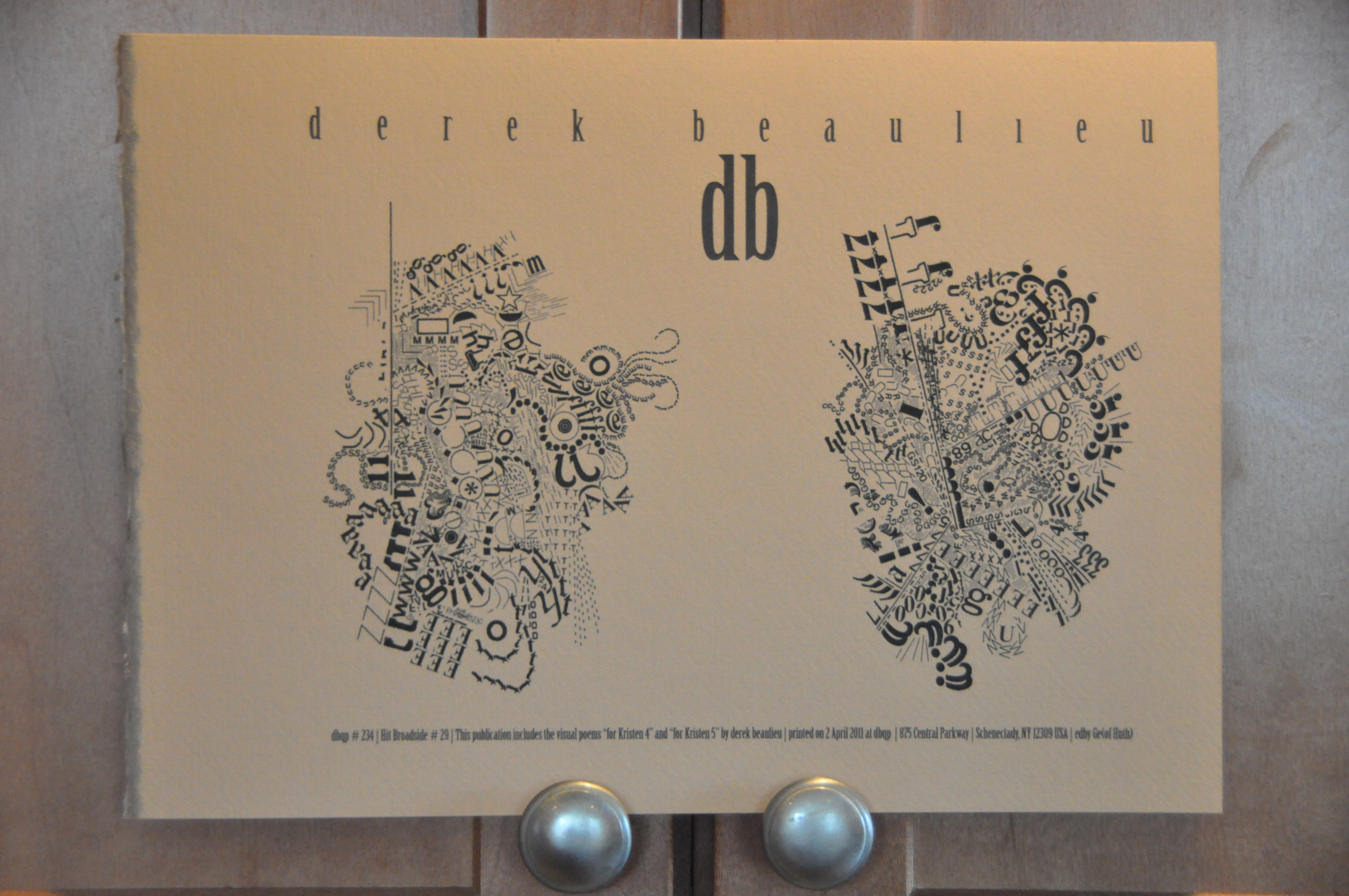 Geof Huth has just released a limited edition broadside of 2 of my visual poems. “db” (as titled by Huth) is available for US$2 postpaid, most of which cost will be mailing costs (he’s also open to trades). More information on the work, and how to order, can be found here.
 I’ll be reading at the University of Lethbridge this coming Friday:
April 8, 2011 1pm
W561 (Fine Arts Building)
as part of Dr. Jay Gamble’s “Experimental Poetry” Seminar.
The reading is free and open to the public.
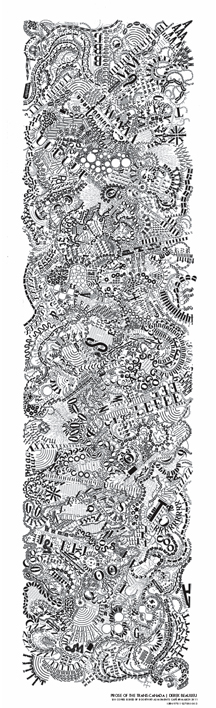 Jay Millar’s BOOKTHUG has just published my visual poem Prose of the Trans-Canada:
In 1913 Blaise Cendrars created his monumental Prose of the Trans-Siberian, a milestone in the history of artists books and visual poetry. When the intended edition of 150 copies was laid end-to-end they measured the same length as the height of the symbol of Parisian Modernity, the Eiffel Tower. Prose of the Trans-Canada responds to Cendrars’ legacy in a 16″ x 52″ visual poem. When all 150 copies of this limited edition are placed end-to-end, the resultant length is the same as the symbol of Calgarian Modernity, the Calgary Tower.
“A towering moment in beaulieu’s on-going exploration of letraset as a medium for concrete poetry, Prose of the Trans-Canada, issued as Moments Cafe No. 8, is published in a strictly limited edition of 150 copies printed on matte polypro film and available for order here.”
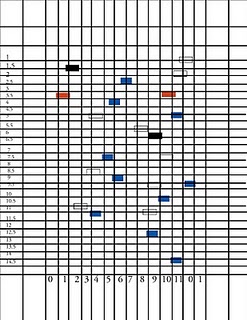 Gary Barwin delivered an excerpt from his score of Local Colour this weekend at St.Catharines’ Niagara Arts Centre — and explores the generation of the score and performance here.
 In a column for Sina Queyras’ Lemon Hound blog I discussed poets and novelists who used previously published texts as palimpsests for new writing. These books—as exemplified by Mary Ruefle’s A Little White Shadow, Jen Bervin’s Nets, Elizabeth Tonnard’s Let us go then, you and I and Janet Holmes’ The ms of m y kin—treat other writers’ texts as the raw material for their own work. Each of those books—and the key texts in this genre, Tom Phillip’s A Humument and Ronald Johnson’s Radi Os—look to “compose the holes” and create a new text from the already present. They suggest that embedded within any text is a myriad of latent texts.
Jonathan Safran Foer’s Tree of Codes (London: Visual Editions, 2010) is the latest entry in this sub-genre and has become an Internet sensation. Foer has executed the logical extension of these projects by literally excising unwanted from his source text leaving each page a lattice-work. The book is visually stunning—when I’ve shown my copy to friends it has elicited gasps of surprise (first by its incongruous lack of weight considering its page count, then by the pages themselves)—and the production values are exceptional.
The publisher, London’s Visual Editions, has released only one other title, a beautiful new edition of Laurence Sterne’s The Life and opinions of Tristram Shandy, Gentleman and has seemingly spared no expense in the preparation of Tree of Codes.
As radical as Tree of Codes may look on the surface, it belies a traditional sensibility which undermines the project as a whole. Foer has chosen as his source text Bruno Schultz’s short story collection Street of Crocodiles, his “favorite book.” This selection reflects not upon a latent text within Street of Crocodiles, nor upon a potential commentary upon Schultz’s biography or bibliography, but rather simply upon Foer’s own personal aesthetic. Tree of Codes is, then, Foer’s love letter to Schultz’s oeuvre. An excision text like Tree of Codes is based entirely on the quality of the writer’s choices: her ability to choose an initial text and style of writing / creation which is both uncanny and self-contained. In the best examples in this genre the resultant text is dictated by, and comments upon, the source text. There should be some awareness, some commentary, some self-reflection, on the process of moving the source text into the recombinant resultant text. Tree of Codes, sadly, is not an example of (as Craig Dworkin defines Conceptual writing) “a writing in which the idea cannot be separated from the writing itself: in which the instance of writing is inextricably intertwined with the idea of Writing: the material practice of écriture.” Foer has merely mined one straight-forward narrative for yet another straight-forward narrative.
The litmus test for writing is, as Craig Dworkin argues, “no longer whether it could have been done better (the question of the workshop), but whether it could conceivably have been done otherwise.” Tree of Codes has claimed this form of excision writing as squarely its own and prevents other writers from undertaking a project with similar execution; sadly it does so without engaging with the content as solidly as it has the form of the novel. The entirety of the first page of text in Tree of Codes reads “The passerby / had their eyes half-closed / . Everyone / wore his / mask . / children greeted each other with masks painted / on their faces; they smiled at each other’s / smiles” [8] and while the excisions and textual absences does create a sense of foreboding and melancholy, they do not meaningfully add to the story itself. Tree of Codes is not explicitly tied to its means of creation; there is no reason that the book was composed in this manner instead of a more traditional means of composition.
 derek beaulieu's blog