
 My Fall 2013 Alberta College of Art + Design ENGLISH 315 students spent a semester studying 21st-Century Canadian Poetry. As their final assignment, they responded to Jordan Scott and Stephen Collis’s book, Decomp, via sound art. Students were responsible for creating pieces of sound art that responded to Decomp‘s text, photography or concepts. Completed assignments were produced in limited edition CDs, cassettes, performances and musical objects, Many of those objects and performances are now compiled here, at the Coach House website.
Thank you so very much to the students and faculty at the Alberta College of Art + Design for this incredible recognition …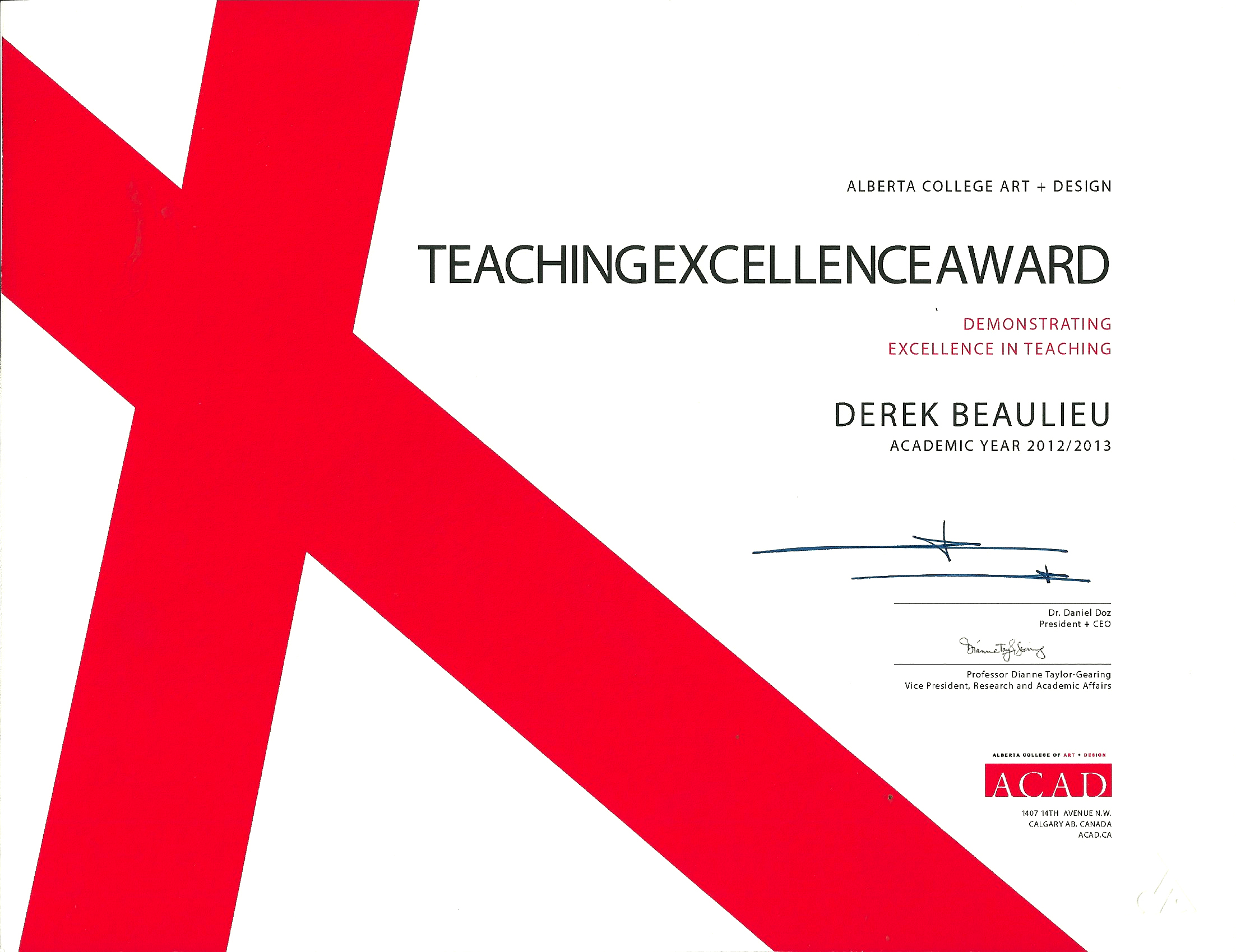
 Once again, December brings an opportunity to reflect upon the year’s books. Like previous years, this “most engaging books” list is idiosyncratic and by no means reflects “the best”, only what i found most engaging and most rewarding … this is a selection of what i considered the most fascinating / useful / generative books of the year. Seek out these volumes, every one will reward the search (and your local, independent, bookstore can help…). This is the cream of the crop for 2013:
Heimrad Bäcker. Seascape. Patrick Greaney, trans. (Brooklyn: Ugly Duckling Presse)
Jen Bervin and Marta Werner. The Gorgeous Nothings. (New York: New Directions).
Jaap Blonk klinkt. (Gent: het balanseer).
Craig Dworkin. No Medium. (Cambridge: MIT Press).
Kenneth Goldsmith. Seven American Deaths and Disasters. (Brooklyn: Powerhouse)
Jeet Heer. In Love with Art: Françoise Mouly’s Adventures in Comics with Art Spiegelman. (Toronto: Coach House).
bpNichol. A book of variations: love-zygal-art facts. Stephen Voyce, ed. (Toronto: Coach House).
Yoko Ono. Acorn. (New York: OR)
Rachel Simkover, ed. An Anthology of Concrete Poetry. (Berlin: Motto).
Nick Thurston. Of the Subcontract (York, UK / Toronto: information as material / Coach House)
Emmett Williams. Anthology of Concrete Poetry (New York: Primary Information)
Andrew Zawacki. Video Tape. (Denver: Counterpath)
Paul Zits. Massacre Street (Edmonton: University of Alberta Press)
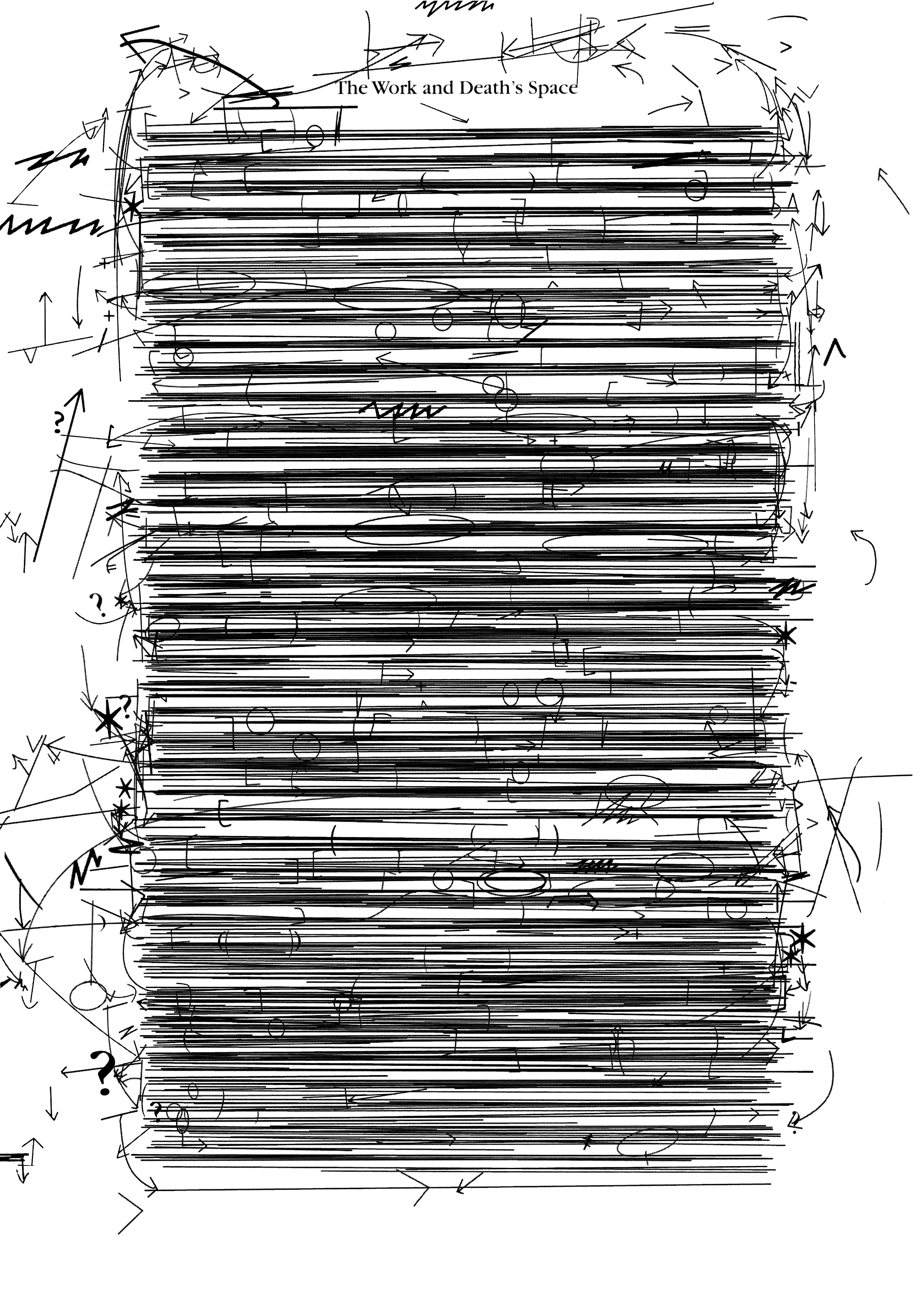 No Press is proud to announce the publication of Kristen Mueller’s “Partially Removing the Remove of Literature”
Produced in a limited edition of 50 hand-bound copies.
Partially Removing the Remove of Literature is a reading of Nick Thurston’s book Reading the Remove of Literature, which is itself a reading of Maurice Blanchot’s book L’Espace littéraire (The Space of Literature). In Thurston’s appropriation, he has assiduously erased every page of Blanchot’s seminal work, while preserving his own marginalia, through a processual transposition of hand-writing into formal typography. In Mueller’s reading of Thurston, she has partially erased every page of his book, leaving only Thurston’s (extra-textual(?)) markings—the underlinings and arrows, parentheses and exclamation marks—intact. By layering these remains, chapter for chapter, she presents portraits of Thurston’s reading of Blanchot, collapsed and condensed, proffering the gift of theft.
Kristen Mueller is the author of Language to Cover a Page (Motto Books, 2014). A longer version of Partially Removing the Remove of Literature will be published by her small press, & So, in 2014.
“Partially Removing the Remove of Literature” is now available for $5ea.
To order please email derek beaulieu
50 Heads (2007)
Written during 2006 in Venice, Cologne, Reykjavik, Tokyo, Edinburgh and Manchester, 50 Heads is a suite of 49 poems each of which can stand alone, but read together are a single larger work; recurring themes handed from one poem to the next compose images and ideas in the way a musical score resonates in a listener’s memory. The missing 50th Head is the writer or the reader.
 Uniquely, Tony Trehy has developed an international reputation as a poet and text artist alongside his work as an innovative curator. To date he has published 5 books of poetry in the UK and abroad, plus poetic essays and text-art theory. His work is also included in various published and online anthologies. His performance style is entertaining and friendly while his writing is rigorous and often challenging.
“One might say that, just as William Carlos Williams brought ‘American speech’ into the long tradition of ‘making’ poetry in English/American literary usage/language, so Tony Trehy has introduced the lingo/thinking (‘style’) of mathematics into the ‘poem-containing-history’ – well emboldened by passionate, personal knowledges of his own” — Robert Grenier
Originally published in 2007 by Manchester’s Apple Pie Editions, Tony Trehy’s 50 heads is now available as a PDF: trehy_50_heads_2006
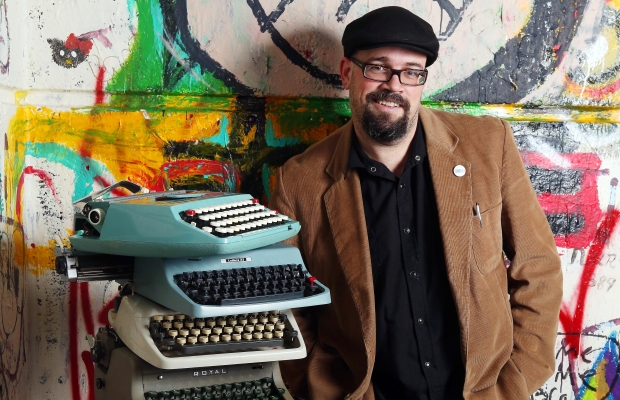
By Eric Volmers, Calgary Herald.
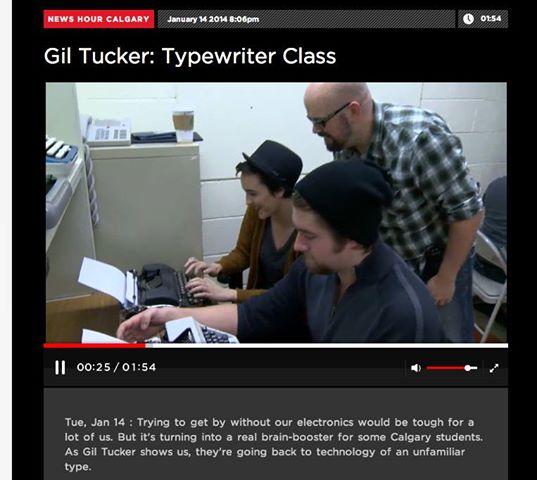
They will be on the CTrain. In coffee shops. In the class room. Just about anywhere you would see fledgling writers tapping silently away on laptops.
“We are going to have that sound back in the culture again,” says Beaulieu, in an interview at a typewriter-free coffee shop last week. “We are going to have that sound in the classroom. I’m going to tell them no laptops and no iPads in the classroom, only manual typewriters. All their notes are going to have be done that way, and yes they are going to have to hand them in. They are going to be doing poetry, they are going to be doing prose.”
While all this might sound avant-garde and far afield from what many would consider traditional instruction for creative writing, it fits with Beaulieu’s own impressive canon of work as a writer and the theories that guide it. He has earned acclaim locally and internationally for cheerfully breaking rules when it comes to poetry. Even in Calgary, a hot spot for the avant-garde, Beaulieu’s work is aggressively experimental. Earlier this year, Wilfrid Laurier University Press released Please, No More Poetry, which found Mount Royal English instructor Kit Dobson putting together an anthology of Beaulieu’s work, which stretches back to the 1990s and includes nine books and countless pieces in magazines and chapbooks.
The title poem was written as a “manifesto” for a Vancouver magazine a few years back. It was meant to be a less-than-subtle nudge to his fellow bards, encouraging them to think more about expanding poetry than adhering to its old rules.
Among the withering observations contained within are “In poetry we celebrate mediocrity and ignore radicality” and “all bad poetry springs from genuine feelings” and “having been unpopular in high school is not just cause for book publications.”
“I want our community of writers and of poets to push this art form forward,” says Beaulieu. “I don’t see poetry as where we go to be told comforting stories or to have the same old words told back to us. I would like poetry to be challenging itself, to be pushing itself and to be finding new ways of expressing and using language in a way that is akin to experimental astrophysics, where scientists don’t just create work for consumption, they also try to theorize what comes next.”
Which should give some context to Beaulieu’s own body of work. In “That’s Not Writing”, another piece in the collection, Beaulieu puts together 50 proclamations that he found through a Google search that start with the titular term. “That’s not writing, that’s plumbing” is one, which was apparently what Samuel Beckett said about William Burroughs. But most of the work isn’t so on the nose in presenting Beaulieu’s ideas. Please, No More Poetry contains a number of concrete or shape poems, where the visual aspects are just as, if not more, important than the words. In his 2011 book How to Write, Beaulieu “plagiarized” 10 short stories from various sources; basically treating words the way a DJ samples music. A few years ago, he created a representation of an issue of the Calgary Herald without using any text. He used different colours to represent the type of news that was being reported, recreating 124 pages of multi-coloured blocks for a piece that has been exhibited worldwide.
It all fits loosely into the category of conceptual art, something writer Russell Smith once cheekily described as “art that takes longer to read about than to witness.”
But it represents the sort of radical thinking that Beaulieu wants to pass on to his students with the typewriter. Of course, the problem with using an antiquated remnant from the past is that they tend to be antiquated. So far, Beaulieu has only secured seven manual typewriters. He reckons he needs 35. But he hopes more will be donated, with the idea that the collection can be used for future classes as well.
So what if, to play devil’s advocate, a young student has scant interest in expanding the boundaries of poetry and simply wants to learn how to write like Shakespeare or Robert Frost or E.E. Cummings or Kanye West?
Well, the nuts and bolts of writing are still part of the course, he says. But Beaulieu does not see a contradiction in encouraging young poets to be forward-looking in how they approach their art, while simultaneously forcing them to use an outdated machine to create it. In fact, it all makes strange sense, at least in a poetic, avant-garde kind of way.
“By using dead technology, but using these machines that are outside, we are in fact learning how we interface with the tools we have now,” Beaulieu says. “Students don’t look to their iPad and their cellphone as productive artistic spaces because they are too close. These are not paint brushes, these are the extensions of their hand. So if you get them a few steps back from their machine and give them another one that does the same stuff, it gives them enough artistic distance to be able to use them as a tool. Then, once they learn how to use them as a tool and how to be productive around these type of machines, hopefully what they end up doing is bring that forward. (They will) use that same kind of awareness of the poetic possibilities of these tools and apply them to cellphones, iPads, your PlayStation 3. Whatever.”
Thursday DEC 5 5:30-9:00: (RE)VERB, A multimedia event in response to Decomp by Stephen Collis and Jordan Scott. Featuring a reading and talk by Jordan Scott and performances and sound art pieces by students in ENGL315 (Room 595).
Friday DEC 6 7:30pm at PAGES BOOKS: Jordan Scott will be reading from his new book Decomp (co-written with Stephen Collis and published by Coach House Books) and Aaron Giovannone will be reading selections from his forthcoming book The Loneliness Machine (Insomniac Press)
and A REMINDER: I’m still hoping to gather 35 working portable manual typewriters for my January 2014 Creative Writing class at ACAD. Can you help

 No Press is proud to announce the publication of Kate Briggs’s “On reading as an alternation of flights and perchings.”
Produced in a limited edition of 50 hand-bound copies.
Kate Briggs teaches the translation workshop component of the Master’s in Cultural Translation at The American University of Paris. She also teaches creative writing at Paris College of Art and in 2013-14 will be guest tutor at Piet Zwart Institute, Rotterdam. She is co-editor of The Nabokov Paper (Information as Material, 2013)
“On reading as an alternation of flights and perchings.” is now available for $3ea.
To order please email derek beaulieu
 derek beaulieu's blog