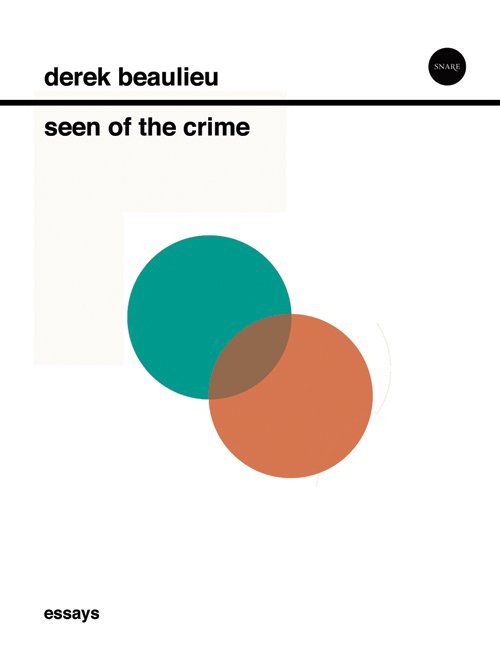
 Seen of the Crime, my first collection of essays and criticism has just been announced by Montreal’s Snare Books for Fall 2011. Snare is one of the best emerging presses in Canada and every title they make is worth the price of admission…
Archives for posts with tag: derek beaulieu
 The City of Calgary Announces Short List for W.O. Mitchell Book Prize
The City of Calgary, the Writers Guild of Alberta and Uptown 17 BRZ are pleased to announce the short list authors for The City of Calgary W.O. Mitchell Book Prize, one of 17 awards presented as part of The Calgary Awards.
The three finalists include Derek Beaulieu for How to Write(Talon Books), Weyman Chan for Hypoderm (Talon Books), and Clem Martini and Olivier Martini for Bitter Medicine (Freehand Books).
In How to Write,Derek Beaulieu writes an indexical, playful and innovative “how to” manual like no other. Derek is a Canadian poet, publisher and anthologist who studied contemporary Canadian poetics at the University of Calgary.
Hypoderm is Weyman Chan’s third collection of poems subtitled “notes to myself” which is a compilation of observations, intimations and recognitions of mortality. Weyman is a Calgary-born poet whose writings have appeared in many Alberta anthologies over the last two decades.
In Bitter Medicine, award-winning playwright Clem Martini chronicles his family’s 30-year struggle with schizophrenia that has plagued those closest to him – his brothers Ben and Olivier. The book is complemented by Olivier Martini’s childlike yet expressive drawings. Both Clem and Olivier reside in Calgary.
The City of Calgary established the W.O. Mitchell Book Prize in honour of the late Calgary writer W.O. Mitchell to recognize literary achievement by Calgary authors. The $5000 prize is awarded each year for an outstanding book published in the award year. The 2009 recipient was Gordon Pengilly for Metastasis and Other Plays.
The winner of The City of Calgary W.O. Mitchell Book Prize will be recognized at the Calgary Awards presentation on June 15, 2011. The Calgary Awards will be televised live on Shaw TV.
 On April 27 and 28th I will be installing an original concrete poem in the windows of the Bury Art Gallery as part of the Text Festival. In addition to that installation, the festival includes my Prose of the Trans-Canada and my Box of Nothing.
The Festival also includes visual poetry from Satu Kaikkonen, Eric Zboya, Geof Huth and a tonne of other international poets; performances by Christian Bok, Ron Silliman, Karri Kokko, Jaap Blonk and more; installation work by Pavel Buchler, Simon Morris and many others. This is the 3rd bi-annual Festival and promises to be an incredible affair. If you find yourself in the UK (or environs), check it out!
 Geof Huth has just reviewed and riffed upon my Prose of the Trans-Canada. Check it out.
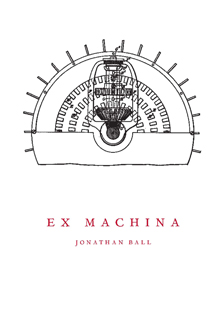 I recently used Jonathan Ball’s Ex Machina (Toronto: Bookthug, 2009) in a first year creative writing class.
Charged with teaching 22 young students how to write fiction, I shirked my task and concentrated on challenging the students to question their assumptions about how (or if) fiction “works.”
Weekly writing assignments requested that they model their work on poetic texts, Oulipan exercises and abstract comics. I asked them to transcribe every word on their street and all the words they said for an hour of typical conversation. They wrote using only questions, using only other people’s texts (excising and overwriting), starting every sentence with “I Remember…”; they sculpted their assignments, recorded their assignments—and some went so far as to build their work into self-creating video games.
They discussed and crafted responses to Melville, Gogol, Kafka, Moure, Slater, Calvino, Borges, Molotiu, rawlings, Blonk, Morris, Lethem and more. Their mid-term assignment was to reply in a piece of “fiction” (however they defined that) to Jonathan Ball’s Ex Machina.
Catalogued by the National Library of Canada as “poems,” Ball’s Ex Machina (which he considers a SF/horror novel) is a series of footnoted and intertwined aphorisms, quotations, statements and diagrams about the un-holy combination of book and machine, writer and reader, host and parasite.
With each page, the text becomes a labyrinth in which the reader’s breadcrumbs are devoured by mice as fast as they can be placed. Ex Machina is a predator with an elusive cat-and-mouse game in which it teases the reader into defining the terms of engagement, but “[i]n the garden of forking paths, you appear always to move forward.” (28) Ball’s text is purposefully evasive, preferring to challenge the reader on her need for clarity and purposefulness, for “If you are going to insist / on a poem, / I am going to persist / in this evasion.” (39)
Ball posits that the poetic text—or, in this case, a horror novel masquerading as a poetic text—is a textual symbiote which uses the reader to perpetuate its own survival:
The poem is not written by the author. [52] It is the root, the cause of authors. [57] Like a virus moving inside your skull. [43] To eat, and grow, and change. [61]. (51)
William Carlos Williams notably argued
There’s nothing sentimental about a machine, and: A poem is a small (or large) machine made out of words. […]Prose may carry a load of ill-defined matter like a ship. But poetry is a machine which drives it, pruned to a perfect economy. As in all machines, its movement is intrinsic, undulant, a physical more than a literary character. (“Introduction to The Wedge”, in Selected Essays of William Carlos Williams. New York: New Directions, 1969. 256.)
William S. Burroughs notoriously postulated “language is a virus from outer space” and that we are simply hosts for the spread of this linguistic extraterrestrial disease. Ball’s novel articulates the nature of the parasitic relationship between book, text and reader. While Phyllis Webb famously stated “[t]he proper response to a poem is another poem,” Ball makes the generative quality that Webb desired fraught with the sinister overtones of mutation, for the book machine seeks those “who process the poem, to great effect: host minds for newer and stronger strains” (57)
Ball has published Ex Machina under a Creative Commons License, and encourages readers to respond. He hopes that readers will allow the text to infect their own writing practices for “[t]he human being [is] a larval stage in the reproductive process of the book-machines.” (57)
Ex Machina used my “larval stage” undergraduate students to reproduce as video games, hollowed-out books, 15-minute sitcoms, Norwegian rock operas, illustrated shuffle-texts, scrapbooks made from ransom-note-like assembled texts, photo-essays, comic books and narrative-driven short stories.
With Ex Machina the meme speaks and it is hungry.
 “Clearly we are beginning to get nowhere.”
—John Cage
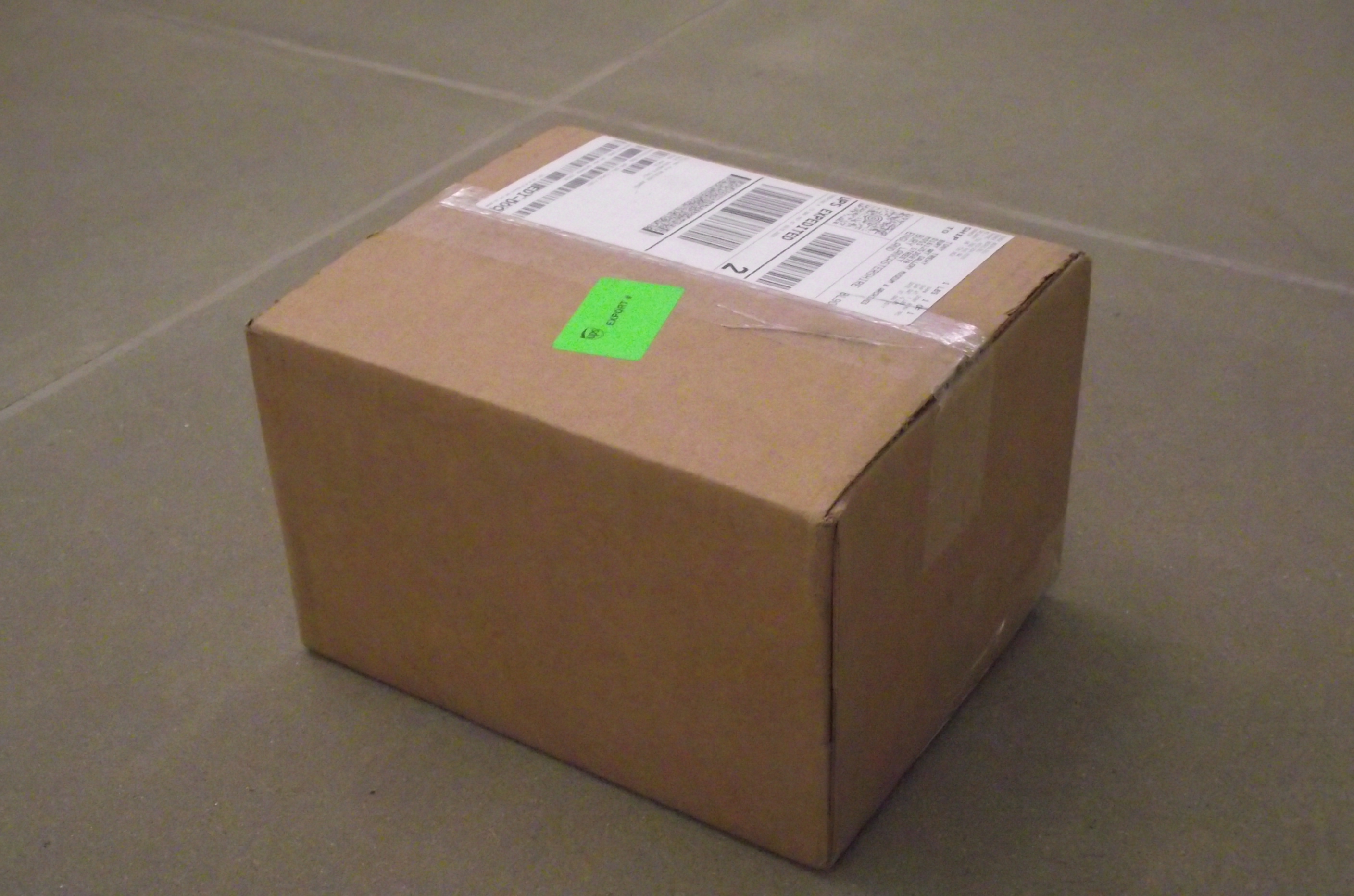
On April 7, 2011 I sent The Bury Museum and Archives an empty box.
I purchased the box for $3.95 (£2.50) and received skeptical looks from the UPS employees when I requested to send the box—devoid of any content—to Bury.
UPS also instructed me that they would not ship an “empty box” and that they needed the contents of the box to fit within one of their predetermined categories. We agreed to enclose within the box a single sheet of blank A4 paper. With this content—as unwritten as it was—UPS could now categorize the contents of the box as “documents” and could continue to process the application for transportation.
Their consternation was compounded with my request to insure the box and its contents to a value of £25,000; the same amount as the yearly wage of an arts worker in the UK (before the current government’s arts funding cutbacks).
UPS, not unexpectedly, refused to insure the parcel for more than $2,500 (£1,500). They would not guarantee the safety of a box of “nothing” and refused to insure the safety of “artwork” (even an empty box) as it was shipped to the UK. For insurance of the amount I requested would have to seek a rider for an independent insurance provider.
I was then asked to complete a Parcel Shipping Order form that included check-boxes which inquired “Are the contents of the parcel breakable?” (Yes) and “Are the contents of the Parcel replaceable?” (No)
 Upon my completion of the form, I was invoiced a shipping cost of $135.90 (£86.23) and the box was assigned a tracking number and a series of bar-codes and QR Codes to expedite the box of nothing as it cleared various processing centres and Canadian and British Customs.
These bar-codes and QR Codes are included in The Bury Museum and Archives’ exhibition The History of Tradestamps.
Tradestamps were the cotton industry’s hand printed labels used to indicate the contents of their shipping bundles in order to appeal to their (often illiterate) purchasers. The tradestamps “often depicted scenes, emblems, animals or figures” and the industry “employed hundreds of designers to create these trade marks as an early form of branding.”
The resultant bar-code is the symbol of nothing. In light of the current administration’s draconian cutbacks and their lack of willingness to insure the growth of social programs and the arts, to quote John Cage, “Nothing more than nothing may be said.”
Cork, Ireland’s The Enclave Review (ER) is a review sheet focusing on the visual arts but with additional texts relating to the greater sphere of contemporary art and thought. It has just archived its first 2 issues online, and has a PDF link to my article “It Quacks like a Duck: Conceptual Writing” here.
 Steven Zultanski’s Pad (Los Angeles: Make Now Press, 2010) hilariously foregrounds the propensity of masculinist experimental writing.
Zultanski builds on the work of Georges Perec (in An Attempt at Exhausting a Place in Paris in which he describes everything he observes from a café window over 3 days in October 1974), Tan Lin (in Bib in which he obsessively enumerates all of his reading materials and the length of time spent on each) and Daniel Spoerri (in An Anecdoted Topography of Chance in which he maps the histories of every item spread across his kitchen table).
Perec, Lin and Spoerri catalogue the random assemblages of the mundane, creating a level of significance simply through their application of choice. The resultant manuscripts are both socio-historical mappings of possessions, habits and behaviours and conceptual novels in which the authors abandon narrative intention in favour of compositional intention. The act of recording behavior and observation borders on the obsessive and yet frequently yields observations of strikingly tender quiet contemplative moments.
A frequent criticism of books of this style (and conceptualism as a whole) is that it is a male-dominated field, where author’s works are judged not by grace or subtlety but by muscular exertion and literary “heavy lifting.” Zultanski fully embraces the masculinist trope of conceptual “heavy lifting” and takes it to an absurd new extreme. In Pad Zultanski not only obsessively catalogues all of the items in his pad; he also lists the items according to whether or not he could life the items with his penis:
My dick cannot lift the small Holmes rotating fan sitting on the windowsill facing the bed. My dick cannot lift the windowsill. My dick cannot lift the bookcase filled with mostly unread books. My dick cannot lift the pile of mostly unread chapbooks sitting on top of the bookcase filled with mostly unread books. My dick can lift the cat postcard from Bob. My dick can lift the 2006 Turtle Point Press catalogue. My dick can lift the book A Little White Shadow by Mary Ruefle. (2-3)
Much as Kenneth Goldsmith’s colleagues pored over his Soliloquy in search of details on how they were discussed behind their backs, Pad includes an obsessively detailed list of all the books in Zultanski’s pad which he can lift with his dick. I imagine that Zultanski’s coterie will similarly search Pad in hope for evidence that their book was submitted to his phallic sorting. Zultaski’s reading list is catalogued by whether or not he could dislodge books from its shelf (and implicitly, from a canonical position) through the muscular force of his own phallocentrism. This canonicity uncannily echoes most libraries own retention criteria:
My dick can lift can lift the book The Maximus Poems by Charles Olson. My dick can lift the book Collected Poems by George Oppen. My dick can lift the book The Collected Poems of Wilfred Owen by Wilfred Owen. My dick can lift the book Notes for Echo Lake by Michael Palmer. (120)
Zultanski gives overt voice to the masculine in Pad by literally associating everything he owns, everything he touches, with his penis. In Pad, the phallic is not implicit it is explicit. Everything in his apartment is included in Zultaski’s tome, and thus he (and his cock) lay claim to everything in his purview. Zultanski surveys his empire and all within it; his schlong becomes the embodiment of the male gaze, and all that it can touch it can own and define. Zultanski’s girlfriend’s possessions are treated to the same disturbing taxonomy:
My dick can lift the girlfriend’s green Gap t-shirt from the plastic bag of clothes. My dick can lift the girlfriend’s navy blue Suzy jeans from the plastic bag of clothes. My dick can lift the girlfriend’s red belt from the plastic bag of clothes. (34)
Interestingly, while Zultanski categorizes all of his possessions according to his own penile acrobatics, he avoids grammatically claiming his girlfriend as ‘his’, preferring the definite article ‘the’ – and while the text opens with Steve’s dick lifting all of “the girlfriend’s” clothing from a “plastic bag of clothes”, by the end of the book he declares
My dick can lift the plastic bag stuffed with the ex-girlfriend’s clothes. My dick cannot lift, all at once, the entire pile of the ex-girlfriend’s clothes. My dick can lift, one at a time, each article of the ex-girlfriend’s clothing (164)
Which suggests that while there is a great deal that Zultanski’s dick could lift, it “cannot lift the doorknob on the front door […] the front door lock […] the eyehole” and ultimately “still cannot lift the door” (165). The litany of products and items that Zultanski’s dick struggles to lift closes with a castrated moment, where Zultaski and his dick are left alone and his “dick cannot lift the floor.”
Zultanski, with Pad, is a phallic King Midas: all that he touches turns to dick.
 George Murray has recently asked me to join the emerging team behind his project NewPoetry.ca. George describes the project:
“I’m sick of borders. I’m sick of silos. Bunkers, too. Don’t even get me started on garrisons. I’m sick of the various poetries and poets I read and admire fighting and carping about each other instead of collaborating constructively (however that is interpreted between artists) to generate new poetic possibilities. I’m sick of judgments and systems of criticism that involve aesthetic preference over intellectual accomplishment, that reward attendance and loyalty over risk and depth, that spend more time tromping on the art and experiments of others than perfecting their own. I’m sick of lack of space for difference, or at least for difference within the same pages.” — check it out!
 derek beaulieu's blog