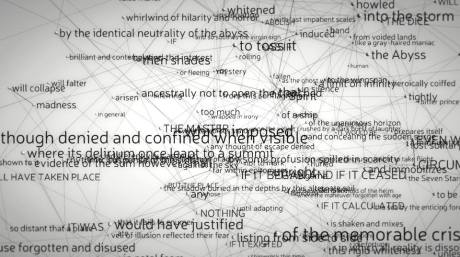
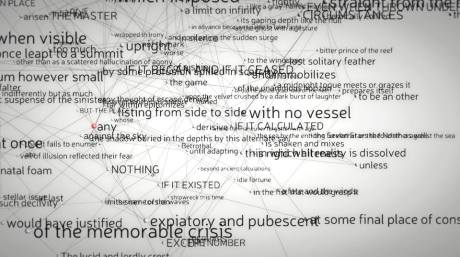
Photographs of my translation / resetting of Mallarme’s “Un Coup de Des” currently on exhibit at the 48th Poetry International Festival – Rotterdam (photos courtesy Amy Catanzano).
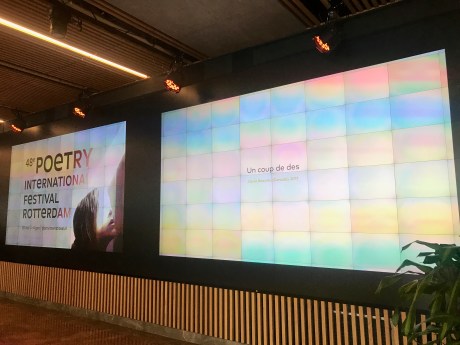
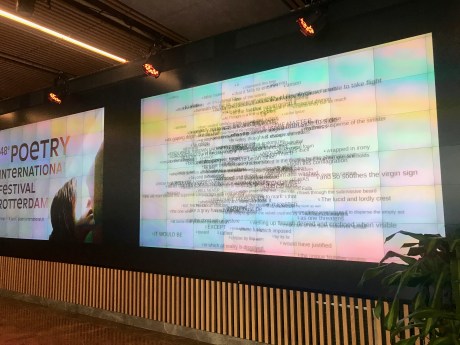
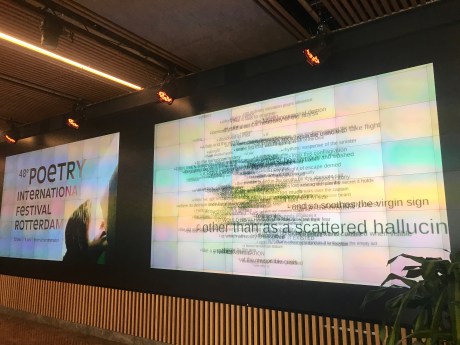

Photographs of my translation / resetting of Mallarme’s “Un Coup de Des” currently on exhibit at the 48th Poetry International Festival – Rotterdam (photos courtesy Amy Catanzano).
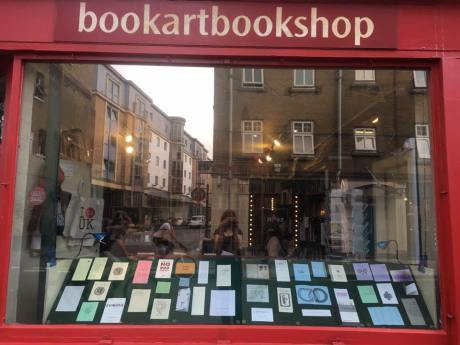 CONCRETE & CONSTRAINT, a new display at London’s bookartbookshop (31 May – 13 June) featuring new editions from no press, Blasted Tree, libros del pez espiral, Spacecraft Press, Penteract Press, Jean Boîte Editions, above/ground and edition taberna kritika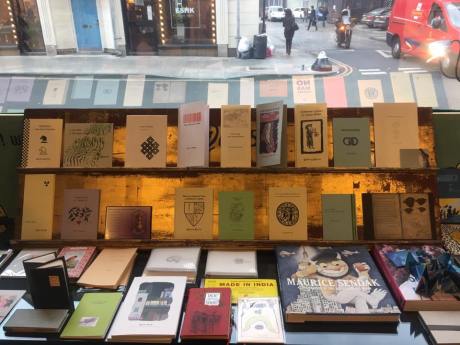
 , Coach House Books and information as material
 … thank you to Tanya Peixoto for curating this exhibit!
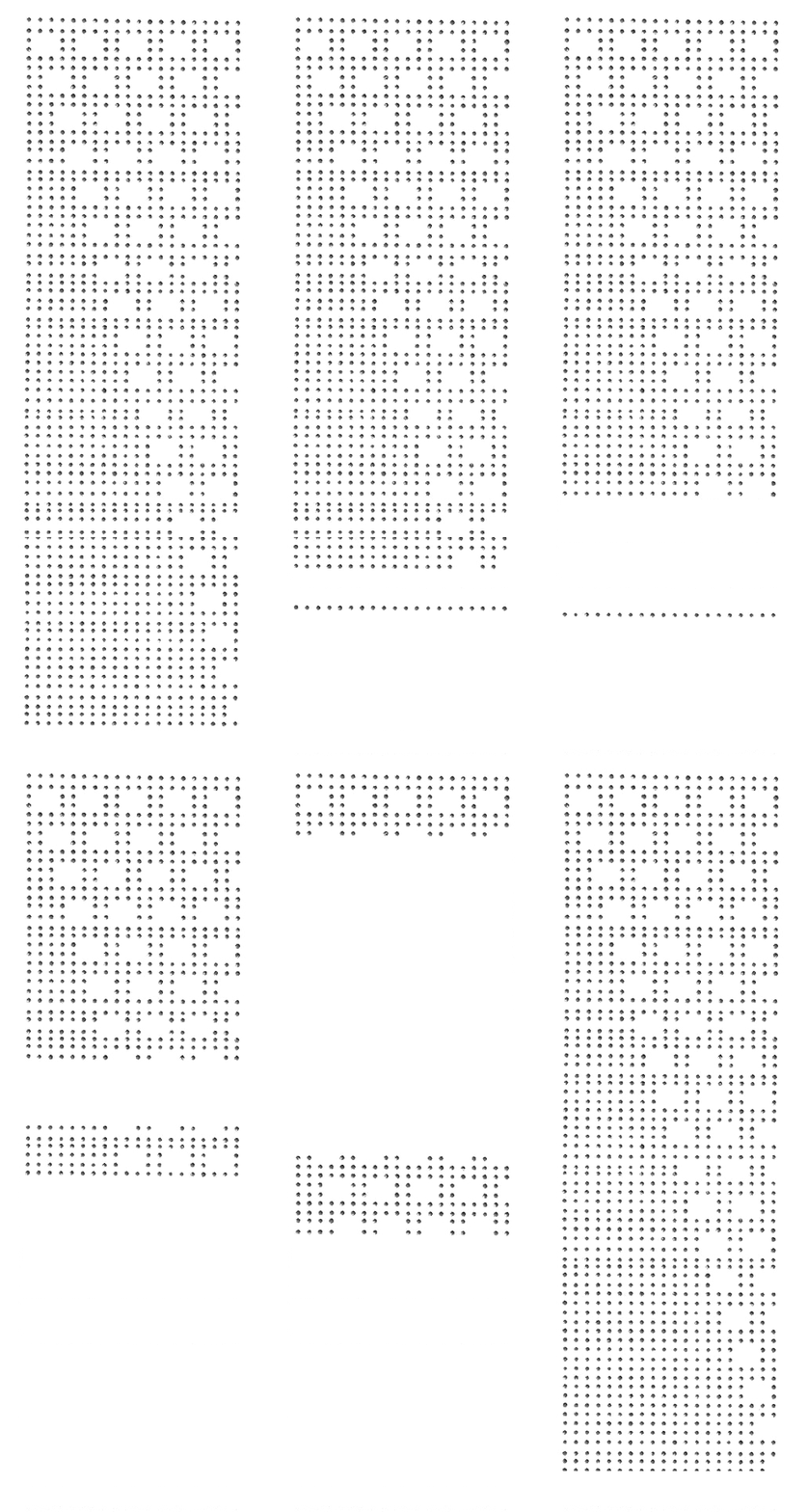 “Tin Soldiers” — one of my typewriter concrete poems, animated by Arn McBay
download Michiel Koelink, Jon Ståle Ritland and David Jonas’s 3DPoetryEditor & write in virtual space.
Mallarme’s “Un Coup de Des” (here in English translation by Robert Bononno and Jeff Clarke from the 2015 Wave books edition) is a foundational text for the exploration of page design, typography & type size and the tension of varied directions in reading. Using 3DPoetryEditor , I have tossed Mallarme’s poem in to the tempest of stormy digital waves, the lines of the poem left to eddy and crash against each other, creating a whirling tension of recombinant text.
Watch my translation of Un coup de Des … [youtube 15:10-16:12) 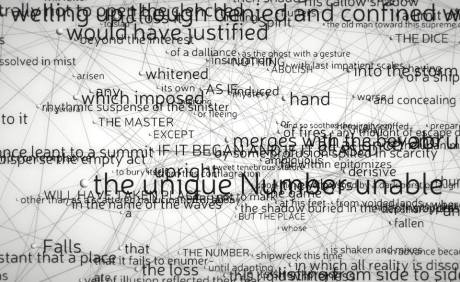

CBC Radio Calgary includes my entreaties to students in “so what’s your spiel?“
 NEW FROM NO PRESS:
twelve aphorisms.
12 leaflets by Charles Bernstein, Christian Bök, Teresa Carmody, Craig Dworkin, Daniel Levin Becker, Nick Montfort, George Murray, Vanessa Place, Danny Snelson, Moez Surani, Hugo Vernier (as selected by derek beaulieu), Ludwig Wittgenstein (as selected by Marjorie Perloff).
Limited edition of 40 copies, distributed exclusively at Miss Read 2017, Berlin, Germany.
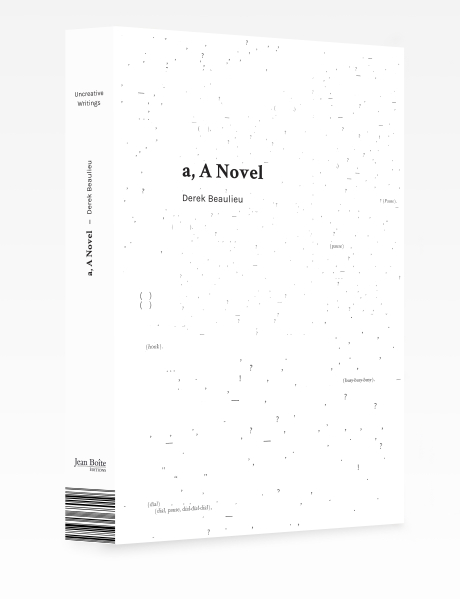
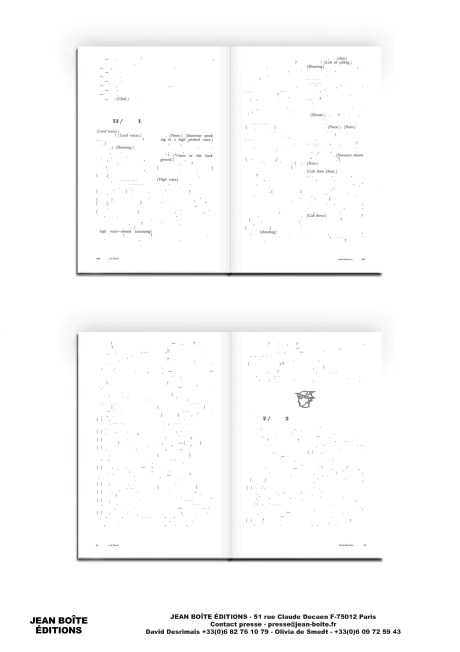
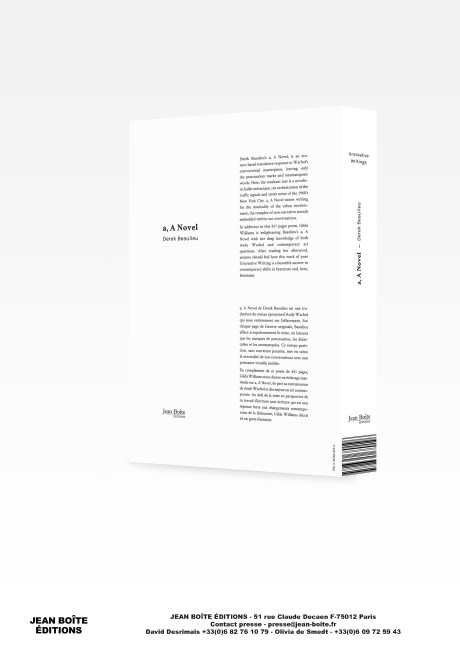
Derek Beaulieu’s a, A Novel is an erasure-based translative response to Andy Warhol’s eponymous novel. Beaulieu carefully erases all of the text on each page of the original work, leaving only the punctuation marks, typists’ insertions and onomatopoeic words. The resultant text is a novelistic ballet mécanique, a visual orchestration of the traffic signals and street noise of 1960’s New York City. This
visually powerful half score/half novel highlights the musicality of non-narrative sounds embedded within conversation.
Published in the autumn of 1968, Andy Warhol’s a, A Novel consists solely of the transcribed conversations of Factory denizen Ondine (Robert Olivo). Ondine’s amphetamine-addled conversations were captured on audiotape as he haunted the Factory, hailed cabs to late-night parties and traded gossip with Warhol and his coterie. The tapes were transcribed by a small group of high school students. Rife with typographic errors, censored sections, and a chorus of voices, the 451 pages of transcription became, unedited, “a new kind of pop artefact”. These pages emphasize transcription over narration, chance over composition.
In his book, Derek Beaulieu offers a radical displacement of Andy Warhol’s work. He erases the novel’s speaking characters — members of the mid-1960s New York avant-garde — and preserves only the musicality of their conversations. Beaulieu perfectly provides a tangible example of Theodor Adorno’s theory elaborated in his essay “Punctuation Marks” (1956), in which he argues that punctuation marks are the “traffic signals” of literature and that there is “no element in which language resembles music more than in the punctuation marks”. This visual poetry is accompanied by an essay by Gilda Williams, “Breaking Up is Hard to Do. Men, Women, and Punctuation in Warhol’s Novel a”. Her deep knowledge of both Andy Warhol’s work and the history of contemporary art explores the complicated history of the original novel and highlights the urgent and precise spirit of Derek Beaulieu’s work—the work of an artist who situates Uncreative Writing at the core of contemporary literature and also shows in his book a feminist gesture.



 derek beaulieu's blog