
I am thrilled to announce that I am the guest blogger for Denver’s Museum of Contemporary Art in conjunction with their exhibition Postscript: Writing after Conceptual Art. My first post, on Fiona Banner’s 1066, is now live…
Archives for category: Uncategorized
 I am one of the keynote speakers at the PUBLIC POETICS conference this coming Sept 20-23 at Mount Allison University


LOCAL COLOUR : Ghosts, variations is a collaboration between In Edit Mode Press and Canadian poet Derek Beaulieu. The publication takes as its point of departure, Paul Auster’s novella Ghosts, and, in particular, Derek Beaulieu’s reworking of Auster’s text, Local Colour, which he describes as follows:
‘Local Colour’ is a page-by-page interpretation of Paul Auster’s 72-page novella ‘Ghosts’. ‘Ghosts’ concerns itself with Blue, a private detective hired by a mysterious character named White to transcribe the actions of Black, a denizen of Brooklyn Heights living on Orange Street. As Blue reports his findings, the reader becomes more aware of the intricate relationship between Black and White, and a tactile awareness of the role of colour spreads through the narrative. With ‘Local Colour’, I have removed the entirety of Auster’s text, leaving only chromatic words—proper nouns or not—spread across the page as dollops of paint on a palette. Taking inspiration from Kenneth Goldsmith’s Gertrude Stein on Punctuation (Abaton Books, 2000) what remains is the written equivalent of ambient music—words which are meant to be seen but not read. The colours, through repetition, build a suspense and crescendo which is loosened from traditional narrative into a more pointillist construction.
Focusing on the tension created in Beaulieu’s manuscript – and alluded to in the description of his process – between the textual narrative and the relatively abstract graphical mark, and the opening it seems to provide towards a sonic realm, we are now hoping to solicit a series of textual, aural, oral, musical, and other interpretations, as well as more machinic ‘utilisations’, of Beaulieu’s manuscript. What interests us, in particular, is the way in which Local Colour seems to split Auster’s narrative text open, deterritorialising it, serially, by rendering it purely graphical, freeing it up, in the same gesture, to an excess and a bifurcation of meaning. Seeking to extend and amplify this ambition, we are now opening the project up for others – writers, poets, musicians, artists – to split Beualieu’s manuscript open, to deterritorialise the coloured rectangles of his manuscript by textual, aural, narrative, graphical and other means.
Local Colour: Ghosts, variations collects and counterposes a wide array of strategies and approaches. It features both textual and aural contributions and contributions that combine text and sound. We hope it will prove an ambitious, vigorous collection that oscillates and moves between textual narrative, graphical mark, and aural impression, exploring these different realms whilst rendering uncertain any easy distinction between them.
Local Colour: Ghosts, variations will available to purchase towards the end of 2012. The release of the publication will coincide with an event featuring live performances and readings in Malmö, Sweden. Contributing poets, artists and musicians include Steve Giasson, Craig Dworkin, Eric Zboya, Helen White, Elisabeth Tonnard, Gary Barwin, Pär Thörn, Peder Alexis Olsson, Cecilie Jordheim, Andreas Kurtsson, Cia Rinne, Martin Glaz Serup, and Ola Lindefelt.
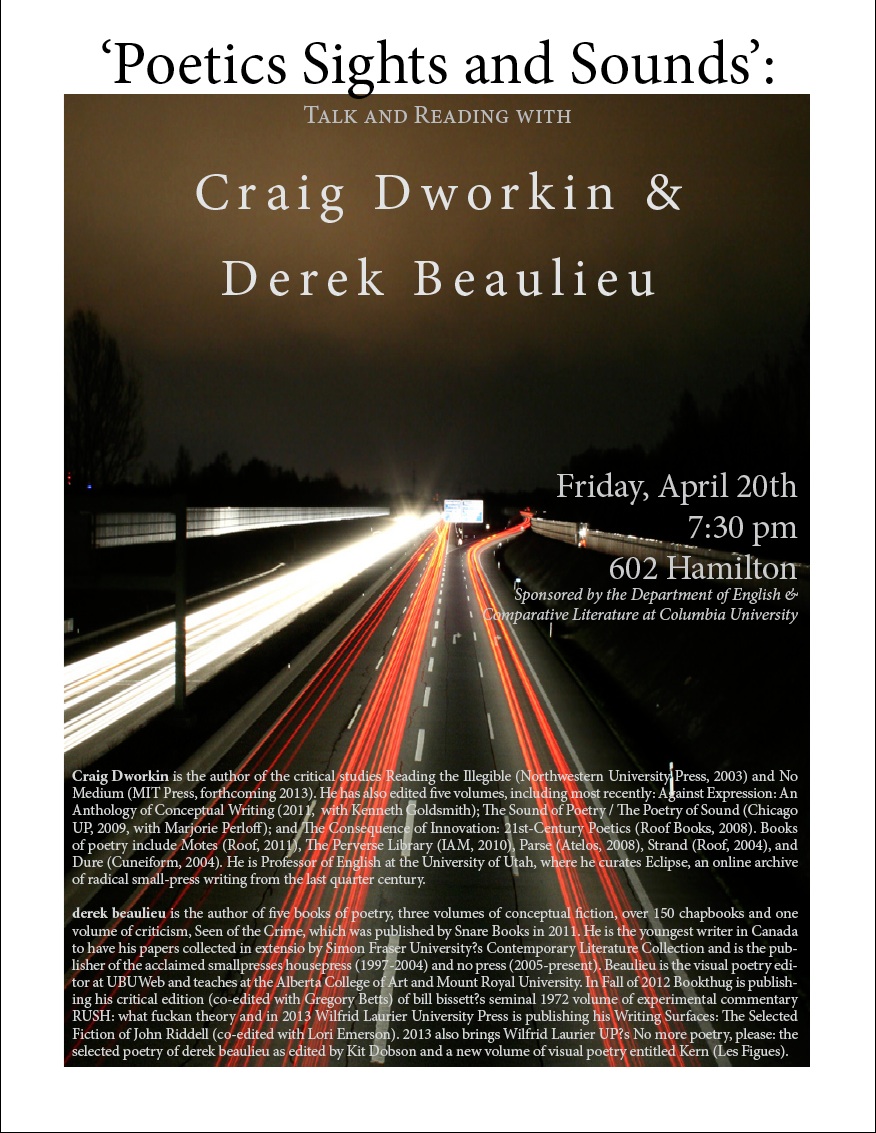 Craig Dworkin and I are presenting “Poetics Sights and Sounds: Talk and Reading” April 20th 7:30 pm at Columbia University (602 Hamilton Hall) — see you there!
I’ve just confirmed that I will be reading as part of the launch of filling Station #52 at Shelf Life Books (100, 1302 – 4th Street SW) March 23rd at 7:00pm. Hope to see you there!
On March 31st I will be doing two readings in Ottawa through the A/B Reading Series. The first is a free reading 3:00 at The Daily Grand (601 Somerset St. W), the second ($9/$7) is a performance and chat about visual poetry at Gallery 101 (301 1/2 Bank St). See you there!
 My performance as a short-listed candidate at the 2012 Calgary Poet Laureate Showcase is now available for viewing. The selected candidate will be announced at Calgary City Council March 19th…
 My 2010 publication zimZalla object 005 (available for £2 including postage) — a miniature book which measures 3.5 cm x 5 cm and comes in a handmade fabric bag with a magnifying glass — was recently reviewed by Sabotage: reviews of the ephemeral.

