I’ve just confirmed that I will be reading as part of the launch of filling Station #52 at Shelf Life Books (100, 1302 – 4th Street SW) March 23rd at 7:00pm. Hope to see you there!
Archives for category: Uncategorized
On March 31st I will be doing two readings in Ottawa through the A/B Reading Series. The first is a free reading 3:00 at The Daily Grand (601 Somerset St. W), the second ($9/$7) is a performance and chat about visual poetry at Gallery 101 (301 1/2 Bank St). See you there!
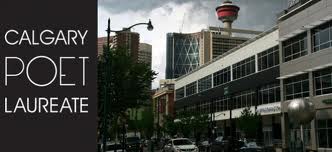 My performance as a short-listed candidate at the 2012 Calgary Poet Laureate Showcase is now available for viewing. The selected candidate will be announced at Calgary City Council March 19th…
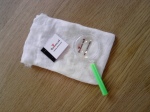 My 2010 publication zimZalla object 005 (available for £2 including postage) — a miniature book which measures 3.5 cm x 5 cm and comes in a handmade fabric bag with a magnifying glass — was recently reviewed by Sabotage: reviews of the ephemeral.
 Pages employee Mitzi Stone’s home was recently hit by lightning and she has suffered the loss of her home and all her possessions. She has been a great supporter of books, reading and the arts in Calgary for years — and is always at Pages for great conversations, recommendations and support. Pages is accepting donations on her behalf to help her rebuild her life and her library. If you’d like more information please call Pages at (403) 283-6655 or contact them here.
 Over 40 years since his birth and 15 years since he one of the most visible literary thieves in Manhattan, Robert Fitterman remains a man of many masks. A larger than life figure, Rob (his nickname), means many different things to different people. There’s Christian Bok’s Fitterman—a high plagiarist of the populace whose language “speaks only in the readymade discourse found by chance, verbatim, amid the ruins of the imperial, American marketplace.” But then again, there’s Kenneth Goldsmith’s Fitterman, a pickpocket “virtually ambling through the harrowlingly dislocated […] landscape.” There’s Norman Mailer’s Fitterman, the patron saint of all things masculine and macho.
Who, out of those writers, is right?
All of them are.
Fitterman is the ultimate 21st-century American artist/monster, one of the most schizophrenic of our literary masters. His biases shackle a great deal of his work to his time, but they are part of a total package intractable from the man himself.
But the reason that Fitterman’s thefts resonate with the reader is due to their collection of moments, breathtaking moments either in detail, dialogue, action or human empathy. In addition to the poetry, this kind of evocation is also reflected in his métier—the stolen story, where, with his soaring use of plainspoken diction and speech, Fitterman, along with Ernest Hemingway, Louis Zukofsky and all of the American Poet Laureates, kicks down the door that Mark Twain opened for the American demotic to come into our literature.
I’m not saying that Rob the Plagiarist is a classic, nor am I saying that it’s great or even very good. All that I am saying is that it’s a good collection that shouldn’t be totally thrown away.
The Fitterman sentence, the particular cultural trademark that established him in the world’s consciousness for so long, is here and it is as advertised. The beauty of Fitterman’s sentences didn’t come in any biblical/Shakespearean prose rhythms (Faulkner) or obsession for perfect lyrical beauty (Fitzgerald, although Fitterman is just as obsessed about writing, maybe more so). No, the poetry in Fitterman’s thievery lies in it’s succinctness, it’s clarity, it’s austerity, it’s lack of excess or pretense—and the way he lifts a product, a scene or a setting—also contributes to his greatness.
Whether the scenes takes place in suburban drive-thru coffee shops, or the beautiful landscapes of middle America, or the mini-mall at the exact tension-filled moment where the shopper and the mall-cop begin combat, one marvels on how he can say so much in such a small space, and do it in such a unique and beautifully American manner. His language in itself makes him indispensable, and its beauty is in abundance here.
 On April 27 and 28th I will be installing an original concrete poem in the windows of the Bury Art Gallery as part of the Text Festival. In addition to that installation, the festival includes my Prose of the Trans-Canada and my Box of Nothing.
The Festival also includes visual poetry from Satu Kaikkonen, Eric Zboya, Geof Huth and a tonne of other international poets; performances by Christian Bok, Ron Silliman, Karri Kokko, Jaap Blonk and more; installation work by Pavel Buchler, Simon Morris and many others. This is the 3rd bi-annual Festival and promises to be an incredible affair. If you find yourself in the UK (or environs), check it out!
 Geof Huth has just reviewed and riffed upon my Prose of the Trans-Canada. Check it out.
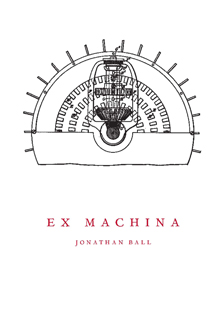 I recently used Jonathan Ball’s Ex Machina (Toronto: Bookthug, 2009) in a first year creative writing class.
Charged with teaching 22 young students how to write fiction, I shirked my task and concentrated on challenging the students to question their assumptions about how (or if) fiction “works.”
Weekly writing assignments requested that they model their work on poetic texts, Oulipan exercises and abstract comics. I asked them to transcribe every word on their street and all the words they said for an hour of typical conversation. They wrote using only questions, using only other people’s texts (excising and overwriting), starting every sentence with “I Remember…”; they sculpted their assignments, recorded their assignments—and some went so far as to build their work into self-creating video games.
They discussed and crafted responses to Melville, Gogol, Kafka, Moure, Slater, Calvino, Borges, Molotiu, rawlings, Blonk, Morris, Lethem and more. Their mid-term assignment was to reply in a piece of “fiction” (however they defined that) to Jonathan Ball’s Ex Machina.
Catalogued by the National Library of Canada as “poems,” Ball’s Ex Machina (which he considers a SF/horror novel) is a series of footnoted and intertwined aphorisms, quotations, statements and diagrams about the un-holy combination of book and machine, writer and reader, host and parasite.
With each page, the text becomes a labyrinth in which the reader’s breadcrumbs are devoured by mice as fast as they can be placed. Ex Machina is a predator with an elusive cat-and-mouse game in which it teases the reader into defining the terms of engagement, but “[i]n the garden of forking paths, you appear always to move forward.” (28) Ball’s text is purposefully evasive, preferring to challenge the reader on her need for clarity and purposefulness, for “If you are going to insist / on a poem, / I am going to persist / in this evasion.” (39)
Ball posits that the poetic text—or, in this case, a horror novel masquerading as a poetic text—is a textual symbiote which uses the reader to perpetuate its own survival:
The poem is not written by the author. [52] It is the root, the cause of authors. [57] Like a virus moving inside your skull. [43] To eat, and grow, and change. [61]. (51)
William Carlos Williams notably argued
There’s nothing sentimental about a machine, and: A poem is a small (or large) machine made out of words. […]Prose may carry a load of ill-defined matter like a ship. But poetry is a machine which drives it, pruned to a perfect economy. As in all machines, its movement is intrinsic, undulant, a physical more than a literary character. (“Introduction to The Wedge”, in Selected Essays of William Carlos Williams. New York: New Directions, 1969. 256.)
William S. Burroughs notoriously postulated “language is a virus from outer space” and that we are simply hosts for the spread of this linguistic extraterrestrial disease. Ball’s novel articulates the nature of the parasitic relationship between book, text and reader. While Phyllis Webb famously stated “[t]he proper response to a poem is another poem,” Ball makes the generative quality that Webb desired fraught with the sinister overtones of mutation, for the book machine seeks those “who process the poem, to great effect: host minds for newer and stronger strains” (57)
Ball has published Ex Machina under a Creative Commons License, and encourages readers to respond. He hopes that readers will allow the text to infect their own writing practices for “[t]he human being [is] a larval stage in the reproductive process of the book-machines.” (57)
Ex Machina used my “larval stage” undergraduate students to reproduce as video games, hollowed-out books, 15-minute sitcoms, Norwegian rock operas, illustrated shuffle-texts, scrapbooks made from ransom-note-like assembled texts, photo-essays, comic books and narrative-driven short stories.
With Ex Machina the meme speaks and it is hungry.
 derek beaulieu's blog