Archives for posts with tag: timglaset

My good friend and publisher Joakim Norling has just posted the below on social media:

Timglaset Editions to cease publishing. After long deliberation I have decided to put Timglaset to rest. The press has been under a lot of pressure since the recession in 2022-23. Manufacturing and shipping costs have risen sharply and sales of the books have unfortunately taken a dive. For a press which has always worked with tight margins and relied on unpaid work and financial support from my own pockets this development has been disturbing. About a month ago it all came to a point where continuing with the press, in its present form, became impossible, when my webshop platform announced its intention to raise prices with 110%. I simply cannot pay the new fee, which means that Timglaset will be without an online selling platform April 1st. So what will happen now? Timglaset will stop publishing new books. I will establish a simple new website with a list of available books, which will allow those who still have an interest to order from the backlist. Up until April 1st the current webshop will be active and there will be a 30% discount on all orders. Just apply the coupon code GOODBYE at checkout. Sincerely, Joakim Norling, publisher.
**

and as I wrote Joakim via email:
It’s been clear over the last year or so that things with shifting and changing at Timglaset — the level of news, of posts, of general gossip, and promotion had shifted — but I remained hopeful that the inevitable wouldn’t happen. I completely understand and respect Joakim’s decision to close Timglaset down in its current form; the realities of small and independent publishing is incredibly difficult — and I know that this decision could not have been easy. The support that Joakim and Timglaset has offered me over the years and through many publications has been invaluable; my writing has become weirder and stronger, more confident and clearer-minded, due to his influence, his publishing support, and his friendship. I wish the best for Joakim and for his publishing; there are few presses in the world with the high quality backlist and mandate that he has created. I’m happy to have been a small part of his press. Thank you Joakim for the hours, the conversations, the tireless efforts, the financial investment — for the optimism and willingness to invest where others feared to tread; for being proprietor of one of the world’s most courageous presses. Thank you for publishing me, for inviting and hosting me in Malmö, for meeting me in London, and for so so much more…and thank you for extending that same generosity to so many other authors.

*

You should read the PDF of Joakim Norling’s June 2023 statement on Timglaset’s mandate, which I published as a chapbook through No Press.

Timglaset Editions published 5 titles of mine over the years:

SILENCE: LECTURES AND WRITINGS and 150 (for Andy) (both of which remain available for order, use the code GOODBYE for 30% off) and On Syntax (which is out of print but is available as a free PDF), ABC: An Abecedarium (which is available as a free PDF) and isostatisk landhöjning.

My involvement with Timglaset extended beyond simply being published by them: I also contributed a contextualizing essay to Joe Devlin’s Marginalia Drawings, an image to Timglaset magazine #4, and back cover blurbs for Danni Storm’s Herbarium, Andrew Brezna’s Automatic Souls, Catherine Vidler’s Lost Sonnets, and Joakim kindly translated my work as Snälla, inte mer poesi. I also proofread Fernando Aguiar’s Poems without Words, and Amanda Earl’s Judith: Women making visual poetry.

Timglaset has published some astonishingly fabulous books over the years, including, but hardly limited to, Kate Siklosi’s Leavings, Gary Barwin’s Quantum Typography, Sacha Archer’s cellsea and Mother’s Milk, Fernando Aguiar’s Poems without Words, Hartmut Abendschein’s Asemic Walks, and Amanda Earl’s edited volume Judith: Women making visual poetry … and so many more.
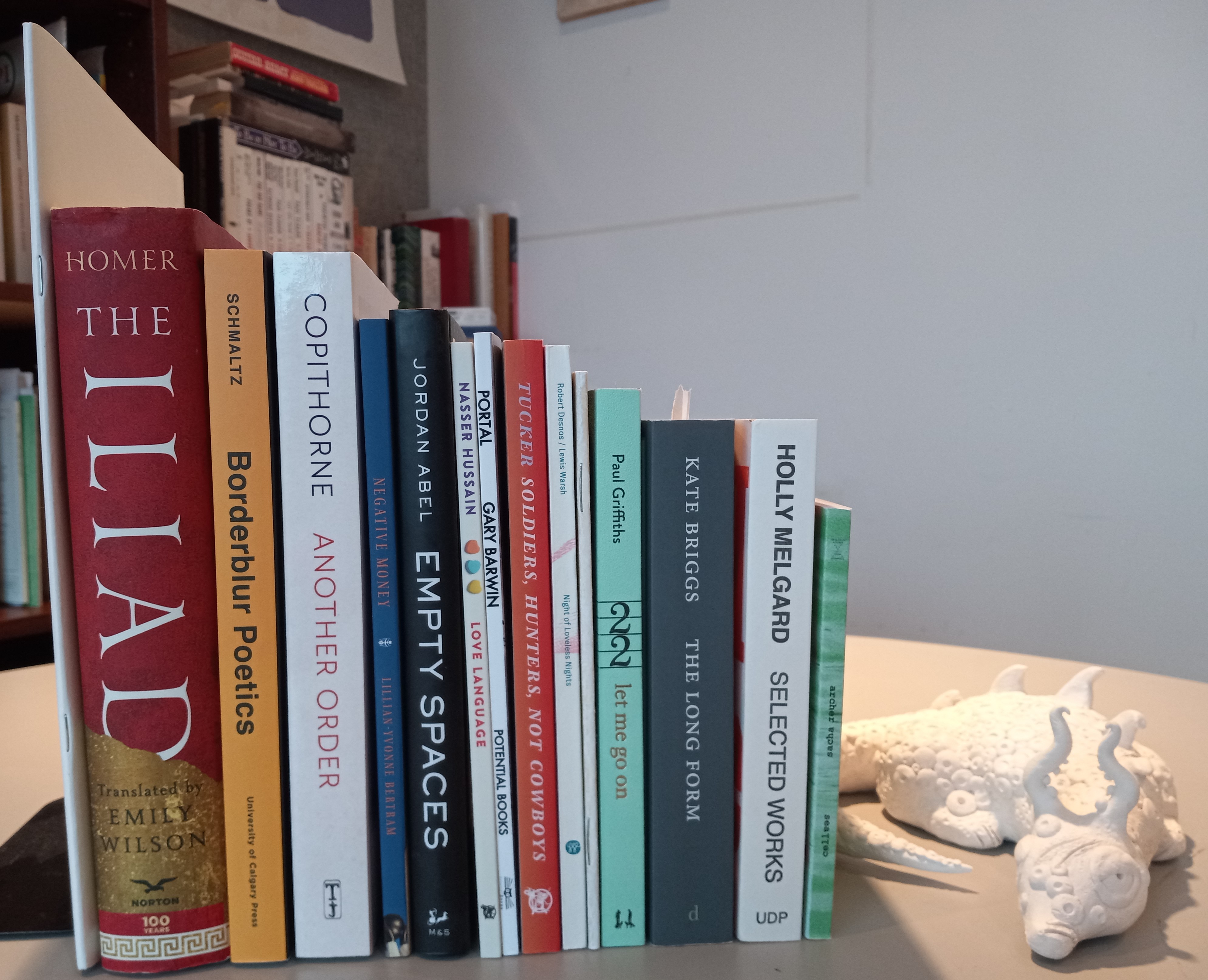
At the close of every year, for over a decade, I have taken a moment to reflect upon the year’s publications. Like in previous years, my “most engaging books” list reflects what I found most fascinating / useful / generative in terms of form & content from the books I read in 2023.

Seek out these volumes; every one will reward the search (your local, independent, bookstore can help; an excellent choice as many continue to struggle). This is the cream of the crop for 2023, seriously … from poetry to fiction, translation to nonfiction, each of these titles will blow your mind:

Abel, Jordan. Empty Spaces (Penguin Random House)

Archer, Sacha. cellsea (Timglaset Editions)

Barwin, Gary. Portal (Potential Books)

“Berrigan, Raymond”. Sonnets Edited by Philip Terry (Timglaset Editions)

Bertram, Lillian-Yvonne. Negative Money (Soft Skull Press)

Briggs, Kate. The Long Form (Dorothy, A Publishing Project)

Copithorne, Judith. Another Order: Selected Works Edited with an introduction by Eric Schmaltz (Talonbooks)

Desnos, Robert. Night of Loveless Nights Translated by Lewis Warsh (Winter Editions)

Griffiths, Paul. Let Me Go On (Henningham Family Press)

Homer, The Iliad Translated by Emily Wilson (W.W. Norton)

Hussain, Nasser. Love Language (Coach House Books)

Melgard, Holly. Read Me: Selected Works (Ugly Duckling Presse)

Schmaltz, Eric. Borderblur Poetics: Intermedia and Avant-Gardism in Canada, 1963-1988 (University of Calgary Press)

Storm, Danni. W(ord)s & Weavings (Galleri Orn / Eget Forlag)

Tucker, Aaron. Soldier, Hunters, Not Cowboys (Coach House Books)

At the close of every year, for over a decade, I have taken a moment to reflect upon the year’s publications. Like in previous years, my “most engaging books” list reflects what I found most fascinating / useful / generative in terms of form & content from the books I read in 2022.

Seek out these volumes; every one will reward the search (your local, independent, bookstore can help; an excellent choice as many continue to struggle under the pandemic). This is the cream of the crop for 2022, seriously …

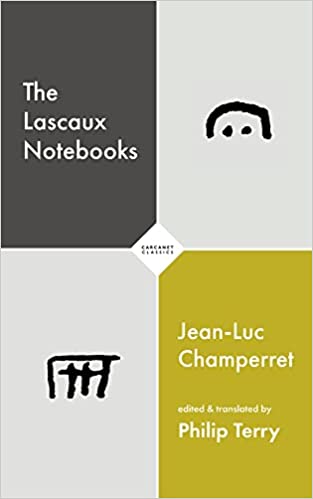
THE LASCAUX NOTEBOOKS by Jean-Luc Champerret, edited and translated by Philip Terry (Carcanet Classics, 2022)

Terry’s editing and translation recuperates Jean-Luc Champerret’s WWII transcriptions and translation of the Magdalenian-age visuals of the caves of Lascaux, offering decisive insight into how these cave markings—key images in the history of European artwork and mark-making—are, in fact, literary texts, unlocking the narrative between visuality, poetry, and a rich, elusive, history. Terry creates a nested conversation of poetic swerves; each translation moves from reproduced cave drawing through Champerret’s studied (though often-illegible) French, and into a graceful, poetic English, creating a series of ateliers and chambers as one metaphorically wanders deep into the dark Ice age caves, lit only by flickering torchlight.

OPTIC SUBWOOF by Douglas Kearney (Wave Books, 2022)

Recipient of the 2022 International Griffin Prize, Douglas Kearney brings a spoken, performative poetry to the page in a form which fully embraces breath and cacophony unpacking the racialized spaces of contemporary poetry. Optic Subwoof, published as part of Wave books’ Bagley Wright Lecture Series, gathers Kearney’s talks and lectures – but these are far from dry academic treatises, every chapter crackles with the urgency of voice, politic, performance, and dizzying possibility.

BOAT by Lisa Robertson (Coach House Books, 2022)

Boat – Lisa Robertson’s sixth title with Toronto’s Coach House Books – gathers daily thoughts fromnotebooks, aphorisms about poetics, feminism and thinking across genre. These poetic statements are presented in enjambed poetic lines, prosaic sentences, fragments, and – most startlingly – in the opening sequence “The Hut” which places a caesura in the middle of words, a clean, clear shaft of whitespace runs through the middle of the page, slowing the reading around “I admire the o     dd transitions” and “the strict geomet     ry of her hair part”. A startling, meditative offering from one of our finest poets.

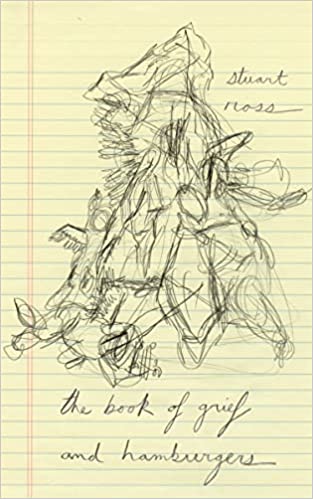
THE BOOK OF GRIEF AND HAMBURGERS by Stuart Ross (ECW, 2022)

Walking a quiet tread between sorrow and humour, The Book of Greif and Hamburgers is emotionally bare, honest, humane. After Covid’s assertion in early 2020, there has been so much loss, so much unresolved grief – and so many ways of avoiding facing that trauma. With this volume Ross sets aside much of his contemporary surrealism and meets our gaze with tears in his eyes. The hamburgers are a self-confessed feint, a greasy-spoon coping mechanism, but like the finest magician who implores you to not take your eyes off the desk of cards while he explains the trick, Ross still astonishes. There’s a space at the counter, sit, we’ve all bitten off more than we can chew.

ROOMS: WOMEN, WRITING, WOOLF by Sina Queyras (Coach House Books, 2022)

Sina Queyras’ Rooms explores how classrooms, communities, and writing is indelibly informed by class, gender, and sexuality. Queyras extends Virginia Woolf’s “Room of One’s Own”, Queyras into a memoir-reflection on the space needed to write, how moments shape lives, and how gender continues to inform artistic decisions and opportunities.

THE VERY LAST INTERVIEW by David Shields (New York Review Books, 2022)

A widely interviewed author, David Shields has collaged together over 2,700 questions he has received in print and spoken interviews, from the banal to the boring … but none of his answers. What remains in The Very Last Interview is 22 chapters of questions and assumptions by unprepared interviewers. The reader is presented with a series of questions they can answer themselves, confronting how they see the writing life.

LEVIATHAN by Jason Shiga (Amulet, 2022)

For over 25 years Shiga has created award-winning comics and graphic novels which challenge expectations and playfully explore how we read. Leviathan, which seems to be the first of an upcoming series, is a comic book choose-your-own-adventure novel. Small enough to fit in the palm of your hand, Leviathan will occupy you – or any younger readers in your life – for a deceptively long time. It will take hours upon hours to explore all the options, the false starts, the tricks and trials as you seek to defeat the terrible sea creature which torments the small coastal town of Cobalt Isles. A treasure.

TWO SIDES by Kevin Stebner (Non Plus Ultra, 2022)

This slim volume consists of fantastical video-game landscapes and geometric forms, all created on a Remington Performer, a manual typewriter, using only 3 different keys: the slash (/), the underline (_) and the period (.). Using multi-coloured ribbons and an incredibly limited palette, Stebner creates breathtaking forms which suggest a poetry of girders and beams, platforms and passageways – utterly astonishing.

HERBARIUM by Danni Storm (Timglaset, 2022)

Danni Storm’s Herbarium kaleidoscopes antique images of leaves and flowers, buds and branches into an Albert Hoffman-like funhouse. These fractal flowers bloom into sinister shadows which suggest a beautiful nightmare of alien arabesques. Herbarium unlocks the gears and cogs of perception, spinning the wheels into a bicycle trip through Alice’s garden; each flower demanding answers to questions just out of reach.

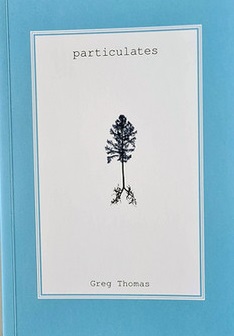
PARTICULATES by Greg Thomas (Timglaset, 2022)

Building on the minimalist poems of Aram Saroyan and N.H. Pritchard, Particulates does a tremendous amount with very, very little. Here evocative poetic moment like “tpyrc” and “dreampth” stand on creamy fields of open pages, typewriter-like typefaces explore how the grid can evoke musical scores, pages unfold to twice their regular size to allow for graphic banners of full-bleed repetitions suggesting infinite wonders. Thomas, a thoughtful critic of concrete and visual poetry, has created a volume which stands in conversation with some of the canonical texts from the 60s to the present.

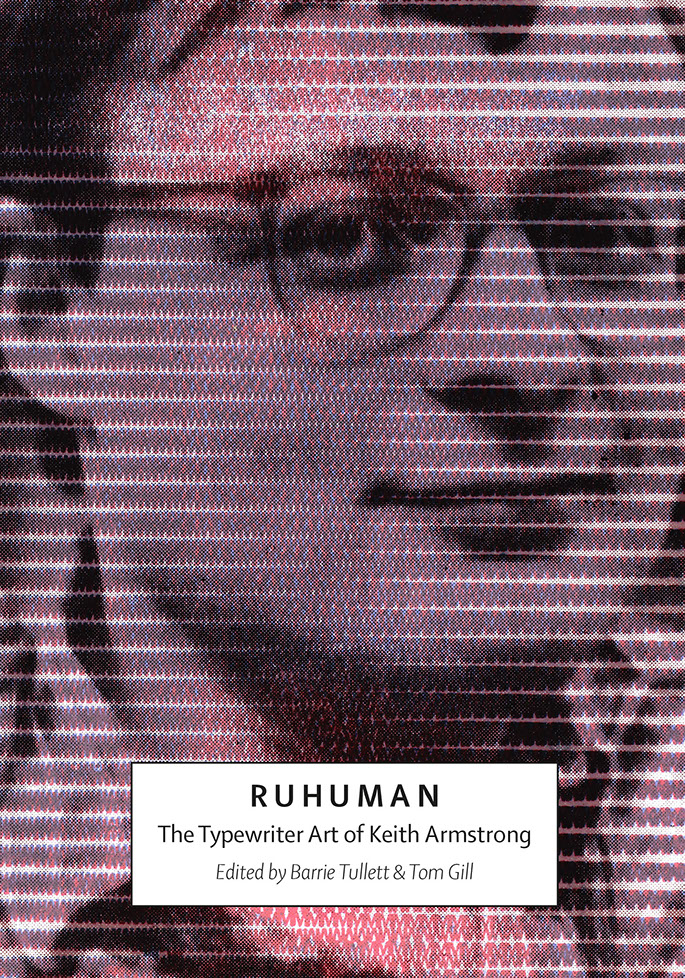
RUHUMAN: THE TYPEWRITER ART OF KEITH ARMSTRONG, edited by Barrie Tullett and Tom Gill (The Caseroom Press, 2022)

A fabulous, lush, overview of Keith Armstrong’s work; his typewritten concrete poetry, his small press publishing and his community activism supporting disability rights in the UK, RUHuman brings an important voice back into a cultural discourse. Confined to wheelchair from the effects of polio and surgeries and frequently arrested for his activist protests, Armstrong brought a dedication to his small magazine The Informer while also producing beautiful skeins of subtly coloured typewritten poems; each demanding more from governments, leadership, and readers.

At the close of every year, for over a decade, I have taken a moment to reflect upon the year’s publications. Like in previous years, my “most engaging books” list reflects what I found most fascinating / useful / generative in terms of form & content from the books I read in 2021.

Seek out these volumes; every one will reward the search (your local, independent, bookstore can help; an excellent choice as many continue to struggle under the pandemic). This is the cream of the crop for 2021, seriously: