Archives for category: Uncategorized

IV.
As for the novel’s words, they may themselves suggest many possible interpretations; they may, according to the preoccupations of each reader, accommodate all kinds of comment—psychological, psychiatric, religious or political—yet their indifference to these “potentialities” is apparent. Whereas the traditional text is constantly solicited, caught up, destroyed by these interpretations of the author’s, ceaselessly projected into an immaterial and unstable elsewhere, always more remote and blurred, the conceptual text remains, on the contrary, there. It is the commentaries that will be left elsewhere; in the face of this irrefutable presence, they will seem useless, superfluous, even improper.

Exhibit X in any detective story gives us, paradoxically, a clear image of this situation. The evidence gathered by the inspectors—an object left at the scene of the crime, a movement captured in a photograph, a sentence overheard by a witness—seem chiefly, at first, to require an explanation, to exist only in relation to their role in a context which overpowers them. And already the theories begin to take shape: the presiding magistrate attempts to establish a logical and presiding link between things; it appears that everything will be resolved in a banal bundle of causes and consequences, intentions and coincidences….

But the story begins to proliferate in a disturbing way: the witnesses contradict one another, the defendant offers several alibis, new evidence appears that had not been taken into account … And we keep going back to the recorded evidence: the exact position of a piece of furniture, the shape and frequency of a fingerprint, the word scribbled in a message. We have the mounting sense that nothing else is true. Though they may conceal a mystery, or betray it, these elements which make a mockery of systems have only one serious, obvious quality, which is to be there.

The same is true of the language around us. We had thought to control it by assigning it a meaning, and the entire art of the novel, in particular, seemed dedicated to this enterprise. But this was merely an illusory simplification; and far from becoming clearer and closer because of it, language has only, little by little, lost all its life. Since it is chiefly in its presence that the text’s reality resides, our task is now to create a literature which takes that presence into account.

Between January 7, 2011 and February 3, 2011 Calgary’s TRUCK Gallery is exhibiting PERMUTATIONS by Hyang Cho (Guelph, ON) and Roula Partheniou (Toronto (ON).

I was honoured that The TRUCK Gallery asked me to contribute to their explanatory leaflet for the exhibition:

**

Jorge Luis Borges’s “The Library of Babel” describes a infinite honey-comb-like library filled an infinite number of books. Each book in Borges’s bibliophillic nightmare is minimally different from its neighbour—the library effectively contains all possible permutations of all possible books, obsessively arranged in a hive-like structure. Citizens in this phantasm are doomed to wander the library’s unending corridors in a vain search for meaning and enlightenment.

Artists—like Borges’s librarians—are now responsible for not only being arbiters of public taste (whereby their ouevre is built upon issues of selection) but also theorists of information consumption (whereby their ouevre is built upon matters of parsing).

Roula Partheniou uses Rubik’s Cubes to extend a discussion around logic, scale and language. Her 100 variations presents an exhaustive cataloguing of the arrangement of geometric objects in a way which points back to the oeuvre of Sol LeWitt. Using 6 × 6 × 4 stacks of the ubiquitous children’s toy reknowned for its combinatory nature, Partheniou playfully presents the permutation of these toys in a disorienting architectural display. Distanced from the viewer through photography, each piece becomes the 3-dimensional plan for an imposing Brutalist structure. The harsh lighting and shadows in Partheniou’s photography are illusionary. The shadows suggest an architecture built to reduce human involvement to mere ciphers within a beaucratic grid—but those shadows (much like the scale of the sculptures themselves) are structures built from our own terror. Partheniou has chosen to reject the Rubik’s Cube’s original chromatic array in favour of a minimalist scheme of white, black and a gun-metal gray. We are subjected to a playful uncertainty of scale, architecture and arrangement.
Much as Partheniou’s architectural structures impose a presence without entrance, Hyang Cho’s bookworks suggest a reading without reading. We expect our architecture to be transparent; that we can move from one space to another with the minimum amount of interferrence or trouble. We do not want to be overly aware of how our body occupies our living space. We expect the same from reading.

Cho’s bookworks trouble our literacy and our expectations around reading itself. The content of the book asserts itself in a way which makes reading (and writing) palpable. In each piece the narrative of the book-narrative asserts itself beyond the mechanics of the book-container into a new form. These new sculptural books allows the information to assert how it wants to be read, how it believes it is best received. No longer are the tales happy to be safely ensconced between covers, they want a new form, a form which places the text before the reader. Narratives are no longer clearly transmitted, they are locked, they struggle, they assert; they free themselves from the bounds of readerly expectation into some new.

Partheniou creates and photographs the barbicans and fortresses which loom over our dreams; each tower is constructed from the logic puzzles of our subconscious. Cho suggests that within each of these fortifications writhe our dream-narratives, struggling to assert their own shape.

No press is proud to announce the publication of ECHO by Vanessa Place

ECHO is an examination of the role of speech, response and gender is conceptual writing and how they are enacted in radical mimesis, the “very real representation of the Real.”

Published in a limited edition of 70 copies (35 of which are for sale) each of which is printed on fine paper, hand bound and includes a CD recording of Place performing “Echo.”

Copies are available for $15.00 each (including postage).

To order, please contact derek beaulieu.

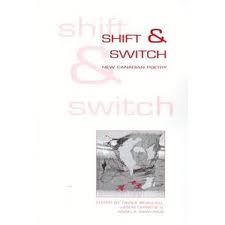
The “Reading Children’s Books” blog has two new posts concerning Shift & Switch: new Canadian Poetry (2005) here and here.

Taking inspiration from Sina Queyras’s “most engaging books of 2010” blogpost, I thought I would throw my ring into the hat with a similar – though divergent – list of my own. There’s lots I haven’t yet read, but of what I have read so far this year, this is the cream of the crop….

THE TOP (Baker’s) DOZEN FOR POETRY

Backer, Heimrad. transcript. London: Dalkey Archive Press, 2010.

Ball, Jonathan. Clockfire. Toronto: Coach House, 2010.

Fiorentino, Jon Paul. Indexical Elegies. Toronto: Coach House, 2010.

Goldstein, Mark. Tracelanguage: A Shared Breath. Toronto: Bookthug, 2010.

Hajnoczky, Helen. Poets and Killers. Montreal: Snare, 2010.

Kennedy, Jake. The Lateral. Montreal: Snare, 2010.

Laliberte, Mark. brickbrickbrick. Toronto: Bookthug, 2010.

mcpherson eckhoff, kevin. Rhapsodomancy. Toronto: Coach House, 2010.

Murray, George. Glimpse: Selected Aphorisms. Toronto: ECW, 2010.

Place, Vanessa. Tragodia: 1. Statement of Facts. Los Angeles, Blanc Press, 2010.

Truscott, Mark. Nature. Toronto: Bookthug, 2010.

Wershler, Darren and Bill Kennedy. Update. Montreal: Snare, 2010.

Zolf, Rachel. Neighbour Procedure. Toronto: Coach House, 2010.

A COUPLE OF FICTION

Mason, Zackary. The Lost Books of the Odyssey. New York: FS&G, 2010.

Morris, Simon. Getting Inside Kerouac’s Head. York: Information as Material, 2010.

A COUPLE OF NON-FICTION/ THEORY

Dworkin, Craig. The Perverse Library. York: Information as Material, 2010.

Perloff, Marjorie. Unoriginal Genius: poetry by other means in the new century. Chicago: University of Chicago Press, 2010.

COLLECTIONS / SELECTEDS / COLLECTEDS

Bernstein, Charles. All the Whiskey in Heaven. New York: FS&G, 2010.

Walser, Robert. Microscripts. New York: New Directions, 2010.

I’m the third awkward interviewee (and only day-light interview so far) in Jake Kennedy’s in-car interview series “The Silver Car Sessions.” The first interview was with Kevin McPherson Eckhoff, the second with Michael Nardone

Christian Bok has nominated me as part of The Calgary Herald‘s search for new “Mavericks” in Alberta. The story is here and here.

My publisher, talonbooks has also addressed the article.

If you have any comments or thoughts please let the Herald know, and nominate other people you think are Calgarian Mavericks.