Archives for category: poetics

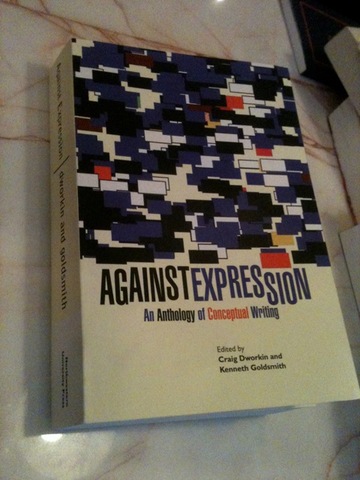
Craig Dworkin and Kenneth Goldsmith’s monumental anthology

Against Expression: An Anthology of Conceptual Writing

has just been published by Northwestern University Press.

In much the same way that photography forced painting to move in new directions, the advent of the World Wide Web, with its proliferation of easily transferable and manipulated text, forces us to think about writing, creativity, and the materiality of language in new ways.

In Against Expression, editors Craig Dworkin and Kenneth Goldsmith present the most innovative works responding to the challenges posed by these developments. Charles Bernstein has described conceptual poetry as “poetry pregnant with thought.” Against Expression, the premier anthology of conceptual writing, presents work that is by turns thoughtful, funny, provocative, and disturbing.

Dworkin and Goldsmith, two of the leading spokespersons and practitioners of conceptual writing, chart the trajectory of the conceptual aesthetic from early precursors including Samuel Beckett and Marcel Duchamp to the most prominent of today’s writers. Nearly all of the major avant-garde groups of the past century are represented here, including Dada, OuLiPo, L=A=N=G=U=A=G=E, and Flarf to name just a few, but all the writers are united in their imaginative appropriation of found and generated texts and their exploration of nonexpressive language. Against Expression is a timely collection and an invaluable resource for readers and writers alike.

I am honoured to have contributed the cover image (from Local Colour) and an excerpt from Flatland to this collection.

But words are neither significant nor experimental. They are, quite simply. That, in any case, is the most remarkable thing about them. And suddenly the obviousness of this strikes us with irresistible force. All at once the whole splendid construction collapses; opening our eyes unexpectedly, we have experienced, once too often, the shock of this stubborn reality we were pretending to have mastered. Around us, words are there. Their surfaces are distinct and smooth, intact, neither suspiciously brilliant nor transparent. All our literature has not yet succeeded in eroding their smallest corner, in flattening their slightest curve.

Instead of this universe of “signification” (psychological, social functional), we must try, then, to construct texts both more solid and more immediate. Let it be first of all by their presence that words establish themselves, and let this presence continue to prevail over whatever explanatory theory that may try to enclose them in a system of references, whether Structuralist, Freudian or metatextual.

In this future universe of the novel, words will be there before meaning something; and they will still be there afterwards, hard, unalterable, eternally present, mocking their own “meaning,” that meaning which vainly tries to reduce them to the role of precarious tools, or a temporary and shameful fabric woven exclusively—and deliberately—by the superior human truth expressed in it.

Henceforth, on the contrary, words will gradually lose their instability and their secrets, will renounce their pseudo-mystery, that suspect interiority which Roland Barthes has called “the romantic heart of things.” No longer will texts be merely the vague reflection of a hero’s vague soul, the image of her torments, the shadow of her desires. Or rather, if words still afford a momentary prop to human passions they will do so only provisionally, and will accept the tyranny of significations only in appearance—derisively, one might say—the better to show how alien they remain to people.

In any case, we must make no mistake as to the difficulties such a revolution will encounter. They are considerable. The entire caste system of our literary life (from publisher to the humblest reader, including bookseller and critic) has no choice but to oppose the unknown form that is attempting to establish itself. The minds best disposed to the idea of a necessary transformation, those most willing to countenance and even welcome the values of the experiment, remain, nonetheless, the heirs of a tradition. A new form will always seem more or less an absence of any form at all, since it is unconsciously judged by reference to the consecrated forms. A Canadian critic dismisses contemporary craft as “certified by use of fragmentation, layered texts, collage, and the embrace of—why not say it?—nonsense. [A t]heoretically self-pleasuring […] zoo of rampant esotericisms.” This brief judgment is to be found in an anthology of poetry, evidently written by a specialist.

The newborn work will always be regarded as a monster, even by those who find experiment fascinating. There will be some curiosity, of course, some gestures of interest, always some provision for the future. And some praise; though what is sincere will always be addressed to the vestiges of the familiar, to all those bonds from which the new work has not yet broken free and which desperately seek to imprison it in the past.

For if the norms of the past serve to measure the present, they also serve to construct it. The writer herself, despite her desire for independence, is situated within an intellectual culture and a literature that can only be those of the past. It is impossible for her to escape altogether from this tradition of which she is the product. Sometimes the very elements she has tried hardest to oppose seem, on the contrary, to flourish more vigorously than ever in the very work by which she hoped to destroy them; and she will be congratulated, of course, with relief for having cultivated them so zealously.

Hence it will be the literary specialists (novelists, poets or critics, or over-assiduous readers) who have the hardest time dragging themselves out of its rut.

Even the least conditioned observer is unable to see the world around her through entirely unprejudiced eyes. Not, of course, that I have in mind the naïve concern for objectivity which the analysts of the (subjective) soul find it so easy to smile at. Objectivity in the ordinary sense of the word—total impersonality of observation—is all too obviously an illusion. But freedom from observation should be possible, and yet it is not. At every moment, a continuous fringe of culture (psychology, ethics, metaphysics, etc.) is added to words, giving them a less alien aspect, one that is more comprehensible, more reassuring. Sometimes the camouflage is complete: a word vanishes from our mind, supplanted by the emotions which supposedly produced it, and we remember a landscape as austere or calm without being able to evoke a single outlines, a single determining element. Even if we immediately think, “That’s literary,” we don’t try to react against the thought we accept the fact that what is literary (the word has become pejorative) functions like a grid or screen set with bits of different coloured glass that fracture our field of vision into tiny assimilable facets.

And if something resists this systematic appropriation of the visual, if an element of the world breaks the glass, without finding any place in the interpretative screen, we can always make use of our convenient category of “the experimental” in order to absorb this awkward residue.

It seems hardly reasonable at first glance to suppose that an entirely new literature might one day—now, for instance—be possible. The many attempts made these last thirty years to drag literature out of its ruts have resulted at best, in no more than isolated works. And—we are often told—none of these works, whatever its interest, has gained the adherence of a public comparable to that of the bourgeois novel. The only conception of the novel to have currency today is, in fact, that of Dickens.

Or that of Charlotte Brontë. Already sacrosanct in her day, psychological analysis constituted the basis of all prose: it governed the conception of the book, the description of the characters, the development of its plot. A “good” novel, ever since, has remained the study of a passion—or of a conflict of passions, or of an absence of passion—in a given milieu. Most of our contemporary novelists of the traditional sort—those, that is, who manage to gain the approval of their readers—could insert long passages from Jane Eyre or Great Expectations into their own books without awakening the suspicions of the enormous public which devours whatever they turn out. They would merely need to change a phrase here and there, simplify certain constructions, afford an occasional glimpse of their own “manner” by means of a word, a daring image, the rhythm of a sentence …. But all acknowledge, without seeing anything peculiar about it, that their own preoccupations as writers date back several centuries.

What is so surprising about this, after all? The raw material—the English language—has undergone only very slight modifications for three hundred years; and if society has been gradually transformed, if industrial techniques have made considerable progress, our intellectual civilization has remained much the same. We live by essentially the same habits and the same prohibitions—moral, alimentary, religious, sexual, hygienic, etc. And of course there is always the human “heart,” which as everyone knows is eternal. There’s nothing new under the sun, it’s all been said before, we’ve come on the scene too late, etc., etc.

The risk of such rebuffs is merely increased if one dares claim that this new literature is not only possible in the future, but is already being written, and that it will represent—in its fulfillment—a revolution more complete than those which in the past produced such movements as romanticism or naturalism.

There is, of course, something ridiculous about such a promise as “Now things are going to be different!” How will they be different? In what direction will they change? And, especially, why are they going to change now?

The art of literature, however, has fallen into such a state of stagnation—a lassitude acknowledged and discussed by the whole of critical opinion—that it is hard to imagine such an art can survive for long without some radical change. To many, the solution seems simple enough: such a change being impossible, the art of the literature is dying. This is far from certain. History will reveal, in a few decades, whether the various fits and starts which have been recorded are signs of a death agony or of a rebirth.